
In Gratitude-Thanksgiving Season
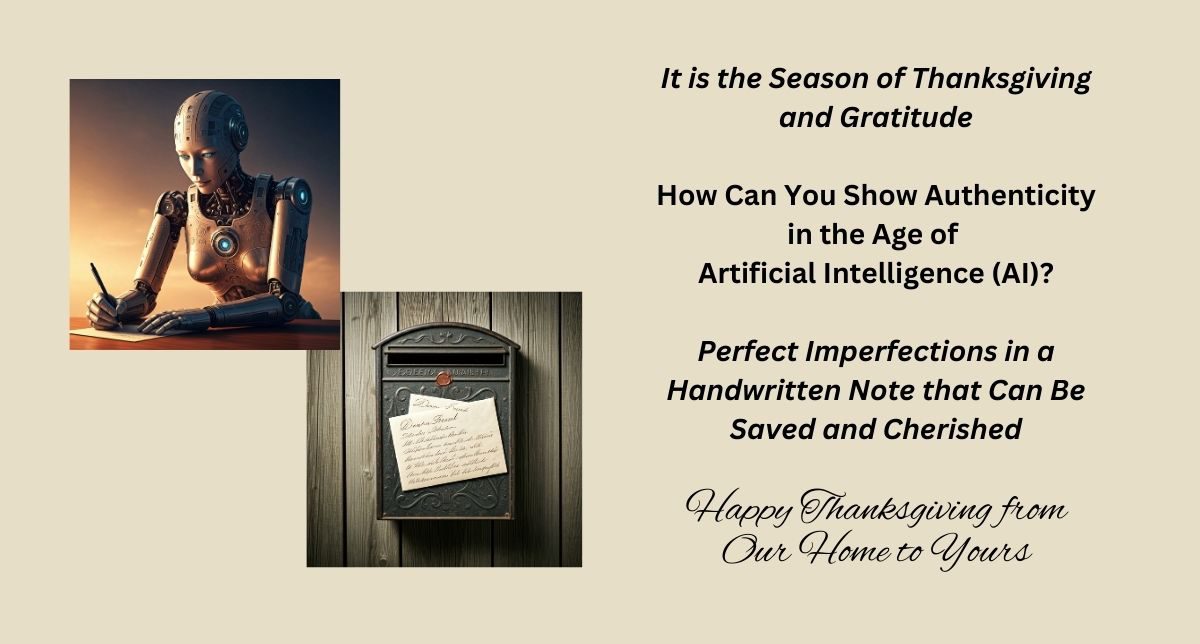
“You have it easily in your power to increase the total of this world’s happiness now.
How? By giving a few words of appreciation to someone lonely or discouraged. Perhaps
you will forget the kind words you say today tomorrow, but the recipient may cherish
them forever.”
Dale Carnegie
November and Thanksgiving are the perfect times to reach out and communicate with
those who have impacted our lives in the past and present. In our digital age, many
ways of communicating exist, including social media, email, and text. AI (Artificial
Intelligence) can make it more difficult since everyone is a prompt away from crafting
the perfect message. Ironically, snail mail (a.k.a. United Postal Service is an easy, cost-
effective way to communicate gratitude with a handwritten notecard.
Does writing a handwritten note take planning and effort? Absolutely, yes. However, the
person and relationship dividends are priceless. Are handwritten notes perfect?
Absolutely not. Handwritten notes are perfectly imperfect. In three sentences, you can
express appreciation, reference memory, and have something tangible for the recipient
to keep.
Every handwritten note is a souvenir (French verb to remember) for the writer and the
recipient. Writing 365 cards in 365 days is my quest for gratitude for 2025. With all of
AI’s advances, I cannot share my sincere appreciation and memories or be a tangible
keepsake.
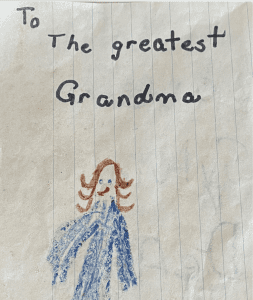
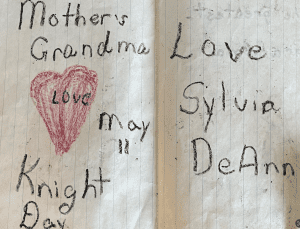
One of my most prized possessions is a card I made for my Great Grandmother when I
was 5. I found it when I became the historian for my family. She died at 87 and died
when I was 11. However, she kept it all those years. A card made on notebook paper
folded the wrong way, and I did not have blue eyes. I keep the notecards that are
written to me. Many have told me that they keep the handwritten notecards that I write
and how my notes touched them.
I admit that I used ChatGPT to explain that handwritten notes are unique and can’t be
replicated.
From ChatGPT
Essentially, a handwritten note lets the recipient know that you are thinking of them, that they are important, and that you care about their well-being. Secondly, it requires your
full and undivided attention, and it takes time to give it a personal touch.
AI can indeed influence the content of a handwritten note, though it typically works behind the scenes. While AI can enhance or facilitate the process, the emotional impact
of a handwritten note still comes from the human element—choosing to send the note and personalizing its content.
Here are some ways AI might be involved:
1. Content Suggestions: AI can help draft or suggest thoughtful messages,
particularly if the sender struggles with expressing themselves. For example, AI-
powered writing tools or assistants can generate phrases, prompts, or entire
messages tailored to specific situations, such as birthdays, thank-you notes, or
condolences.
2. Personalization: AI can help personalize notes by analyzing data about the
recipient, such as their preferences, past interactions, or shared experiences.
This can help the sender craft a more meaningful message.
3. Handwriting Simulation: AI can also simulate handwriting styles. Some
services allow users to type their message, and then AI-driven tools transform it into handwriting that appears more personal and authentic, though it isn’t truly handwritten.
4.Grammar and Style: AI-powered tools like Grammarly can help proofread and improve the tone or flow of the message, ensuring that it is well-written and coherent. Differences between AI and the human element lie in authenticity, emotion, and intent.
Here’s how they differ in specific aspects:
1. Creativity and Emotion:
AI: AI can generate text, mimic styles, and produce content that appears human-
like, but it needs more true understanding, emotions, and lived experiences. It
analyzes patterns and produces responses based on data, but it doesn’t
experience feelings or empathy. Algorithms and training on vast amounts of data
drive AI’s creativity.
Human Element: Humans create from personal experience, emotions, and
unique worldviews. When a human writes something, it often carries personal
insights, emotional depth, and spontaneity that stem from real-life experiences.
The intention behind human expression adds a layer of meaning that AI can
mimic but not generate.
2. Intent and Personal Connection:
AI: AI responds based on patterns and input data but doesn’t have personal
relationships or emotional investment. It can simulate care and connection, but it
doesn’t honestly care. The intent behind AI-generated content is utilitarian,
driven by efficiency, not personal connection.
Human Element: When a human reaches out, whether through a handwritten
note or conversation, there’s genuine intent and a personal connection. Human
interaction involves empathy, understanding, and emotional resonance. A
handwritten note from a person shows thoughtfulness, effort, and care that go
beyond the content—it reflects the person’s desire to connect.
3. Authenticity and Imperfection:
AI aims for precision and can create nearly flawless, polished messages.
However, this perfection can sometimes feel impersonal or mechanical. Although
the content it produces can be accurate, it lacks the small, unique imperfections
that often make human communication feel authentic.
Human Element: Human communication is filled with nuance, subtle
imperfections, and individual quirks—slightly messy handwriting, an unintended
pause, or a personal anecdote. These imperfections are part of what makes
human interaction feel genuine and relatable.
4. Context and Depth of Understanding:
AI: AI can quickly process vast amounts of information and respond based on
learned patterns, but it lacks proper comprehension. It doesn’t experience life, culture, or context as humans do. AI might miss a conversation or note’s deeper
emotional, cultural, or situational nuances.
Human Element: Humans communicate through lived experience, cultural
context, and emotional awareness. A human’s understanding of the world is
shaped by personal experiences, relationships, and emotions, making human-
generated content often more profoundly layered and contextually rich.
5. Motivation and Effort:
AI: AI operates based on instructions and input without any personal motivation.
Its effort is driven by algorithms and a pre-set goal to optimize output, but it
doesn’t feel satisfaction or dedication in its tasks.
Human Element: Humans choose to invest time and effort, especially when it
comes to meaningful gestures like writing a handwritten note. The personal
effort, care, and attention a human puts into such a task make it special,
signaling that they value the recipient.
In summary, AI can assist, automate, and simulate aspects of human communication,
but it needs more emotional depth, authenticity, and genuine intent to define the human
element. The human touch carries real experiences, emotions, and connections that AI
can mimic but never truly replicate.
To learn more, contact me at sylvia@sylproproductions. Sylpro Productions began with
Sylvia France, and the goal was to work with Apple in Silicon Valley. Not only did she realize
that goal, but she also launched new products and industry categories, including personal digital
navigation and streaming television program guides. In addition to working with several startups,
our client roster includes The Home Depot, Union Pacific, Verizon, and Right at Home.