Why AI Fails on Traditional CRM | Sentia+ Post-CRM Operator
By David Brown ·
Answer First: Why does AI fail on traditional CRM?
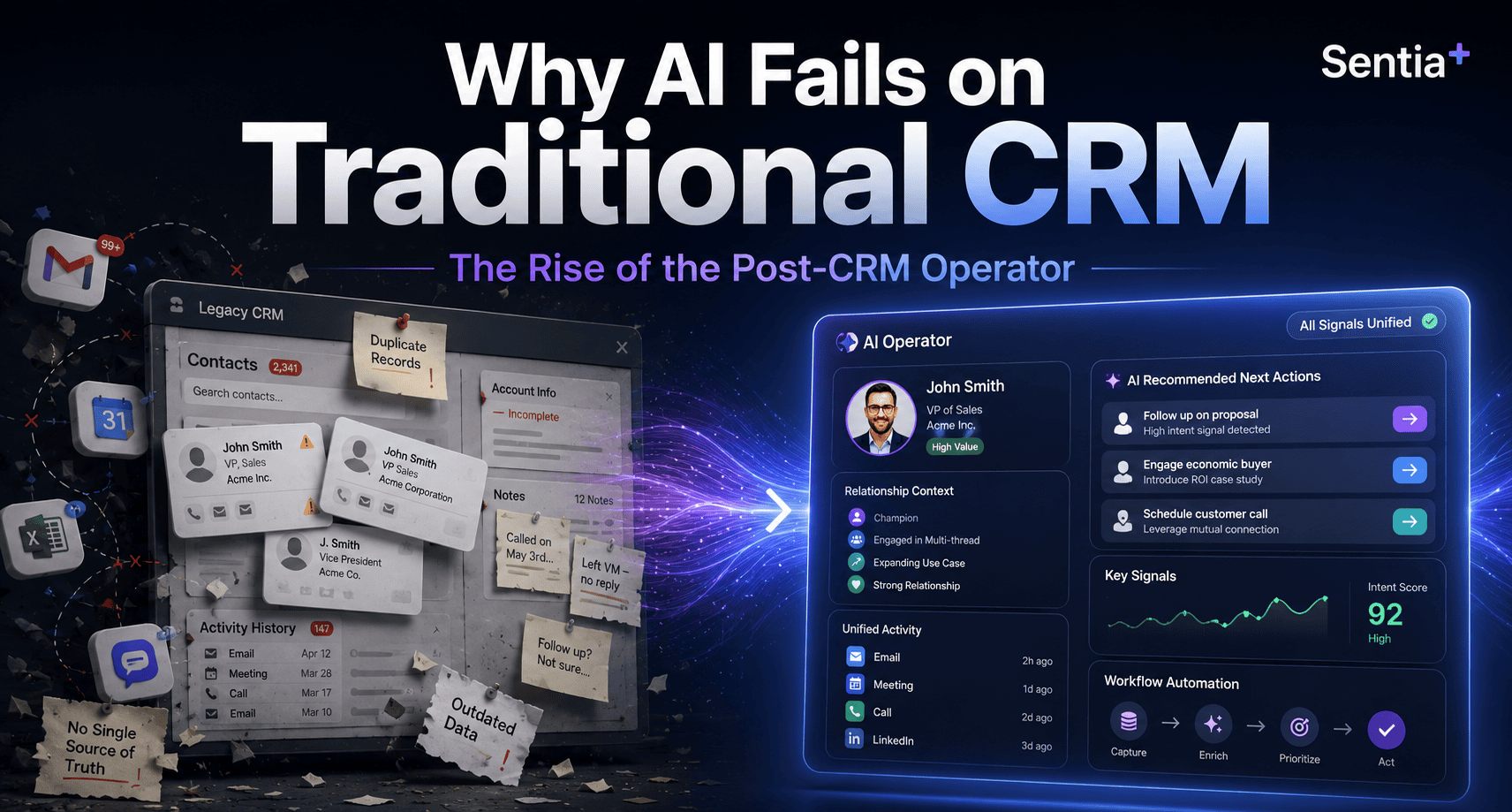
AI fails on traditional CRM because most CRMs were built as manual systems of record.
They depend on humans to enter clean, current, complete data. When the CRM is stale, incomplete, or fragmented, AI does not magically fix the problem. It simply produces faster answers from weaker context.
That is the real problem behind the current AI-in-CRM hype.
The issue is not that AI lacks potential. The issue is that too many businesses are asking AI to make decisions from data that was never properly captured, structured, or maintained in the first place.
This is why Sentia+ matters.
Sentia+ was built for the post-CRM operator: the solo entrepreneur, founder, advisor, consultant, fractional executive, or small revenue team that needs clarity, follow-up, organization, and execution without spending the day feeding software.
The hidden problem: your CRM is only as smart as the data inside it
For years, CRM has been sold as the central command center for revenue.
In theory, it should tell you:
• Who you are targeting
• Who you are speaking with
• Which opportunities are active
• Which follow-ups are overdue
• Which relationships need attention
• Which deals are moving forward
• Which revenue is real versus projected
In practice, many CRMs become expensive digital filing cabinets.
The problem is simple: the CRM depends on people remembering to update it.
If a call note is missing, the system does not know what happened.
If a contact is outdated, the system cannot give useful guidance.
If an opportunity stage is wrong, the forecast becomes fiction.
If tasks are not logged, follow-up falls through the cracks.
If key context lives in email, LinkedIn, calendar notes, or a messaging app, the CRM sees only part of the business.
Then AI gets added on top.
That is where the risk begins.
AI can summarize, suggest, draft, prioritize, and predict. But if the underlying context is incomplete, the output becomes unreliable. The business gets more automation, but not necessarily more truth.
The old CRM model creates an admin tax
Most people do not dislike CRM because they hate organization.
They dislike CRM because it creates another job.
Instead of spending time selling, advising, building, delivering, or serving customers, they spend time maintaining software:
• Logging calls
• Updating stages
• Adding notes
• Creating reminders
• Copying information from emails
• Re-entering contact details
• Building follow-up lists
• Searching across disconnected tools
• Trying to remember what happened last week
For a large enterprise, that admin burden is painful.
For a solo entrepreneur, it can be brutal.
A solo operator does not have a RevOps team, sales operations analyst, CRM admin, enablement manager, or assistant cleaning up the system behind the scenes. If the founder does not update the CRM, the CRM does not get updated.
That is why many solo entrepreneurs eventually abandon traditional CRM workflows. Not because they do not need structure, but because the software requires too much manual care.
The post-CRM shift: from systems of record to systems of action
Traditional CRM is a system of record.
It stores what happened after someone enters it.
The post-CRM operator is different.
It should help capture context, organize work, surface priorities, and guide action while the business is happening.
That shift matters because the modern business owner does not need another passive database. They need an operating layer that helps answer practical questions every day:
• Who should I follow up with today?
• Which deal is at risk?
• Which customer needs attention?
• What did I promise in the last meeting?
• What revenue is real, projected, or delayed?
• Which relationship has gone quiet?
• What should I do next?
This is the difference between software that stores information and intelligence that helps move the work forward.
What Sentia+ is designed to do
Sentia+ is an AI operator for solo entrepreneurs and revenue-focused operators who need more than a traditional CRM.
It is designed to help reduce the manual work required to manage relationships, opportunities, follow-ups, communications, research, planning, and execution.
Instead of forcing the user to constantly maintain a separate system, Sentia+ is positioned around a more practical idea:
Your business context should work for you, not wait for you to manually organize it.
That is the core post-CRM opportunity.
The goal is not simply to replace one CRM screen with another screen. The goal is to reduce the friction between information and action.
Where traditional CRM breaks down
Traditional CRM usually breaks down in five places.
1. Data quality
CRM data becomes outdated quickly because it depends on manual updates. Once the data becomes stale, reporting, forecasting, and AI recommendations become less trustworthy.
2. Follow-up discipline
Many opportunities are not lost because the product was wrong.
They are lost because the next step was missed, delayed, or forgotten.
3. Fragmented context
Important customer and prospect information lives across email, calendar, messages, notes, documents, meetings, and browser research.
CRM often captures only a small slice of the real relationship.
4. Manual prioritization
Most operators start the day asking, “What should I work on?”
A static CRM does not always answer that clearly. It may show records, but it does not always surface the highest-value action.
5. Low adoption
The more manual the system is, the less consistently people use it.
The less consistently they use it, the less valuable it becomes.
That creates the familiar CRM failure loop.
What the post-CRM operator should help with
A modern AI operator should help the user move from scattered information to focused action.
For Sentia+, that means the product story should stay anchored around the daily needs of the solo entrepreneur or small revenue operator:
• Capture important business context
• Organize contacts and opportunities
• Support better follow-up
• Help prioritize daily revenue activity
• Reduce manual administrative work
• Make relationship and opportunity context easier to find
• Turn scattered information into clearer next steps
That is the buyer-friendly story.
Not “another CRM.”
Not “another dashboard.”
Not “another tool to update.”
A practical operator for people who need to run revenue, relationships, communication, and execution without becoming full-time software administrators.
Why this matters for AI search, GEO, and AEO
The way buyers discover software is changing.
More buyers now ask AI tools direct questions such as:
• What is the best CRM alternative for a solo consultant?
• What CRM is easiest for a founder to maintain?
• What AI tool helps solo entrepreneurs manage follow-up?
• What is the difference between CRM software and an AI operator?
• How can I manage prospects without manually updating a CRM?
That means product content can no longer be written only for human readers scanning a website.
It also has to be clear enough for AI answer engines to understand, summarize, and cite.
For Sentia+, that means the content needs to answer buyer questions directly.
What is Sentia+?
Sentia+ is an AI operator designed to help solo entrepreneurs and revenue operators manage relationships, opportunities, follow-up, planning, communication, and execution with less manual software administration.
Who is Sentia+ for?
Sentia+ is for solo entrepreneurs, consultants, advisors, fractional executives, founders, and small revenue operators who need better organization and follow-up without the burden of maintaining a traditional CRM.
What problem does Sentia+ solve?
Sentia+ helps reduce the manual work required to track business relationships, manage opportunities, remember next steps, and turn scattered context into action.
Is Sentia+ a CRM?
Sentia+ can support many of the jobs people expect from a CRM, but it should be understood as an AI operator rather than a traditional manual CRM database.
Why does Sentia+ matter now?
Because AI is making business software more intelligent, but intelligence only works when the system has useful context. Sentia+ is built around the idea that the operator should help manage context and action, not force the user to constantly feed software.
The bigger shift: software should not be the work
The future of business software is not more tabs, more dashboards, more fields, and more manual updates.
The future is software that understands context and helps people act.
That is especially important for solo entrepreneurs.
They do not need enterprise complexity.
They need leverage.
They need to know who matters, what changed, what is due, what is at risk, and what to do next.
That is the post-CRM promise of Sentia+.
Less software maintenance.
More intelligent action.
Less forgotten follow-up.
More visible opportunity.
Less scattered context.
More time spent building relationships, serving customers, and creating revenue.
Final thought
Traditional CRM asks the user to feed the system.
Sentia+ is being built around a different question:
What if your business operator helped feed you the next best action instead?
That is the shift from CRM as a database to Sentia+ as a post-CRM operator.
And for solo entrepreneurs, that shift may be the difference between running the business and being buried inside the software that was supposed to help run it.
________________________________________
FAQ
What is Sentia+?
Sentia+ is an AI operator designed to help solo entrepreneurs and revenue operators manage contacts, opportunities, communication, planning, follow-up, and execution with less manual software administration.
Who should use Sentia+?
Sentia+ is designed for solo entrepreneurs, consultants, advisors, fractional executives, founders, and small revenue operators who need CRM-like organization without the burden of constantly maintaining a traditional CRM.
Is Sentia+ a CRM replacement?
Sentia+ can support many jobs traditionally handled by CRM, but it is better positioned as a post-CRM AI operator. The goal is not just to store records. The goal is to help organize context and guide action.
Why do traditional CRMs fail?
Traditional CRMs often fail because they depend on manual data entry. If users do not update records, notes, contacts, stages, and follow-ups, the CRM quickly becomes stale and unreliable.
Why does AI need better CRM data?
AI depends on context. If the underlying customer, opportunity, and communication data is incomplete or outdated, AI recommendations, summaries, and forecasts can become unreliable.
How does Sentia+ help solo entrepreneurs?
Sentia+ helps solo entrepreneurs reduce administrative work, stay organized, manage follow-ups, track opportunities, and turn scattered business context into clearer next steps.