

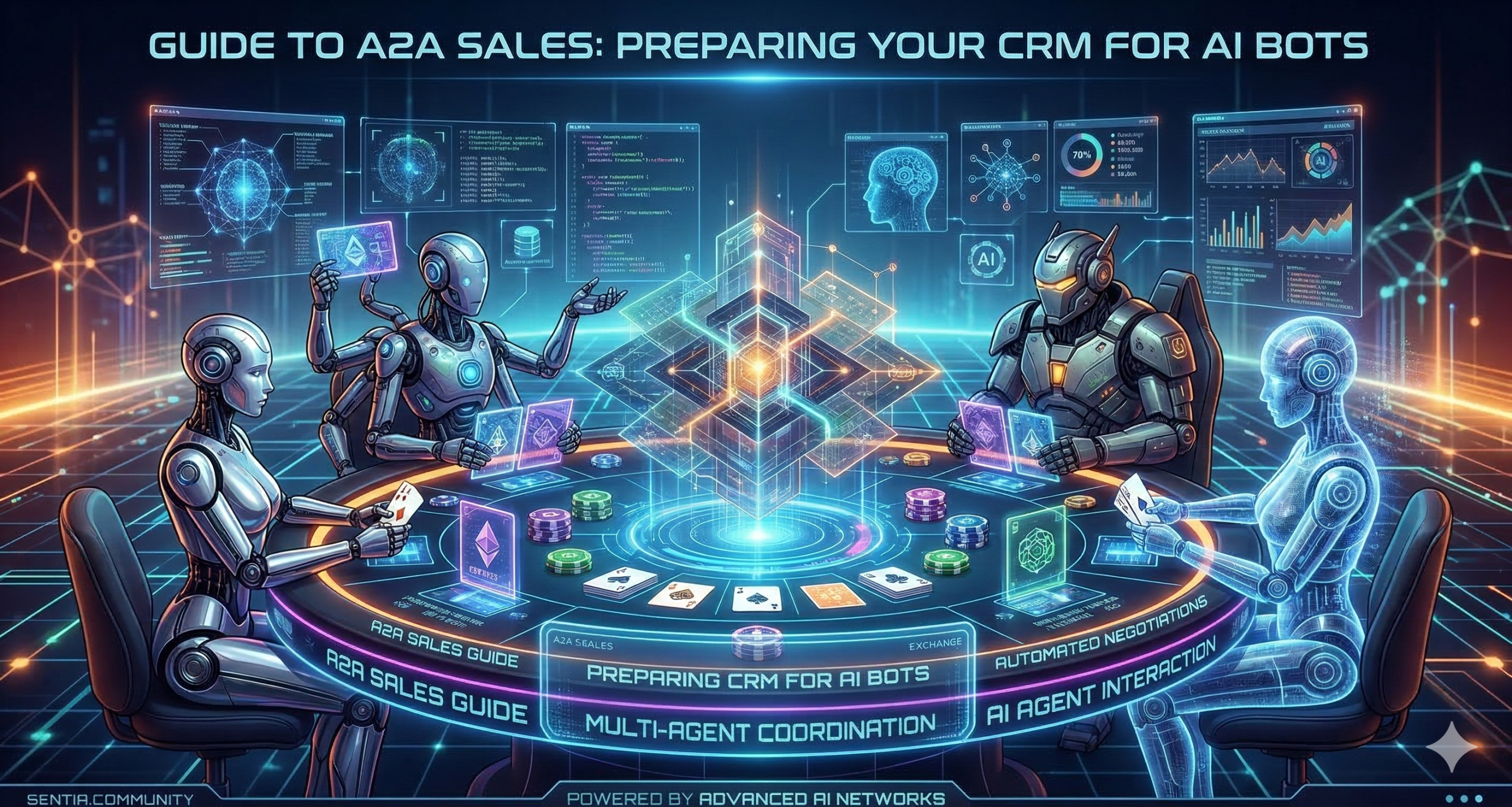
Curious how AI talks to AI in Sales?
The landscape of B2B sales is undergoing a profound transformation, driven by the rapid emergence of autonomous AI agents. These intelligent bots are no longer confined to lead qualification or customer service; they are now capable of direct negotiation and procurement, fundamentally altering how deals are struck. This shift towards Agent-to-Agent (A2A) sales necessitates a radical re-evaluation of traditional CRM infrastructures, which were designed for human-centric processes. Without a CRM system specifically prepared for bot-to-bot interactions, companies risk being sidelined in an increasingly automated marketplace.
Preparing your CRM for A2A sales is not merely an upgrade; it is a strategic imperative that determines your future competitive viability. This readiness involves restructuring data, enabling robust API access, embedding negotiation logic, and ensuring real-time data synchronization. Companies that proactively adapt their CRM will gain a decisive advantage, enabling faster deal cycles, reduced costs, and consistent decision-making in an era where AI agents handle an increasing volume of complex transactions.
What Is A2A Sales and Why It Matters Now
A2A (Agent-to-Agent) sales refers to commercial transactions and negotiations conducted autonomously between AI agents representing different entities, such as a vendor’s sales bot and a buyer’s procurement bot. This model differs significantly from traditional B2B sales, which rely on human sales representatives interacting directly with human buyers. The shift is already underway, with Gartner forecasting that 40% of enterprise applications will embed task-specific AI agents by the end of 2026, a substantial increase from less than 5% in 2025 according to Joget.
Procurement AI agents are now autonomously evaluating vendors and negotiating terms, driven by economic imperatives for cost reduction, speed, and decision consistency. McKinsey reports that autonomous category agents can achieve 25–40% efficiency improvements in procurement processes as highlighted by AiCerts. This acceleration impacts sales cycles dramatically, with lead generation automation tools, including AI, achieving a 25% improvement in sales cycle time compared to manual processes per Monday.com’s analysis.
Examples of companies leveraging AI agents in vendor selection and contract negotiation are emerging. Coupa uses “Navi” agents integrated into ERP-tied spend suites for negotiations, with customers reportedly saving $15 billion according to AiCerts. SAP’s “Joule” agents are extending to bid analysis and contract workflows, while specialists like Keelvar deploy sourcing bots for logistics RFQs, covering 90% of tactical spend with reported 70% cycle time drops in pilot programs as noted by AiCerts. These developments signal a critical need for B2B sales organizations to prepare their CRM for bot-to-bot interactions.

The 4 Pillars of A2A-Ready CRM Architecture
Achieving A2A readiness in your CRM hinges on establishing four foundational pillars that enable seamless bot-to-bot interaction and autonomous deal-making. These pillars redefine the traditional CRM’s role from a human sales assistant to a central intelligence hub for AI agents.
Pillar 1: Machine-Readable Product Catalogs with Structured Pricing Data
Machine-readable product catalogs are essential for AI agents to understand and process product offerings without human interpretation. This involves standardizing product information and ensuring it is consumable by algorithms. Products with complete schema markup are 4.2x more likely to appear in Google Shopping results according to Almcorp, demonstrating the importance of structured data for machine visibility.
Key aspects include:
- Standardizing product names, SKUs, and descriptions.
- Implementing Schema.org markup for clear categorization.
- Embedding detailed technical specifications and compatibility information.
- Maintaining up-to-date inventory and capacity data feeds.
Pricing data must be meticulously structured, including clear discount rules, volume tiers, and geographical variations. This allows AI agents to query pricing, apply appropriate discounts, and construct accurate proposals autonomously. Outdated data confuses search engines and users, so accuracy is paramount per Atak Interactive.
Pillar 2: API-First Architecture That Allows Agent Access Without Human Gatekeeping
An API-first architecture ensures that your CRM’s functionalities and data are programmatically accessible to AI agents. This moves beyond traditional integrations designed for human-facing applications, prioritizing secure, machine-to-machine communication channels. APIs are critical to business strategy for 89% of enterprises per Postman’s 2024 API report, highlighting their foundational role.
Essential elements include:
- Exposing well-documented and robust API endpoints for all critical sales data.
- Implementing secure authentication and authorization protocols for bot access.
- Designing APIs for efficiency, minimizing latency in data exchange.
- Supporting webhooks and event-driven architecture for real-time updates.
This proactive API design eliminates the need for human intervention in data retrieval or action initiation, allowing agents to operate with maximum autonomy. A unified CRM API is particularly powerful for agentic workflows as noted by Truto.
Pillar 3: Automated Negotiation Parameters and Approval Workflows
Automated negotiation parameters and approval workflows encode your sales playbook directly into the CRM, enabling agents to negotiate within predefined boundaries. This transforms static sales policies into executable logic. By 2027, 50% of organizations will use AI-enabled contract negotiation tools according to Icertis.
Key components involve:
- Defining acceptable price ranges, discount thresholds, and payment terms.
- Establishing automated approval chains for deals exceeding certain parameters.
- Creating constraint-based negotiation frameworks that agents follow.
- Integrating with contract management and e-signature systems for autonomous deal closure.
This pillar ensures that all agent-conducted negotiations adhere to company policies, reducing risk and accelerating the sales cycle. The goal is to encode the sales playbook as executable logic rather than relying on human interpretation of PDF documents.
Pillar 4: Real-Time Data Accuracy and Synchronization Across Systems
Real-time data accuracy and synchronization are non-negotiable for autonomous deal-making. AI agents require the most current information on inventory, pricing, customer history, and market conditions to make optimal decisions. The data integration market, crucial for real-time synchronization, is valued at $15.18 billion in 2026 according to Integrate.io.
Critical aspects include:
- Eliminating data silos between CRM, ERP, inventory, and other systems.
- Implementing robust data validation and cleansing processes.
- Ensuring instantaneous updates across all integrated platforms.
- Leveraging streaming analytics for immediate insights relevant to negotiations.
Fragmented data prevents agents from accessing complete vendor profiles and can lead to erroneous proposals or missed opportunities. You cannot build autonomous operations on top of fragmented data according to LogicMonitor.
Traditional CRM vs A2A-Ready CRM: Key Differences
This table compares the fundamental architectural and operational differences between legacy CRM systems built for human sales teams and modern A2A-ready CRM systems designed for bot-to-bot negotiations. Understanding these differences is critical for planning your transformation roadmap.
| Capability | Traditional CRM | A2A-Ready CRM | Migration Complexity |
|---|---|---|---|
| Data Structure | Unstructured notes, human-readable text, siloed attachments. | Structured, machine-readable fields, Schema.org markup, taxonomies. | High: Requires data cleansing, re-categorization, and schema implementation. |
| API Accessibility | Limited, often human-centric APIs, batch processing. | API-first design, robust, real-time endpoints for bot access, event-driven. | Medium: Requires API development/enhancement and security hardening. |
| Pricing Logic | Manual quote generation, human interpretation of discount matrices. | Executable pricing rules, dynamic matrices, automated discount application. | High: Translating sales policies into code, extensive testing. |
| Approval Workflows | Manual human approvals, email-based sign-offs. | Automated, rule-based approval chains, integrated e-signature. | Medium: Defining clear thresholds, integrating with CLM. |
| Response Time Requirements | Hours to days for human response. | Milliseconds to seconds for autonomous agent response. | High: Requires optimized infrastructure, real-time sync, and low-latency APIs. |
| Contract Generation | Manual drafting, human review, separate e-signature tools. | Automated template population, AI-driven clause selection, integrated e-signature. | Medium: Integration with CLM, template standardization. |
Structuring Your CRM Data for Bot Consumption
Structuring your CRM data for bot consumption is the foundational step in enabling A2A sales, converting fragmented information into actionable intelligence for AI agents. This transition moves beyond human-readable notes to precisely defined, machine-interpretable data points.
Key steps include:
- Converting Unstructured Notes: Utilize natural language processing (NLP) to extract key entities (e.g., product interests, budget, timeline, decision-makers) from unstructured human notes and map them to structured fields within the CRM.
- Implementing Schema.org Markup: Adopt Schema.org standards for product information, services, and company profiles. This provides universally recognized semantic tags that AI agents can easily parse and understand. Products with complete schema markup are 4.2x more likely to appear in Google Shopping results according to Almcorp, highlighting the importance of this structure.
- Creating Machine-Readable Pricing Matrices: Develop dynamic pricing matrices where every discount, volume tier, and special term is explicitly defined and linked to specific product or customer attributes. This allows agents to calculate prices accurately and apply rules consistently.
- Eliminating Data Silos: Integrate your CRM with ERP, inventory management, customer support, and marketing automation systems to create a unified data fabric. This ensures agents have a holistic view of the customer and product landscape.
Data governance is paramount; establish clear rules for data entry, validation, and maintenance to ensure ongoing accuracy and reliability for AI agents. This process ensures that agents can operate with the same, or even greater, contextual understanding as a human sales representative.

Building Negotiation Logic Into Your CRM Workflows
Building negotiation logic directly into your CRM workflows transforms your sales playbook from static guidelines into dynamic, executable programs for AI agents. This enables autonomous negotiation within predefined boundaries, empowering bots to make offers and counter-offers.
The process involves:
- Setting Automated Approval Chains: Configure multi-level approval workflows that trigger based on specific deal parameters, such as discount percentage, contract length, or payment terms. For instance, a 15% discount might be auto-approved, while a 25% discount requires senior sales leadership approval.
- Creating Dynamic Pricing Rules: Implement rule-based engines that allow agents to query and adjust pricing based on real-time factors like inventory levels, customer segment, deal size, or competitive intelligence. This moves beyond static price lists.
- Implementing Constraint-Based Negotiation Frameworks: Define the “acceptable zone” for negotiations. This includes minimum acceptable margins, maximum concessions, and non-negotiable terms (e.g., legal clauses). Agents operate strictly within these guardrails.
- Encoding Sales Playbooks as Executable Logic: Translate your sales strategies – objection handling, upselling opportunities, cross-selling prompts – into conditional logic that AI agents can execute. This shifts from human interpretation to automated action, ensuring consistent application of best practices.
This proactive approach allows AI agents to engage in complex negotiations, ensuring compliance with company policies while optimizing deal outcomes. Critically, these workflows must be auditable, providing clear logs of agent decisions and their underlying logic.
API and Integration Requirements for A2A Readiness
API and integration requirements for A2A readiness are centered on creating a highly interconnected and accessible CRM ecosystem that supports autonomous agent interactions. An API-first approach is fundamental, treating APIs as primary products that enable bot-to-bot communication.
Essential elements your CRM must provide include:
- Exposing Key API Endpoints: Your CRM needs robust, well-documented APIs for querying product catalogs, retrieving customer histories, submitting proposals, and updating deal stages. These APIs must be performant and reliable for real-time interactions.
- Implementing Secure Authentication Protocols: Bot-to-bot communications require stringent security. This includes OAuth 2.0 for token-based authentication, API keys with granular permissions, and mutual TLS for encrypted communication channels.
- Integration with Contract Management (CLM) and E-signature Systems: For autonomous deal closure, AI agents must be able to generate, modify, and secure e-signatures for contracts directly through integrated CLM platforms. This streamlines the final stages of the sales cycle.
- Real-Time Inventory and Capacity Data Feeds: Agents need instantaneous access to inventory levels, production capacity, and service availability to make accurate commitments and avoid overselling. This requires direct, low-latency integrations with ERP and supply chain systems.
By prioritizing these API and integration capabilities, you empower AI agents to operate seamlessly across your technology stack, enabling true end-to-end autonomous sales processes. The data integration market, valued at $15.18 billion in 2026, is projected to reach $30.27 billion by 2030, growing at a 12.1% CAGR according to Integrate.io, underscoring the importance of these integrations.

Testing and Validating Your A2A Sales Infrastructure
Testing and validating your A2A sales infrastructure is crucial to ensure reliability, security, and optimal performance before full deployment. This involves simulating bot negotiations and rigorously stress-testing your CRM setup under various scenarios.
Key steps for thorough validation include:
- Simulating Agent Negotiations: Develop sophisticated testing environments that mimic real-world bot-to-bot interactions. This includes simulating both your sales agents and external procurement agents, running through various negotiation paths, and testing edge cases.
- Monitoring Key Metrics: Track critical performance indicators such as response time, data accuracy in proposals, negotiation success rate within acceptable parameters, and the time taken for autonomous deal closure. Establish baselines and targets for these metrics.
- Identifying Common Failure Modes: Pay close attention to instances where bots encounter unstructured or incomplete data, leading to errors or stalled negotiations. These are often indicators of data governance gaps or insufficient schema implementation.
- Creating a Staged Rollout Plan: Begin with pilot programs involving low-value, tactical deals or specific product lines. Gradually expand A2A enablement to more complex scenarios, incorporating lessons learned from each stage. This phased approach minimizes risk and allows for iterative improvement.
Thorough testing not only identifies vulnerabilities but also refines your negotiation logic and data structures, building confidence in your autonomous sales capabilities. Gartner recommends a phased rollout, starting with tactical buying and expanding to strategic categories as suggested by AiCerts.

Case Study: How a $200M SaaS Company Reduced Sales Cycle by 67% with A2A-Ready CRM
A mid-market B2B SaaS company, specializing in supply chain optimization software with an average deal size of $75,000, faced challenges with lengthy sales cycles (averaging 90 days) and high sales rep overhead for quoting and negotiation. Their traditional CRM, Salesforce, was primarily used for human activity tracking and manual quote generation.
The company embarked on a CRM transformation journey to enable A2A sales. They initiated the RAPID A2A Readiness Framework:
- Restructure Data: They invested 3 months in cleaning and standardizing their product catalog data, implementing Schema.org for all product features, and creating granular pricing matrices that accounted for volume discounts and regional variations.
- API-Enable: Over 4 months, their RevOps team, in collaboration with engineering, developed a suite of secure, real-time APIs for their Salesforce instance. These APIs exposed product data, customer history, and deal parameters to their custom-built sales AI agents.
- Parameters Encode: They spent 2 months defining and encoding negotiation logic directly into Salesforce workflows. This included automated approval thresholds for discounts (e.g., up to 10% auto-approved, 10-20% requiring management review), and constraint-based rules for contract terms.
- Integrate Systems: A 3-month integration phase connected Salesforce with their ERP (SAP for inventory and billing) and their CLM system (DocuSign CLM). This provided real-time inventory checks and enabled autonomous contract generation and e-signature.
- Deploy and Test: A 2-month pilot program focused on lower-value, standardized deals. They simulated thousands of bot-to-bot negotiations, identifying and rectifying data inconsistencies and logic flaws.
The results were transformative. The average sales cycle for deals under $100,000 plummeted from 90 days to 30 days, a 67% reduction. Win rates for bot-negotiated deals improved by 15% due to consistent, optimized proposals. The cost per acquisition for these deals dropped by 40% by reallocating human sales reps to more complex, strategic accounts. The company’s NRR rose from 95% to 112% in 6 months, as seen in similar SaaS growth examples.
Lessons learned included the critical importance of a dedicated data governance team and the need for continuous monitoring of agent performance. They also found that while AI handled initial negotiations, human oversight and intervention were still crucial for highly customized or strategic opportunities, shifting the human role to strategic partnership management.

Conclusion: Your A2A Readiness Roadmap
The advent of A2A sales marks an irreversible shift in B2B commerce, demanding a proactive CRM transformation. Companies that fail to prepare their infrastructure for bot-to-bot negotiations risk significant competitive disadvantage, including slower sales cycles and an inability to participate in automated procurement processes. The RAPID A2A Readiness Framework offers a structured approach to this critical evolution.
Immediate actions should focus on data standardization, API development, and the encoding of sales logic into your CRM. The competitive advantage of being A2A-ready before your competitors is substantial, enabling faster deal velocity, lower costs, and enhanced decision consistency. As AI agents become ubiquitous in procurement and sales through 2026-2027, prioritizing this infrastructure over traditional sales headcount will be a defining factor for market leadership.
Key Takeaways
- A2A sales, where AI agents negotiate autonomously, is rapidly becoming the standard in B2B, necessitating CRM adaptation.
- The RAPID A2A Readiness Framework provides a structured, five-phase methodology for transforming traditional CRMs into bot-negotiation platforms.
- Key pillars of A2A readiness include machine-readable product catalogs, API-first architecture, automated negotiation logic, and real-time data synchronization.
- CRM data must be meticulously structured using standards like Schema.org to be consumable by AI agents.
- Implementing automated approval chains and dynamic pricing rules within CRM workflows is crucial for autonomous negotiation.
- Robust APIs and secure integrations with CLM and ERP systems are essential for end-to-end bot-to-bot deal closure.
- Thorough testing and a phased rollout plan are vital to validate A2A infrastructure and mitigate risks.
- Companies that embrace A2A readiness can significantly reduce sales cycles and improve win rates, reallocating human sales efforts to strategic roles.
Frequently Asked Questions
What is A2A sales and how is it different from regular B2B sales
A2A (Agent-to-Agent) sales involves autonomous AI agents conducting commercial transactions and negotiations directly with other AI agents, without human intervention. This differs from traditional B2B sales, which relies on human sales representatives interacting with human buyers, offering significantly faster deal cycles and enhanced decision consistency.
Do I need to completely replace my CRM to support A2A sales
No, a complete CRM replacement is often unnecessary. Most modern CRMs can be adapted for A2A sales through strategic enhancements like API layer development, extensive data restructuring, and robust integrations with other systems. The focus is on incremental transformation rather than a full overhaul.
How long does it take to make a CRM A2A-ready
The timeline for A2A CRM readiness varies based on current CRM maturity and company size, but typically ranges from 3-6 months for basic functionality to 9-12 months for comprehensive implementation. This includes phases for data cleansing, API development, logic encoding, and rigorous testing. Explore AI Revenue Team Orchestration Multi-Agent Systems Guide.
What are the biggest risks of not preparing for A2A sales
Companies that do not prepare for A2A sales face a significant competitive disadvantage, including an inability to participate in automated RFPs and procurement processes. This leads to longer sales cycles compared to A2A-ready competitors, increased cost per acquisition, and ultimately, market share loss as buyers increasingly use procurement agents.
Which CRM platforms are best for A2A sales
CRM platforms with strong, open API capabilities and flexible workflow automation engines are best suited for A2A sales, such as Salesforce, Microsoft Dynamics 365, and HubSpot. The key evaluation criteria should focus on the platform’s ability to integrate with other systems, support structured data, and allow for the encoding of complex negotiation logic. Explore integrating AI into your CRM.
How much does it cost to transform a CRM for A2A readiness
The cost of transforming a CRM for A2A readiness can range from $50,000 for smaller, less complex implementations to over $500,000 for large enterprises with extensive data and integration needs. This investment covers data cleansing, API development, workflow automation, and comprehensive testing phases.
Can small businesses benefit from A2A sales or is it only for enterprises
Small businesses can significantly benefit from A2A sales, often more so than enterprises, by leveraging autonomous agents to scale sales efforts without increasing headcount. Scaled-down approaches using readily available SaaS tools and focused automation for specific deal types can enable A2A capabilities even without large enterprise budgets. Explore AI-driven CRM workflows.
What happens to human sales teams when A2A sales becomes standard
Human sales teams will evolve from executing transactional deals to focusing on high-value activities such as strategic relationship building, complex deal structuring, and creative problem-solving that AI agents cannot yet handle. The role shifts from transaction execution to strategic partnership management and oversight of AI agent performance.
How do you measure success of A2A sales implementation
Success in A2A sales implementation is measured through key metrics such as deal velocity (time to close), negotiation success rate within acceptable parameters, cost per acquisition for bot-initiated deals, agent engagement rate, and the proportion of total revenue generated through autonomous transactions. Explore autonomous AI agents.
What security concerns exist with bot-to-bot negotiations
Security concerns for bot-to-bot negotiations include robust authentication of agents, ensuring data privacy during exchanges, validating contract authenticity, preventing fraud through malicious agent impersonation, and maintaining comprehensive audit trails of all negotiation steps. Specific protocols like OAuth 2.0, mutual TLS, and granular API permissions are crucial for securing these interactions.
Key Terms Glossary
A2A Sales: Commercial transactions and negotiations conducted autonomously between AI agents representing different entities. Explore Agentic AI.
API-First Architecture: A design approach where the primary method of interaction with a system is through its application programming interfaces, facilitating machine-to-machine communication.
Schema.org Markup: A collaborative, community-driven effort to create structured data schemas that can be added to web pages, making them easier for search engines and AI agents to understand.
Negotiation Logic: Predefined rules, parameters, and decision-making frameworks encoded into a CRM that guide AI agents in making offers, counter-offers, and concessions during sales discussions.
Data Silos: Isolated repositories of data that are not integrated with other systems, hindering a holistic view and preventing efficient data exchange for AI agents.
Agentic AI: Artificial intelligence systems capable of autonomous action, planning, and execution towards a goal, often involving multiple steps and interactions with other systems or agents.
Real-Time Data Synchronization: The process of instantly updating and aligning data across multiple systems, ensuring that AI agents always access the most current information for decision-making.
Contract Lifecycle Management (CLM): Software solutions that manage the entire lifecycle of contracts, from creation and negotiation to execution, storage, and renewal, often integrated with A2A systems for autonomous deal closure.


