

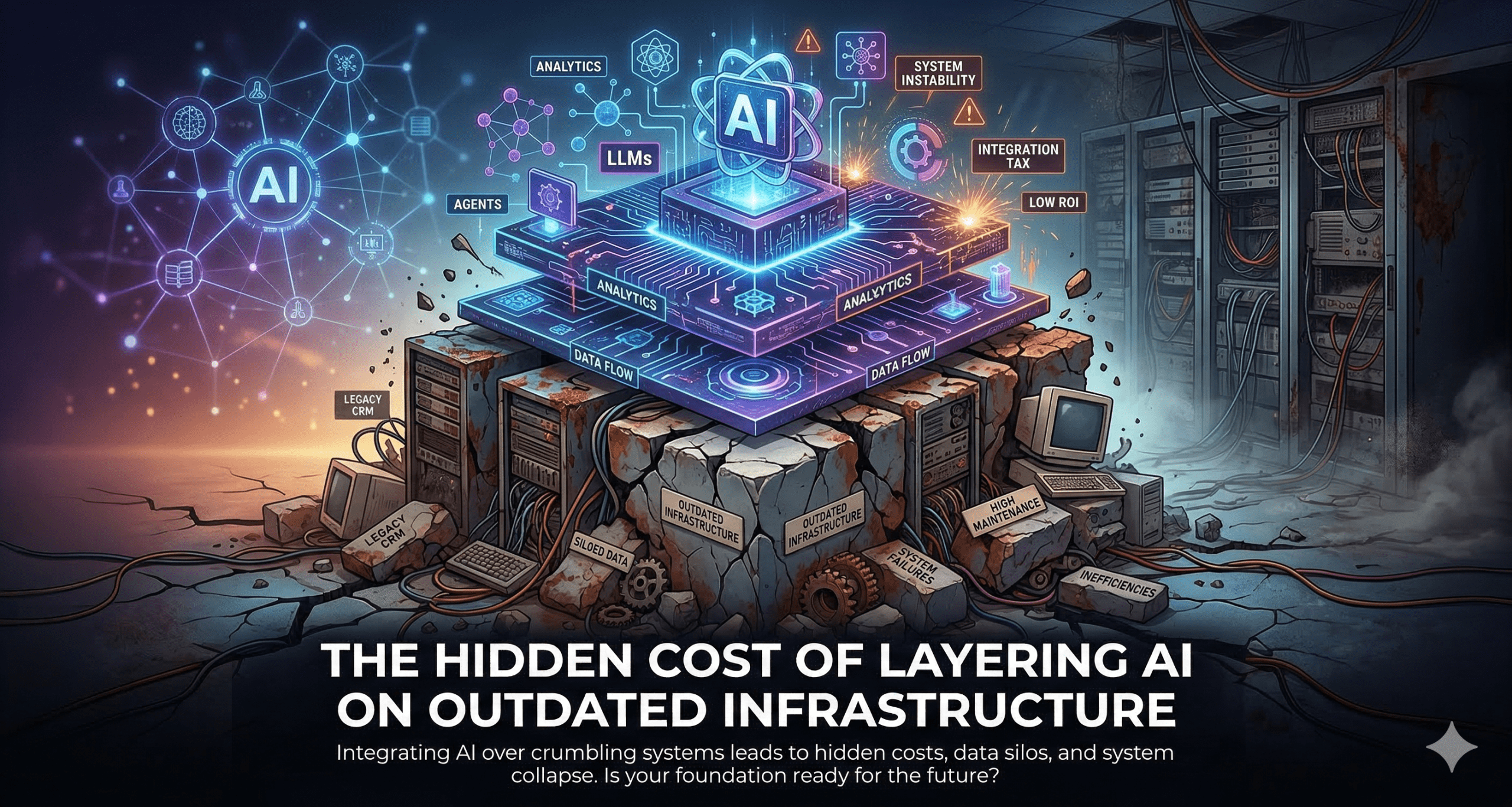
Just like Building a house, AI – Needs a Strong Foundation
Companies often invest heavily in agentic AI, expecting transformative results, only to find their efforts hampered by underlying infrastructure. For instance, an $800,000 investment in cutting-edge AI might yield a mere 12% adoption rate because the legacy CRM systems cannot support the required data flows. This isn’t just a slowdown; outdated infrastructure creates an exponential failure cost, silently eroding ROI and competitive advantage. This article reveals the true cost breakdown and provides a critical decision framework for addressing infrastructure debt before it cripples your AI initiatives.
The Infrastructure Readiness Gap: Why Your Stack Isn’t AI-Ready
Your current technology stack, especially older CRMs and sales tools, was fundamentally built for human workflows, not the autonomous orchestration demanded by agentic AI. Agentic AI requires three critical infrastructure layers: robust data quality and consistency, real-time API connectivity and synchronization, and sufficient compute and processing capacity. Legacy systems frequently lack the APIs or modern data formats needed for seamless AI integration, according to Berkeley CMR.
The silent killers of agentic AI adoption are data silos, batch processing delays, and rigid field structures. These issues break down the continuous, real-time data exchange essential for AI agents to operate effectively and make accurate decisions. Without addressing these foundational weaknesses, AI implementations will struggle to achieve their promised potential, leading to low adoption rates and inflated costs.
The Real Cost Breakdown: Where the Money Actually Goes
Layering agentic AI onto inadequate infrastructure incurs significant financial penalties, both direct and indirect. Direct costs include expensive integration middleware, extensive data cleaning and normalization efforts, API rate limit upgrades, and custom development to bridge system gaps. For example, API and middleware integration can cost $2,000–$9,000 initially, with monthly upkeep ranging from $200–$2,000 as estimated by RTS Labs.
Indirect costs are often far greater. They encompass extended implementation timelines, which can stretch from a projected 2-3 months to 6-9 months for basic agents on modern platforms. Reduced AI accuracy due to poor data quality leads to diminished business outcomes, and ongoing maintenance overhead becomes a constant drain. The opportunity cost is arguably the most damaging: while wrestling with infrastructure, companies lose competitive advantage by delaying the optimization of AI performance and the realization of its strategic benefits.

The 3 Infrastructure Debt Scenarios (And What Each One Costs)
Understanding your company’s infrastructure debt level is crucial for accurately forecasting agentic AI implementation costs and success rates. These scenarios quantify the impact of existing tech stack maturity on AI projects. Gartner predicts that over 40% of agentic AI projects will fail by 2027 due to issues like inadequate foundations.
Scenario 1: Minimal Debt (Modern Stack, Clean Data)
Companies with modern CRM and sales tech stacks (0-3 years old) and high data quality experience the most straightforward AI implementations.
- AI implementation cost: $200K-$400K
- Timeline to production: 2-3 months
- Expected AI adoption: 70%+
- Primary risk factors: Minor integration tweaks, user training.
These organizations can typically achieve rapid deployment and high ROI due to their prepared environment.
Scenario 2: Moderate Debt (5-10 Year Old CRM, Some Data Issues)
This common scenario involves CRMs 5-10 years old with some data quality inconsistencies, requiring pre-implementation cleanup.
- Total cost (including infrastructure fixes): $600K-$1.2M
- Timeline to production: 6-9 months
- Expected AI adoption: 40-50%
- Primary risk factors: Data normalization complexity, API rate limits, integration middleware costs.
Here, a significant portion of the budget and timeline is dedicated to making the existing systems AI-ready.
Scenario 3: Severe Debt (Legacy Systems, Major Data Quality Issues)
Organizations with systems older than 10 years and significant data problems face the steepest climb.
- Total cost: $1.5M-$4M+
- Timeline to production: 12-18 months
- Expected AI adoption: 15-25% with high failure risk
- Primary risk factors: Extensive data migration/cleaning, custom API development, system rewrite needs, low user trust.
In this scenario, the cost of layering AI can quickly outweigh the benefits if foundational issues are not addressed first.
Infrastructure Readiness Levels: Cost & Timeline Impact
This table compares three common infrastructure scenarios companies face when implementing agentic AI, showing the real cost and timeline differences based on infrastructure maturity. It helps revenue leaders quickly assess where they fall and what to expect.
| Infrastructure Scenario | Total Implementation Cost | Timeline to Production | Expected AI Adoption Rate | Primary Risk Factors |
|---|---|---|---|---|
| Modern Stack (0-3 years old, clean data) | $200K-$400K | 2-3 months | 70%+ | Minor integration tweaks, user training. |
| Mid-Age Stack (5-8 years old, moderate data issues) | $600K-$1.2M (incl. fixes) | 6-9 months | 40-50% | Data normalization complexity, API rate limits, integration middleware. |
| Legacy Stack (10+ years old, severe data quality issues) | $1.5M-$4M+ | 12-18 months | 15-25% (high failure risk) | Extensive data migration/cleaning, custom API development, system rewrite. |
| Hybrid Stack (mix of modern and legacy with silos) | $1M-$2.5M (variable) | 9-15 months | 30-45% | Data governance, conflicting schemas, complex API orchestration. |
| Greenfield (new implementation, no legacy debt) | $300K-$700K | 4-6 months | 80%+ | Initial setup complexity, vendor lock-in. |
The Fix-First vs. Layer-Anyway Decision Framework
The choice between fixing infrastructure first or layering AI directly depends on the severity of your infrastructure debt and your competitive landscape. Trullion analysis suggests that “the real issue is the wrong AI projects being prioritized,” often due to outdated ROI expectations.
When to Fix Infrastructure First
Prioritize infrastructure modernization when you face severe data quality issues (e.g., >30% duplicate or incomplete records), your core systems are older than 8-10 years, or your intended AI use cases are mission-critical and cannot tolerate failures. This approach, while initially slower, builds a solid foundation for sustainable, high-performing AI. Firms with standardized IaC and governance, like JP Morgan Chase, saw 38% fewer incidents after implementing agentic platforms.
When You Can Layer AI Anyway
You can consider layering AI directly if your stack is relatively modern with only isolated data issues, or if the AI use case is non-critical and intended for testing and learning. This strategy is also viable when competitive pressure demands immediate, albeit potentially limited, AI deployment for specific functions. However, be prepared for potential integration nightmares and data silos if foundational problems are ignored.
The Hybrid Approach
The most pragmatic strategy for many enterprises is a hybrid approach. This involves parallel infrastructure modernization while piloting agentic AI in contained environments. This allows for iterative learning and value demonstration without pausing critical infrastructure work.

What Modern AI-Ready Infrastructure Actually Looks Like
Modern AI-ready infrastructure is a comprehensive ecosystem designed for dynamic, autonomous operations. Technologically, it features a unified data model across all systems, real-time API connectivity, and flexible schemas that support AI-generated fields and insights. Architectures should be API-first and cloud-native, emphasizes Berkeley CMR.
Operationally, this requires robust data governance processes, clear ownership of data quality, and strong cross-functional alignment among RevOps, IT, and AI teams. These elements ensure data integrity and system reliability, which are paramount for AI agent orchestration. Sentia AI’s orchestration platform is specifically designed to bridge these infrastructure gaps by providing pre-built integrations, a data normalization layer, and adaptive workflows that seamlessly work with existing systems, even those with moderate debt. This approach enables AI agent orchestration without requiring a full system overhaul.
The 90-Day Infrastructure Readiness Sprint
A focused 90-day sprint can kickstart your journey toward AI-ready infrastructure. This structured approach helps identify critical gaps and implement targeted fixes, paving the way for successful agentic AI deployments.
Phase 1 (Days 1-30): Infrastructure Audit
Conduct a thorough data quality assessment, mapping API connectivity, and identifying bottlenecks. This includes analyzing duplicate rates, data completeness, and system integration points. RevOps leaders emphasize that AI adoption is moving faster than data readiness, making this audit crucial.
Phase 2 (Days 31-60): Quick Wins Implementation
Address critical data cleaning issues and implement key integration fixes. Set up a pilot environment for initial AI testing. This phase focuses on high-impact, low-effort changes that yield immediate improvements.
Phase 3 (Days 61-90): AI Pilot Launch
Deploy a contained agentic AI pilot, meticulously monitoring its performance and validating ROI. This allows for controlled learning and adjustment before a broader rollout. This phased approach helps avoid a bad AI install.

Conclusion: The Infrastructure-First Advantage
The companies truly winning with agentic AI in 2026 are those that made strategic investments in infrastructure modernization in 2024-2025. This infrastructure-first approach ensures a solid foundation for AI, leading to higher adoption rates and tangible ROI. The ROI on infrastructure investment can pay back 3-5x through faster AI adoption, increased accuracy, and reduced ongoing maintenance costs. Menlo Ventures’ Venky Ganesan notes that “2026 is the ‘show me the money’ year for AI,” reinforcing the need for measurable returns.
The strategic imperative for revenue leaders is clear: assess your infrastructure readiness now and build a compelling business case for a fix-first or hybrid approach. Only then can you fully unlock the transformative power of agentic AI.

Key Takeaways
- Outdated infrastructure creates an exponential failure cost, not just performance slowdowns for agentic AI.
- Legacy CRM and sales tools were built for human workflows, lacking the data quality, real-time APIs, and compute for autonomous AI.
- Direct and indirect costs of layering AI on poor infrastructure can inflate total project costs by 2-5x.
- Companies with severe infrastructure debt (10+ years old systems, major data issues) face $1.5M-$4M+ costs and low AI adoption.
- An infrastructure-first approach or hybrid strategy yields 3-5x ROI through faster AI adoption, higher accuracy, and reduced maintenance.
- A 90-day infrastructure readiness sprint can audit, implement quick wins, and launch a contained AI pilot for validation.
Frequently Asked Questions
How do I know if my infrastructure is ready for agentic AI?
Your infrastructure is ready for agentic AI if it exhibits high data quality (under 10% duplicate or incomplete records), modern API capabilities for real-time data exchange, and seamless cross-system connectivity. Assess your systems for these three critical areas to determine readiness.
What is the average cost of fixing infrastructure before implementing AI?
The average cost of fixing infrastructure varies significantly by debt level; minimal fixes might cost $50K-$150K, moderate overhauls range from $200K-$500K, and severe modernization efforts can exceed $500K-$1.5M. These costs cover data cleaning, API development, and system integrations.
Can I implement agentic AI on a legacy CRM like older Salesforce versions?
Yes, you can implement agentic AI on older Salesforce versions, but it will likely require significant middleware, custom integrations, and data synchronization tools to bridge functionality gaps. A full modernization might be necessary for mission-critical applications to avoid severe limitations and high failure rates.
How long does infrastructure modernization take before AI deployment?
Infrastructure modernization timelines vary based on scope; quick fixes can take 30-60 days, a moderate overhaul typically requires 3-6 months, and a full modernization effort can span 6-12 months. A hybrid approach allows for parallel AI piloting while modernization progresses.
What are the signs my infrastructure is causing AI implementation to fail?
Key signs that your infrastructure is hindering AI include low AI adoption rates (below 30%), frequent data synchronization errors, AI agents making decisions based on stale or inaccurate data, recurring integration timeouts, and user complaints about the AI’s reliability or accuracy. Explore Agentic AI.
Is it better to fix infrastructure first or implement AI and fix issues later?
It is generally better to fix infrastructure first if you have severe data quality issues or very old systems, as this ensures a stable foundation for AI. However, if competitive pressure is high and issues are isolated, a “layer-anyway” or hybrid approach might be considered for non-critical use cases.
What does AI-ready infrastructure actually look like in 2026?
AI-ready infrastructure in 2026 features a unified data model across all systems, real-time API connectivity, flexible schemas that support AI-generated insights, and a cloud-native, API-first architecture. It also includes robust data governance and cross-functional alignment.
How much does poor infrastructure increase the total cost of AI implementation?
Poor infrastructure can increase the total cost of AI implementation by 2-5x through extended project timelines, the need for extensive custom development, higher ongoing maintenance overhead, and a reduced ROI resulting from low AI adoption and accuracy issues.
What is the ROI of infrastructure modernization before AI deployment?
Infrastructure modernization before AI deployment typically yields a 3-5x return on investment through faster AI implementation, significantly higher adoption rates (70%+ compared to 20-30%), improved AI accuracy, and reduced long-term operational costs. This ROI is realized through enhanced efficiency and better business outcomes. Explore what really works and doesn’t in Agentic AI.
Can Sentia AI work with my existing outdated infrastructure?
Yes, Sentia AI’s orchestration platform is specifically designed to bridge infrastructure gaps by providing pre-built integrations, a data normalization layer, and adaptive workflows that work with existing systems. While some foundational stability is beneficial, Sentia AI helps maximize value from your current tech stack while you plan for modernization.
Key Terms Glossary
Agentic AI: Artificial intelligence systems capable of autonomous decision-making and task execution based on predefined goals and environmental feedback.
Infrastructure Debt: The accumulated cost and complexity arising from maintaining outdated or poorly integrated technology systems that hinder new technology adoption.
Data Normalization: The process of organizing data to eliminate redundancy and improve data integrity, making it consistent and usable across different systems. Explore why 95% of enterprise AI pilots are failing.
API Connectivity: The ability of different software systems to communicate and exchange data in real-time through Application Programming Interfaces.
CRM: Customer Relationship Management, a technology used to manage and analyze customer interactions and data throughout the customer lifecycle.
RevOps (Revenue Operations): A strategic function that optimizes the revenue generation process by aligning sales, marketing, and customer service teams.
Opportunity Cost: The loss of potential gain from other alternatives when one alternative is chosen, such as delaying AI benefits due to infrastructure issues.


