Enterprise Financial Orchestration: Five Critical Fractional CFO Challenges solved by Modern Artificial Intelligence
By David Brown ·
The rapid expansion of the fractional executive model has transformed corporate finance leadership, enabling high-growth startups, private equity portfolio companies, and middle-market enterprises to leverage tier-one financial stewardship without the fixed overhead of a full-time Chief Financial Officer. However, the operational reality of the Fractional CFO (fCFO) is defined by extreme structural complexity. Managing multiple client portfolios requires navigating disparate software ecosystems, fragmented data structures, unpredictable cash flows, and strict regulatory standards under severe time constraints.
While early-generation automation focused on broad administrative workflows—such as basic CRM updates, email scheduling, and high-level sales pipeline tracking—these tools fail to address the core quantitative and analytical burdens of strategic corporate finance. Fractional CFOs do not merely manage relationship context; they hold fiduciary responsibility for financial integrity, capital allocation, risk mitigation, and strategic growth narrative.
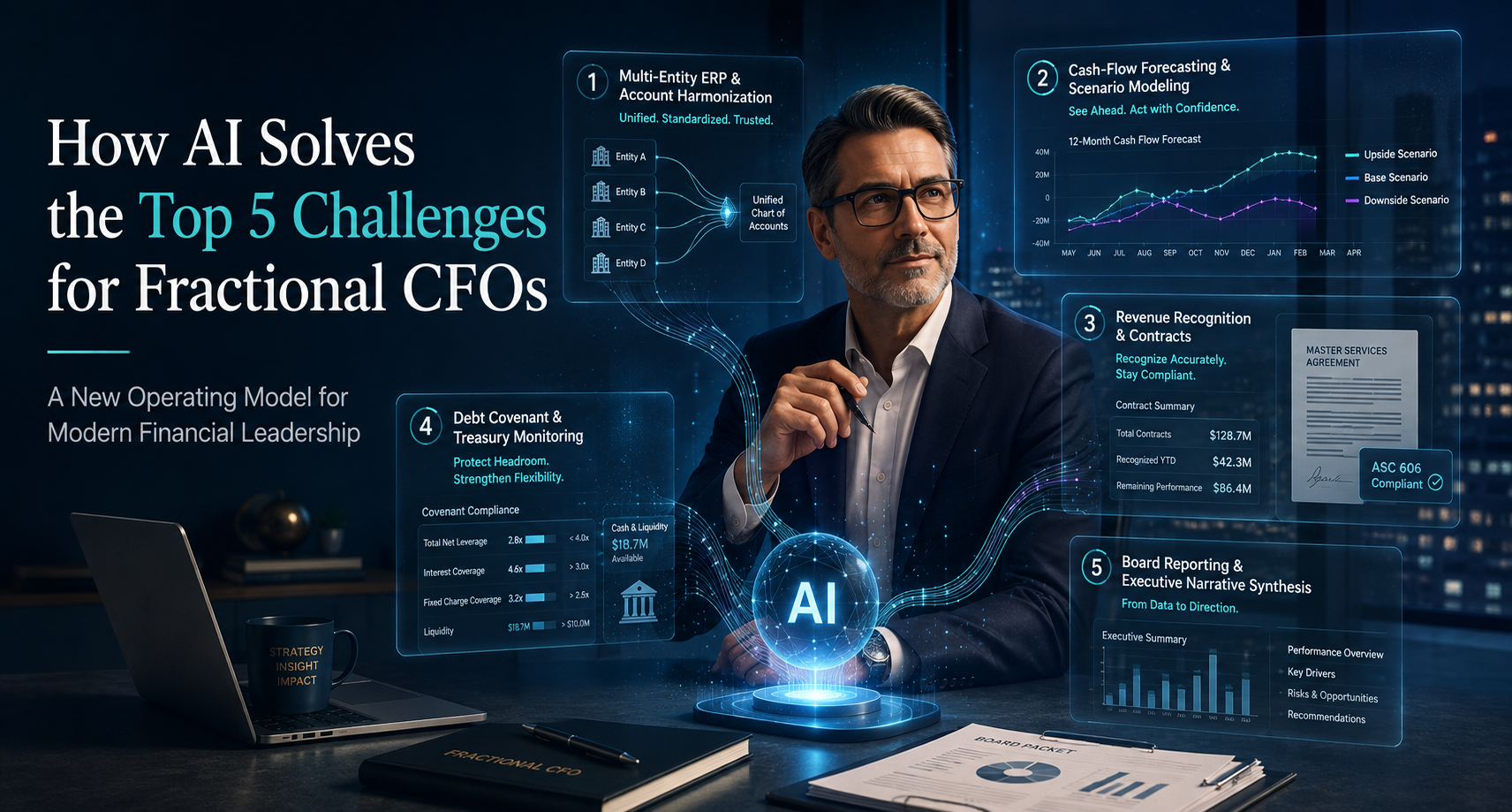
Artificial intelligence architectures have evolved beyond generic task assistants into specialized, autonomous operating layers capable of tackling the deep operational bottlenecks unique to corporate finance. This report examines the top five technical and operational challenges faced by Fractional CFOs that advanced AI systems solve, focusing on specialized financial execution domains distinct from general sales and revenue operations literature.
Challenge 1: Multi-Entity Chart of Accounts Harmonization Across Disparate ERP Systems
Fractional CFOs frequently oversee portfolio companies operating on completely heterogeneous enterprise resource planning (ERP) platforms—ranging from cloud-native software like QuickBooks Online and Xero to enterprise platforms such as NetSuite, Sage Intacct, and SAP. Each entity maintains its own custom Chart of Accounts (COA) with unique account numbering, naming conventions, and transaction categorizations.
When delivering consolidated financial views for holding companies, private equity sponsors, or parent-subsidiary structures, the CFO must manually extract raw trial balances and perform cell-by-cell mapping into a standardized master taxonomy. This manual process introduces substantial human error, delays month-end closing cycles, and makes real-time financial comparisons across client business units nearly impossible.
Modern artificial intelligence solves this systemic friction through semantic schema-mapping engines and natural language processing models fine-tuned on US GAAP and IFRS accounting frameworks. The pipeline begins when raw transaction data is continuously ingested via APIs from disparate client ERPs. Rather than relying on rigid, rule-based database queries that break whenever a client adds a new GL account, the AI engine evaluates the semantic intent, historical transaction behavior, and underlying metadata of atomic journal entries.
The AI system autonomously categorizes incoming transaction lines into the master reporting taxonomy, reconciles intercompany eliminations, and flags mapping anomalies for executive approval. This transforms a manual mapping process into a dynamic, real-time consolidation architecture.
| Financial Operation Dimension | Legacy Manual Paradigm | AI-Native Semantic Engine Paradigm |
| Data Ingestion | Batch CSV exports from individual client ERPs | Continuous API telemetry ingestion across all platforms |
| COA Standardized Mapping | Manual spreadsheet VLOOKUPs and account re-classification | Semantic neural matching against standardized GAAP/IFRS taxonomies |
| Intercompany Reconciliations | Periodic end-of-month manual elimination entries | Automated real-time matching of intercompany ledger balances |
| Anomalous Entry Detection | Retrospective spot-checking during month-end audits | Real-time transaction evaluation with automated outlier flagging |
| Consolidation Velocity | 10 to 15 business days post-month-end | Near-real-time continuous financial reporting |
Challenge 2: Stochastic Cash Flow Forecasting and Multi-Scenario Capital Modeling
Venture-backed and middle-market companies operate in high-volatility environments where liquidity management is the primary determinant of corporate survival. Fractional CFOs are routinely task-oriented around evaluating burn rate, projecting cash runway, and modeling dynamic capital allocation scenarios, such as aggressive hiring sprees, international expansion, product line pivots, or downside economic recessions.
Traditional financial modeling relies on deterministic, spreadsheet-based driver models. These models are inherently rigid; a single formula error can cascade across tabs, and updating assumptions across five portfolio companies requires dozens of hours of manual recalibration. Furthermore, deterministic models fail to capture stochastic distribution—the probabilistic reality of how revenue collection delays, variable vendor costs, and macroeconomic shifts compound over time.
Strategic corporate finance requires evaluating dynamic metrics, such as the Burn Multiple, defined as:

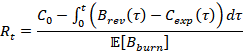
To accurately evaluate capital efficiency under uncertain conditions, the probability-weighted runway at time
must account for stochastic variance in cash receipts
and cash disbursements
:
Generative financial modeling engines solve this limitation by combining deterministic financial logic with Monte Carlo simulation capabilities. Instead of building static spreadsheet tabs, the fCFO defines core strategic parameters in natural language or baseline financial structures.
The AI agent autonomously extracts historical cash volatility metrics, models thousands of probabilistic revenue and expense trajectories, and presents the CFO with distribution curves representing best-case, expected, and downside runway scenarios. When market conditions change, the AI agent updates the underlying assumptions across all portfolio financial models simultaneously, providing instantaneous scenario sensitivity analysis without manual cell manipulation.
Challenge 3: Automated ASC 606 and IFRS 15 Revenue Recognition Decomposition
For fractional CFOs advising high-growth Software-as-a-Service (SaaS), hybrid hardware-tech, or enterprise services companies, revenue recognition represents one of the most technically complex and risk-laden responsibilities. Under ASC 606 and IFRS 15, revenue must be recognized as performance obligations are satisfied, rather than when cash is received or contracts are signed.
Enterprise contracts frequently contain non-standard terms, including:
- Bundled software licenses and professional service hours
- Variable usage-based pricing thresholds
- Tiered discount structures and refund clauses
- Custom milestone delivery sign-offs
Unraveling these multi-element arrangements manually requires reading dozens of lengthy legal contracts, extracting specific performance obligations, assigning Standalone Selling Prices (SSP), and manually constructing amortization schedules in spreadsheets. Errors in revenue recognition distort financial statements, skew critical SaaS metrics like Annual Recurring Revenue (ARR) and Net Retention Rate (NRR), and create severe valuation write-downs during M&A due diligence or institutional fundraising rounds.
Advanced multimodal document processing agents eliminate this accounting bottleneck by operating a multi-stage deconstruction pipeline. Executed customer contracts, master service agreements (MSAs), and statements of work (SOWs) in PDF format are ingested by optical character recognition and clause extraction modules. The AI engine parses the legal text to identify distinct performance obligations, calculate relative Standalone Selling Price (SSP) allocations, and flag variable consideration risks.
The system then auto-generates the corresponding revenue amortization schedules and posts the required debits and credits directly to Deferred Revenue and Recognized Revenue accounts within the ERP, maintaining an immutable, audit-ready compliance trail.
Challenge 4: Continuous Debt Covenant Monitoring and Treasury Capital Optimization
As borrowing costs remain elevated, growth-stage enterprises increasingly rely on venture debt, asset-backed credit facilities, and commercial loans to fund operations. These credit facilities are bound by strict financial covenants—such as minimum liquidity balances, maximum leverage ratios, minimum trailing-three-month (TTM) EBITDA thresholds, and strict Fixed Charge Coverage Ratios (FCCR).
The Fixed Charge Coverage Ratio is calculated as:

For a Fractional CFO managing 5 to 10 companies, continuous monitoring of covenant health across all credit facilities is an operational challenge. Because financial statements are traditionally updated on a monthly or quarterly lag, a company can inadvertently breach a debt covenant mid-month due to unexpected operational expenditures or delayed receivables, triggering default rates, credit line freezes, or lender warrants.
Continuous financial monitoring agents solve this visibility gap by establishing persistent API connections between banking institutions, credit card platforms, and ERP backends. Operating as autonomous guardians, these agents continuously calculate real-time covenant ratios and project financial trajectory against lender thresholds weeks into the future.
If cash drawdowns or revenue deceleration indicate a prospective covenant breach 30 or 60 days out, the AI system triggers proactive executive alerts. It presents the CFO with prescriptive capital reallocation strategies—such as drawing down a secondary credit facility, shifting short-term vendor payments, or adjusting discretionary marketing burn—preventing default conditions long before traditional month-end reports would reveal the risk.
Challenge 5: Automated Board Narrative Synthesis and Executive Reporting
Financial data in isolation is ineffective for strategic decision-making. Boards of directors, investors, and founders rely on the Chief Financial Officer to translate complex financial statements, budget-to-actual variances, and operational metrics into actionable strategic insights.
A significant portion of a Fractional CFO’s billable capacity is consumed by the administrative friction of executive presentation prep:
- Exporting financial statements into design tools or slide software
- Calculating period-over-period variance percentages across business units
- Drafting narrative commentary explaining why gross margins compressed or CAC payback expanded
- Structuring strategic recommendations for executive leadership
This narrative synthesis bottleneck creates a structural ceiling on the number of clients a fractional CFO can serve without compromising output quality.
Financial narrative orchestration engines resolve this friction by establishing an automated bridge between quantitative ledger telemetry and qualitative strategic reporting. The platform continuously ingests general ledger and operational metrics from ERP, payroll, and CRM backends. A quantitative variance engine performs automated bridge calculations, including price-volume-mix analysis and unit economics decomposition.
The AI narrative engine then translates these variance outputs into concise executive commentary, populating investor presentations with formatted charts, critical risk callouts, and strategic recommendations. This reduces presentation preparation time from days to minutes, allowing the Fractional CFO to focus entirely on high-level advisory and strategic execution.
Strategic Synthesis: Comparing Fractional CFO Operating Models
The integration of artificial intelligence into corporate finance transforms the fractional CFO practice from a labor-constrained advisory service into a technology-amplified strategic platform. By moving beyond point-solution automations and adopting domain-specific AI orchestration, fractional executives can scale their client capacity while delivering higher-precision financial governance.
| Operational Domain | Traditional Fractional CFO Practice | AI-Orchestrated Fractional CFO Practice |
| Multi-Entity Consolidation | Periodic manual spreadsheet exports; fragile cell-mapping rules | Real-time semantic schema matching and continuous cross-ERP consolidation |
| Financial Modeling | Static, deterministic Excel models prone to broken formulas | Dynamic Monte Carlo scenario modeling with automated parameter updates |
| Revenue Recognition | Manual legal contract review and spreadsheet amortization schedules | Autonomous contract parsing, ASC 606 obligation extraction, and auto-GL posting |
| Covenant Compliance | Retrospective monthly checking; high risk of mid-month default | Persistent real-time telemetry monitoring with predictive breach forecasting |
| Executive Reporting | Hours of manual chart creation and narrative drafting per client | Automated variance decomposition and investor-ready narrative generation |
| Leverage & Scale Limit | Hard capacity ceiling at 3–5 portfolio clients due to manual overhead | Scalable portfolio management (8–12+ clients) with enhanced strategic depth |
Nuanced Operational Risks and Governance Imperatives
While artificial intelligence offers high operational leverage for financial professionals, deploying autonomous systems within corporate finance introduces specific compliance, legal, and fiduciary considerations that require strict operational governance.
Hallucination and Financial Misstatement Risk
Large language models operating strictly as generative probabilistic engines can output plausibly formatted but mathematically incorrect financial data. In corporate accounting, a misplaced decimal or miscalculated discount rate distorts GAAP compliance. Financial AI deployments must utilize deterministic calculation layers—where the AI performs entity extraction and task planning, but delegates mathematical computation to verified financial execution engines.
Regulatory and Audit Lineage
Regulatory frameworks, such as the EU AI Act and US SEC financial reporting mandates, emphasize auditability and data provenance. Financial models and automated GL entries generated by AI must maintain complete lineage tracking. Every automated entry posted to a general ledger or revenue schedule must link directly back to the source document—such as a specific clause in an executed PDF contract or a specific bank clearance ID—to ensure full external auditability.
Human-in-the-Loop Governance Controls
The architectural flow of financial AI must be gated by human verification before impacting official systems of record. Raw transaction inputs and contract documents undergo automated processing, validation, and preparation by AI agents. However, before outputs are committed to the general ledger or disclosed to external board members, they pass through a deterministic governance checkpoint requiring human-in-the-loop review.
The Fractional CFO evaluates proposed journal entries, revenue schedules, and strategic narratives, serving as the ultimate fiduciary authority. This architecture ensures that autonomous speed and scale are strictly aligned with human judgment, legal accountability, and regulatory compliance.
Conclusions
The evolution of enterprise AI represents a fundamental shift in how fractional corporate finance is conducted. By directly addressing the high-complexity domains of multi-entity schema harmonization, stochastic capital modeling, contract-level revenue recognition, continuous debt covenant monitoring, and board narrative synthesis, financial executives can eliminate the structural manual bottlenecks that previously capped their professional capacity.
Implementing these architectures transforms the Fractional CFO from a reactive manager of retrospective spreadsheet data into a proactive strategic growth partner equipped with real-time financial intelligence. Organizations that adopt these AI-native financial execution frameworks gain superior capital clarity, accelerated closing cycles, and robust risk governance in an increasingly dynamic market environment.