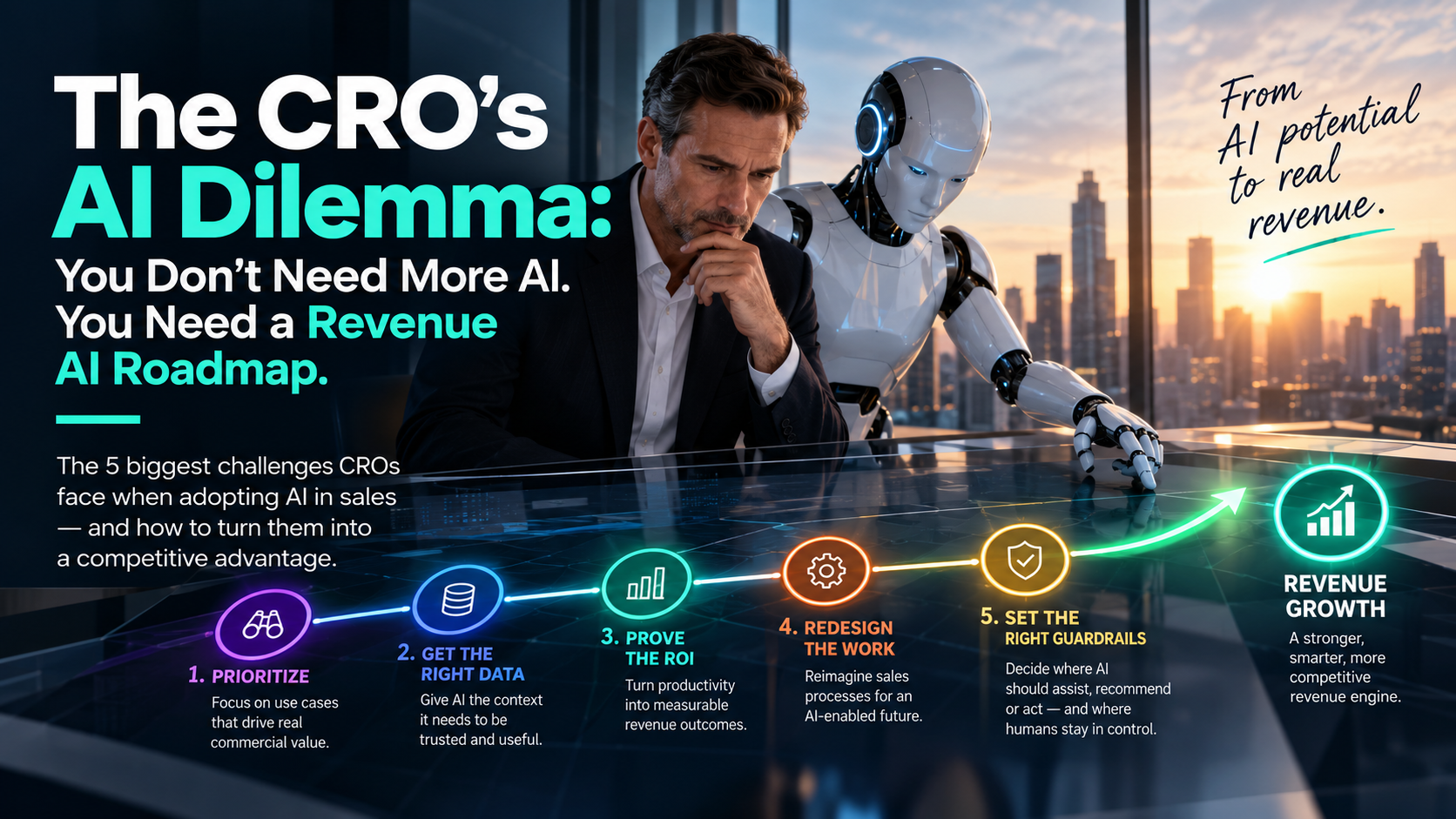
The CRO’s AI Dilemma: You Don’t Need More AI. You Need a Revenue AI Roadmap.
By David Brown ·
AI in sales has moved past the experimentation stage.
Most CROs are no longer asking whether AI will affect their sales organization. They are being approached almost daily with new tools promising better prospecting, better forecasting, automated research, cleaner CRM data, personalized outreach, meeting intelligence, coaching, next-best actions and increasingly autonomous AI agents that can actually perform parts of the sales process.
The technology is moving incredibly quickly.
The harder question is deciding what to do with it.
Where should AI actually sit inside the sales process? Which problems are worth solving first? What data should it be trusted to use? Where should people remain in control? And perhaps most importantly, how does a CRO prove that any of this is producing more revenue rather than simply creating a greater technology debt?
Those questions are becoming much more important than, “Which AI sales tool should we buy?”
Research increasingly points in the same direction. McKinsey’s 2026 B2B sales research found widespread AI experimentation but much more limited value creation. The companies getting stronger results aren’t simply adding AI tools; they’re redesigning important commercial workflows around them. Read the McKinsey research
That is the issue I believe CROs now need to address.
AI needs a revenue roadmap.
Not a 50-page AI strategy. Not another transformation program. A practical plan for deciding where AI can make the biggest commercial difference, what needs to change for it to work and how the organization will know whether it did.
Here are the five problems that roadmap needs to solve.
1. There Are Too Many Places to Use AI — So Where Do You Start?
This is becoming one of the most difficult decisions.
Take a typical B2B sales organization. AI could potentially research accounts, identify buying signals, prioritize opportunities, prepare sellers for meetings, draft correspondence, capture meetings, update CRM, recommend next actions, identify stalled deals, improve forecasts, coach sellers, produce proposals and monitor existing customers for expansion or churn.
Every one of those can be a legitimate use case.
Trying to do all of them at once is where the trouble begins.
The CRO’s job isn’t to find places where AI can be used. There are hundreds of them. The job is to identify the small number of workflows where AI can materially affect a commercial outcome.
Gartner’s 2026 research gives us a useful clue. Sales organizations providing sellers with AI-enabled next-best actions were 2.6 times more likely to achieve commercial growth in its study. The significance isn’t simply that next-best-action technology works. It’s that the AI is being connected to a decision that affects what the seller actually does next. See the Gartner findings
That’s a very different proposition from giving every salesperson a chatbot and hoping something useful happens.
For a CRO, I would start by looking for friction in the revenue engine. Where are good opportunities being missed? Where are deals slowing down? Where are sellers spending time on administration instead of customers? Where does important customer context disappear between meetings, people and systems? Where are managers making decisions from incomplete information?
Then rank the AI opportunities against commercial impact.
A tool that saves five minutes writing an email may be useful. An AI capability that helps a salesperson identify which ten accounts need attention today — and why — may fundamentally change productivity.
The question for the CRO is not “Where can we use AI?” It is “Where would better intelligence or execution materially change our revenue outcome?”
2. AI Is Only as Good as the Context You Give It
This is where the AI conversation quickly becomes a data conversation.
Most sales organizations don’t have one perfect source of customer truth. CRM has some of it. Email has some. Meeting notes contain another piece. Calendars, proposals, support systems, spreadsheets, marketing platforms and people’s own memories contain the rest.
Humans have spent years compensating for that fragmentation.
AI doesn’t magically make it disappear.
Salesforce’s 2026 State of Sales research found that among teams already using AI agents, 46% said data-quality problems were hurting sales, while manual errors, duplicate data, security concerns and incomplete data were among the most common issues.
Gartner found another problem: 66% of sales leaders reported low trust in AI-generated insights. One of the reasons is straightforward. If AI doesn’t have enough proprietary customer and deal context, its recommendations can become generic, incomplete or simply wrong. Read Gartner on AI trust and proprietary sales data
That doesn’t mean a CRO should wait until every CRM field is perfect before using AI. For most organizations, that day will never arrive.
It does mean the implementation sequence matters.
Start with the commercial problem. Determine what information the AI needs to solve it. Connect and improve that data. Put human review around the recommendations until confidence increases. Then expand.
Done properly, AI can actually become part of the solution to the data problem. It can capture meeting context, identify missing information, surface inconsistencies, suggest CRM updates, connect information across systems and reduce the manual data entry that created poor CRM hygiene in the first place.
The ambition shouldn’t be “clean everything before we use AI.”
It should be “make the information required for this revenue decision trustworthy enough for AI and humans to use it.”
3. Productivity Isn’t the Same Thing as Revenue
This may be the most important point in the entire AI sales discussion.
AI can absolutely save salespeople time.
Gartner found that AI is saving sellers an average of 4.8 hours per week. That sounds fantastic until you get to the next number: 72% of sales organizations reported low reinvestment of those savings into higher-value sales activities. Read Gartner’s sales productivity research
That’s the trap.
If AI saves a salesperson five hours but those five hours disappear into email, internal meetings or lower-value activity, the company has achieved efficiency without necessarily achieving additional revenue.
A CRO therefore needs to decide before deploying the technology what will happen to the capacity AI creates.
If AI eliminates three hours of administration each week, does that become additional customer conversations? More prospecting? More whitespace analysis across existing accounts? Better opportunity planning? More coaching?
Without that decision, “hours saved” becomes a vanity metric.
This also explains why proving AI ROI remains difficult. Gartner found that 31% of chief sales officers cited difficulty proving ROI from AI-driven tools as a top challenge to achieving their 2026 sales objectives. Read Gartner’s research on proving sales AI ROI
The measurement needs to move beyond adoption.
Instead of simply asking, “Are people using it?”, CROs need to build a chain between AI and the commercial outcome:
AI activity → time or decision improvement → changed seller behavior → pipeline impact → revenue impact.
That might mean measuring increased customer-facing capacity, additional accounts covered, response times, opportunity progression, conversion rates, sales-cycle duration, forecast accuracy, retention or expansion.
Gartner makes the same broader point in its AI ROI research: executive leaders need to move beyond activity measures and connect AI investments to measurable outcomes such as revenue growth, cost reduction and employee impact. See Gartner’s AI ROI framework
If we can’t say what number should move before we implement the AI, proving value afterwards becomes much harder.
4. We Keep Adding AI to Sales Processes That Were Never Designed for AI
This is the problem I think many organizations are underestimating.
Most sales processes were designed around people operating software.
A salesperson researches an account, opens CRM, looks through email, attends a meeting, takes notes, creates tasks, updates an opportunity, searches for information, prepares a proposal and then repeats the process with the next customer.
Now we are adding AI to every stage.
AI writes the email faster. AI summarizes the meeting faster. AI enters information into CRM faster. AI prepares the research faster.
All useful.
But at some point a CRO should ask a more uncomfortable question:
Why is the salesperson doing some of this work at all?
McKinsey’s latest B2B research describes this distinction particularly well. Companies capturing greater value aren’t simply using AI to improve individual tasks. They are beginning to rewire end-to-end commercial workflows, allowing AI to synthesize signals, prioritize opportunities and support sellers around the customer rather than around the software.
Deloitte found the same gap more broadly. Its 2026 State of AI research reports that AI is delivering efficiency and productivity, but only 34% of companies say they are truly reimagining the business around it. Role and workflow redesign continue to lag AI adoption. Read Deloitte’s 2026 State of AI research
This is where the bigger opportunity sits.
Rather than giving a salesperson six AI tools to operate alongside the eight systems they already have, AI can increasingly work across those systems, preserve context, surface what matters and help orchestrate the work.
Imagine the difference between these two models.
In the first, the salesperson asks AI to research an account, asks another system about CRM history, checks email, reviews meeting notes and then decides what to do.
In the second, AI has already connected those signals and tells the salesperson: This account needs your attention today. Here is what changed, why it matters, what happened in the last conversation and the next action that appears most appropriate.
The human hasn’t disappeared.
The administrative burden around the human has.
That is what sales-process redesign around AI should start to look like.
5. CROs Need to Decide How Much Authority AI Should Have
The next phase of sales AI makes this question unavoidable.
For the last few years, most AI sat beside the salesperson. You asked a question and AI produced an answer.
Agentic AI changes that relationship because AI can increasingly take action.
It can update systems. Create tasks. conduct research. Prepare communications. Trigger workflows. Recommend decisions. In some environments, it can execute those decisions.
This creates enormous opportunity, but it also creates a completely different category of risk.
Should AI draft a customer email?
Probably.
Should it send the email without approval?
Maybe.
Should it change an opportunity stage?
Under what circumstances?
Should it recommend a discount?
Should it approve one?
Should it alter a forecast?
Should it initiate contact with a strategic account based on a detected buying signal?
There isn’t one correct answer because the appropriate level of autonomy depends on the action, the customer, the consequences of getting it wrong and the quality of the underlying data.
What matters is that someone makes the decision deliberately.
Deloitte’s research shows why this is becoming urgent. Only around one in five organizations currently has a mature governance model for autonomous AI agents, even as adoption is expected to accelerate rapidly. Read Deloitte’s research on agentic AI governance
A useful CRO framework is therefore to classify AI actions into four levels:
Assist: AI gathers information or creates something, but the human does the work.
Recommend: AI tells the salesperson what it believes should happen next and explains why.
Execute with approval: AI prepares the action and a person authorizes it.
Execute autonomously: AI performs defined actions inside agreed rules, with monitoring and escalation.
Most organizations will use all four.
The mistake would be allowing the technology to determine the level of autonomy simply because the technology is capable of it.
So, Does Every CRO Need an AI Roadmap?
I believe the answer is increasingly yes.
But it shouldn’t be an abstract document about the future of AI.
A useful Revenue AI Roadmap should answer some very practical questions.
Where are we currently losing seller time?
Where are we losing revenue because information, context or action arrives too late?
Which workflows would produce the greatest commercial return if AI improved them?
What customer and company data does the AI need to make good decisions?
Where should AI assist, where should it recommend and where should it act?
What will people stop doing once AI takes on more of the administrative burden?
And what commercial metric has to improve for us to call the investment successful?
From there, prioritize.
Pick the first three to five revenue workflows. Establish the baseline. Decide what AI and people will each do. Define the required information and governance. Measure the result. Then expand.
That is a roadmap.
The Real AI Opportunity for CROs
There is an understandable temptation right now to treat AI as another category in the sales technology stack.
I think that understates what’s happening.
Gartner predicts that AI agents could outnumber human sellers ten to one by 2028, while simultaneously warning that fewer than 40% of sellers may believe those agents actually improved their productivity unless companies solve the underlying issues of data, workflow integration and user experience. Read Gartner’s AI agent forecast for sales
That is a useful warning.
The winners won’t necessarily be the sales organizations with the most AI.
They will be the ones that figure out how to combine people, AI, data and process into a better revenue operating model.
For CROs, that makes the question much bigger than which tool to buy next.
The question is:
If we could redesign our revenue organization knowing what AI can now do, what would we do differently?
That is where I would start the roadmap.
#CRO #RevenueLeadership #SalesAI #ArtificialIntelligence #RevenueOperations #SalesTransformation #RevenueGrowth #AgenticAI #SalesLeadership #FutureOfSales