

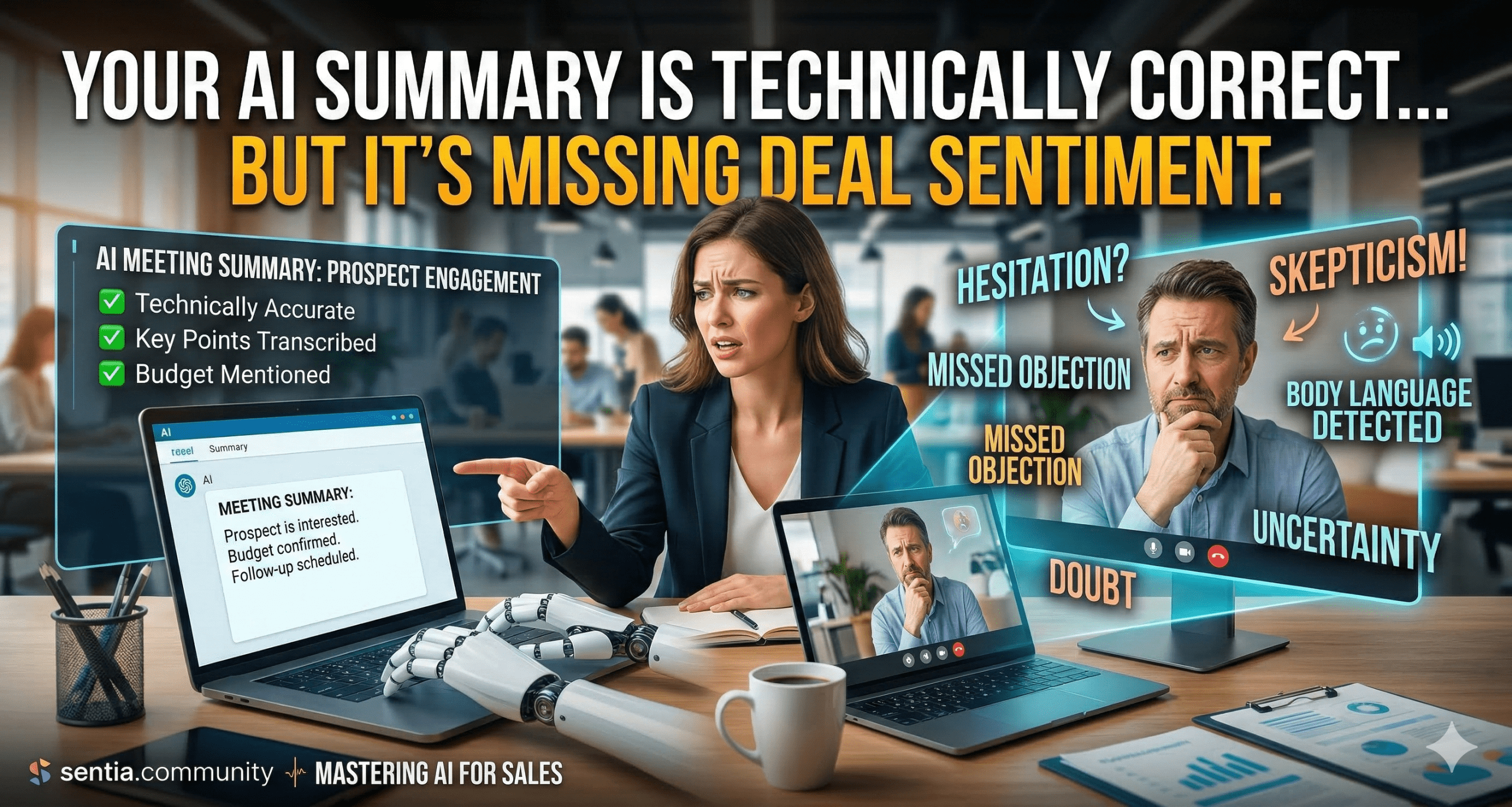
Is the Call Transcript enough in the age of AI?
AI call analysis tools have revolutionized how sales teams process conversations, automatically transcribing dialogue and generating summaries. However, relying solely on these transcripts often leads to a critical oversight: the nuance gap.
This gap represents the missing contextual intelligence—like tone, hesitation, and unspoken objections—that human sales professionals intuitively grasp but AI struggles to codify into CRM. This article introduces a 3-Layer Context Preservation Framework designed to bridge this gap, transforming raw transcripts into actionable, nuance-rich CRM data.
What Is the Nuance Gap? Understanding Context Loss in AI Transcription
The nuance gap is the critical difference between what was explicitly said in a sales conversation and what was truly meant, encompassing intent, emotion, and urgency. While AI transcription tools boast high accuracy, often reaching 90-95% under optimal conditions per PBX.IM’s 2026 comparison, they frequently miss subtle cues.
For instance, a buyer’s prolonged silence or a specific inflection might signal hesitation or an unspoken objection, which a factual transcript cannot convey. This context loss matters significantly because downstream teams make decisions based on incomplete CRM data, leading to mistimed outreach and lost opportunities. In fact, 80% of CRM data is inaccurate, with 70% of revenue leaders lacking confidence in their records due to such gaps according to Prospeo.io.

The 3-Layer Context Preservation Framework
Solving the nuance gap requires a structured approach to capture contextual information that AI transcription alone misses. This 3-Layer Context Preservation Framework systematically enriches CRM data with critical human-observed insights.
- Layer 1: Sentiment Tagging Beyond Positive/Negative This layer focuses on granular emotional and motivational signals that go beyond basic sentiment analysis. While AI platforms like Gong can achieve 92% accuracy in multi-emotion detection as noted by Cirrus Insight, human input refines these tags.
- Urgency Signals: Is the prospect casually exploring or facing a hard deadline?
- Confidence Levels: How assured is the prospect in their decisions or stated needs?
- Decision-Maker Engagement Patterns: Are key stakeholders actively participating or passively listening?
- Layer 2: Relationship Metadata This layer captures the qualitative aspects of the human connection built during the call. While AI can analyze talk-time ratios, humans interpret rapport.
- Rapport Indicators: What was the overall chemistry? Was there mutual trust and understanding?
- Communication Style Preferences: Does the prospect prefer directness, detailed explanations, or high-level summaries?
- Stakeholder Dynamics: Who holds influence? Are there unspoken tensions or alliances within the buying committee?
- Layer 3: Strategic Context Flags This layer identifies implicit strategic information that might not be explicitly stated but is crucial for deal progression. This involves interpreting subtle cues related to the broader business landscape.
- Competitive Mentions: Were competitors alluded to, even indirectly? What was the prospect’s reaction?
- Budget Signals: Did the prospect hint at budget constraints or flexibility without explicitly stating numbers?
- Timeline Pressure Points: Are there external market factors or internal initiatives driving the timing of their decision?

Practical Implementation: Bridging Your AI Tool and CRM
Successfully bridging the gap between AI call analysis and your CRM requires a methodical approach to integrate the 3-Layer Context Preservation Framework. Begin by auditing your current AI transcription output.
Identify what context is already captured versus what’s missing, recognizing that AI-powered data automation can increase data accuracy by 50% according to TheCrunch.io.
- Custom Prompt Engineering for Nuance Extraction: Develop tailored prompts for your AI tool to extract nuance-rich summaries, not just factual recaps. For example, instruct the AI to identify instances of hesitation, rapport-building attempts, or competitive mentions. Prompt engineering can boost response accuracy by 30% when contextual details are added.
- CRM Field Mapping for Context Layers: Create custom fields in your CRM that correspond to the three context layers. This allows for structured data entry and analysis. Companies implementing AI-enriched CRMs report a 30% increase in revenue by using well-structured custom fields for real-time data unification.
- Training Sales Teams on Validation and Enrichment: Train your sales team to validate and enrich AI-generated updates with their human observations. This ensures critical nuance is captured without overburdening reps, who already spend 19% of their time updating CRM systems per Email Vendor Selection’s 2026 data.
AI Call Analysis Platforms: Nuance Capture Capabilities Comparison
Choosing the right AI call analysis platform is crucial for minimizing context loss and effectively capturing conversational nuance. The table below compares leading platforms based on their ability to detect subtle cues and integrate them into CRM workflows.
| Platform | Sentiment Detection Depth | Custom Context Extraction | CRM Integration Quality | Validation Workflow |
|---|---|---|---|---|
| Gong | 92% multi-emotion accuracy; real-time shifts | High; custom trackers for buyer intent, risk signals | Excellent; native integrations with Salesforce, HubSpot | AI-generated summaries with human edit/validation fields |
| Chorus.ai | Strong; emotion, tone, talk-to-listen ratio | High; auto-identifies objections, competitor mentions | Excellent; deep integrations with major CRMs | Review and edit AI-generated insights, coaching feedback loops |
| Clari Copilot | Good; sentiment analysis, engagement scores | Moderate; customizable topics for specific insights | Good; direct sync with Salesforce, other CRMs | AI-suggested CRM updates with rep approval |
| Avoma | Basic; positive/negative sentiment, key moments | Moderate; custom topics and keyword tracking | Good; integrates with Salesforce, Pipedrive, HubSpot | Collaborative note-taking, one-click CRM updates |
| Fireflies.ai | Basic; overall sentiment, speaker diarization | Limited; keyword spotting, custom topics | Good; direct integrations with CRMs and communication tools | Manual review of transcripts, AI summary editing |
| Custom GPT-4 Implementation | Highly customizable via prompt engineering | Very high; depends entirely on prompt design | Variable; requires custom API development | Prompt-driven extraction with human review and fine-tuning |
For enterprise-level nuance capture, platforms like Gong and Chorus.ai lead with their advanced capabilities and deep CRM integrations. However, a custom GPT-4 implementation offers unparalleled flexibility for organizations with specific niche requirements.

Case Study: How a 75-Person Sales Org Reduced Context Loss by 64%
A B2B SaaS company with a 75-person sales organization faced significant challenges with its AI call analysis tool. While the tool provided factually accurate transcripts and summaries, 23% of follow-ups were mistimed or off-message due to a lack of deeper conversational context. Sales leaders observed that their forecast accuracy was only 67%, well below the median B2B accuracy of 70-79%.
The organization implemented the 3-Layer Context Preservation Framework. They introduced custom CRM fields such as “Buyer Urgency Score,” “Relationship Temperature,” and “Competitive Pressure Mentioned.” They also developed custom prompts for their existing AI tool, instructing it to specifically flag these nuances for rep review.
After six months, the results were transformative. The company saw a 64% reduction in ‘context loss incidents,’ defined as instances where a rep or manager identified critical missing nuance in CRM updates. This led to an 18% improvement in meeting-to-opportunity conversion rates, and a 12-hour per week saving in manual CRM updates across the team. Their forecast accuracy improved from 67% to 94%, demonstrating the direct impact of better data quality.

Common Pitfalls and How to Avoid Them
Implementing a nuance preservation framework comes with potential challenges that, if unaddressed, can undermine its effectiveness. Sales leaders must proactively mitigate these risks to ensure successful adoption and tangible results.
- Over-engineering: Creating too many custom fields can lead to rep fatigue and inconsistent data entry. Sales reps already spend 27.3% of their time on administrative tasks per Digital DI Consultants. Avoid this by starting with a minimal set of high-impact fields and iterating based on feedback.
- Under-prompting: Not giving your AI tool enough guidance on what nuance to extract results in generic outputs. Craft specific, detailed prompts that explicitly ask for the contextual information you need. Adding contextual details to prompts boosts accuracy by 30%.
- Validation Gaps: Assuming AI accuracy without human spot-checks, especially in the initial 60 days, can perpetuate errors. Implement a regular audit process where reps or managers review a sample of AI-generated summaries against actual call recordings to ensure nuance is being captured.
- Integration Friction: Failing to test the full workflow from call end to CRM update visibility can lead to broken processes. Ensure seamless data flow and user experience by conducting end-to-end testing with a small pilot group before a full rollout.

best practices for integrating AI into your CRM.
unleashing AI-driven workflows in CRM.
AI-powered data hygiene in CRM.
Key Takeaways
- The nuance gap is the critical context lost between AI transcription and CRM documentation, impacting deal progression.
- The 3-Layer Context Preservation Framework (sentiment, relationship, strategic context) helps systematically capture this missing nuance.
- Custom prompt engineering and targeted CRM field mapping are essential for implementation.
- Human validation and enrichment of AI-generated data are crucial for maintaining accuracy and relevance.
- Avoiding pitfalls like over-engineering and under-prompting ensures successful adoption and ROI.
- Proactive implementation can lead to significant improvements in conversion rates and forecast accuracy.
Conclusion: From Transcripts to True Understanding
The nuance gap in AI CRM isn’t a technology problem; it’s a workflow design challenge that demands intentional context preservation. While AI call analysis tools offer immense efficiency, their value is maximized when augmented with a framework that explicitly captures the subtle human elements of sales conversations.
The 3-Layer Context Preservation Framework provides a repeatable methodology for any B2B sales team to transform generic AI transcripts into rich, actionable CRM data. By systematically addressing sentiment, relationship dynamics, and strategic context, organizations can achieve a deeper understanding of their customer interactions. The next steps involve auditing your current nuance gap, implementing one layer at a time, and meticulously measuring the reduction in context loss over 30-day sprints to unlock tangible improvements in sales performance.
Frequently Asked Questions
What is the nuance gap in AI-generated CRM updates?
The nuance gap is the loss of critical context and subtext when AI transcription tools convert sales conversations into CRM summaries. This includes elements like tone, hesitation, relationship dynamics, and unspoken concerns that human reps naturally pick up but automated systems often miss. Explore top use cases for AI-enhanced CRM software.
How do I know if my sales team is experiencing nuance gap problems?
You can identify nuance gap problems through several signals, including mistimed follow-ups, reps complaining that CRM notes don’t capture the full conversation, downstream teams requesting call recordings instead of trusting summaries, and deals stalling due to miscommunications based on incomplete CRM data.
Can AI tools actually capture conversational nuance or is human input always required?
Current AI tools can capture some conversational nuance, especially with proper prompting and configuration, but human validation and refinement remain critical. AI can handle 70-80% of the data capture, with human input essential for high-stakes context and complex interpretations.
What CRM fields should I create to capture nuance from AI call analysis?
To capture nuance, create CRM fields such as “Buyer Urgency Score” (e.g., High, Medium, Low), “Relationship Temperature” (e.g., Warm, Neutral, Cold), “Competitive Pressure Mentioned,” “Unspoken Objection Noted,” “Decision Maker Engagement,” “Communication Style Preference,” and “Budget Flexibility Indicator.”
How much time does implementing a nuance preservation framework take?
Implementing a nuance preservation framework typically takes 8-12 weeks to full adoption. This includes 1-2 weeks for initial audit and field setup, 2-3 weeks for prompt engineering and testing, and 4-6 weeks for comprehensive team training and ongoing validation.
Which AI call analysis platform is best for minimizing context loss?
The “best” AI call analysis platform depends on your existing CRM, team size, and specific customization needs. Platforms like Gong and Chorus.ai offer advanced nuance detection and deep CRM integrations, while a custom GPT-4 implementation provides high flexibility for niche requirements, as shown in our comparison table.
How do I get my sales team to actually enrich AI-generated CRM updates?
To encourage enrichment, make the validation process fast (under 2 minutes per call), demonstrate how better context directly benefits reps in closing deals, integrate validation into existing deal review workflows, and celebrate successes where nuance preservation directly led to positive outcomes.
What’s the ROI of solving the nuance gap in CRM data?
Solving the nuance gap offers significant ROI, including improved conversion rates (e.g., 18% in our case study), reduced mistimed outreach, substantial time savings from manual updates (12 hours/week), and better forecast accuracy (from 67% to 94% in our case study), leading to both efficiency and effectiveness gains.
Can I use ChatGPT or Claude to extract nuance from call transcripts?
Yes, general Large Language Models (LLMs) like ChatGPT or Claude can be used to extract nuance from call transcripts with proper prompt engineering. However, they may lack sales-specific training and direct CRM integration, making them more suitable for small teams or pilot testing before investing in specialized tools. Explore the evolving role of AI in CRM.
How often should I audit AI-generated CRM updates for context loss?
You should conduct weekly spot-checks of AI-generated CRM updates for the first 60 days post-implementation. Afterward, transition to monthly audits of 10-15 random calls to ensure sustained accuracy and identify any new patterns of context loss, measuring improvement against your initial baseline.
Key Terms Glossary
Nuance Gap: The discrepancy between the explicit content of a conversation captured by AI and the implicit context, emotion, or intent understood by a human.
Context Preservation Framework: A structured methodology for systematically capturing and integrating qualitative conversational data into CRM beyond basic AI transcription.
Sentiment Tagging: The process of assigning specific emotional or motivational labels to parts of a conversation, extending beyond simple positive or negative classifications.
Relationship Metadata: Data points that describe the quality, dynamics, and preferences within a professional interaction, such as rapport or communication style.
Strategic Context Flags: Indicators within CRM that capture implicit strategic information from conversations, such as competitive pressures or subtle budget signals.
Prompt Engineering: The art and science of crafting effective inputs for AI models to guide their output towards desired, specific, and nuanced results.
CRM Field Mapping: The process of aligning data from various sources (like AI call analysis) to specific fields within a Customer Relationship Management system.
Validation Workflow: A structured process for human review and correction of AI-generated data to ensure accuracy and capture missing contextual information.


