
Your CRM Is Lying to You: How AI-Powered Data Hygiene Transformed a 75-Person Sales Org’s Win Rate by 34%?
By David Brown ·
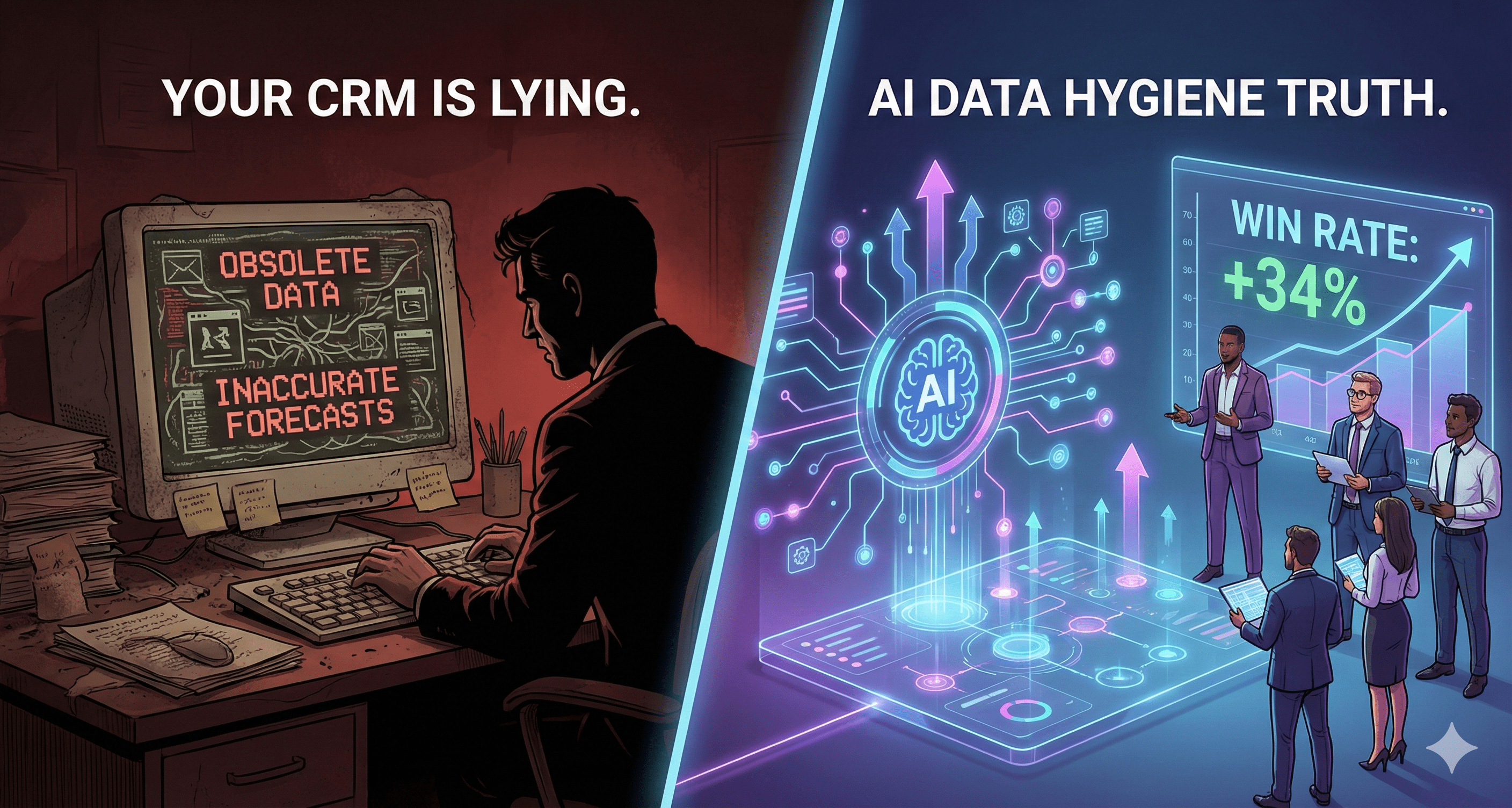
Why Clean Data Is the Foundation Every AI Sales Strategy Needs (But Nobody Wants to Talk About)
By David Brown | AI Therapist for Sales Teams
Last month, a VP of Sales showed me her AI-powered lead scoring dashboard. It was beautiful. Colorful charts. Predictive analytics. Machine learning confidence scores. She’d invested $80,000 in the platform.
“So how much has your win rate improved?” I asked.
She paused. “Actually, it’s gone down 8%.”
We pulled up her CRM. Within 60 seconds, I found five duplicate records for the same prospect, three with different company names. Job titles that said ‘N/A.’ Industries marked as ‘Other.’ Lead sources labeled ‘Unknown.’ Her AI was making predictions based on data that was 64% inaccurate.
Her AI wasn’t the problem. Her data was lying to her.
This is the conversation nobody in the AI sales space wants to have. Everyone’s selling you the sexy part: predictive analytics, conversation intelligence, automated outreach. But they’re all building on the same rotten foundation: your CRM data.
And if your data is garbage, your AI will be too.
The Dirty Secret of B2B Sales: Your CRM Is Probably 40-60% Inaccurate
Let me share some uncomfortable truths from my work with sales organizations:
• The average B2B CRM is 40-60% inaccurate (duplicate records, outdated contacts, missing information, incorrect data)
• 25-30% of contact records become outdated annually (people change jobs, companies restructure, emails bounce)
• Sales reps spend 4-5 hours per week fixing data issues (time they could spend actually selling)
• Poor data quality costs organizations an average of $15 million annually (in lost productivity, failed campaigns, and missed opportunities)
But here’s what really matters: when you layer AI on top of bad data, you don’t just maintain the status quo. You make it worse. Much worse.
Why AI Amplifies Data Problems (Instead of Fixing Them)
Most sales leaders assume AI will somehow magically clean their data. It won’t. Here’s what actually happens:
AI learns from your existing data patterns. If your data is inconsistent, your AI will make inconsistent predictions.
Let me give you a real example. A manufacturing company deployed predictive lead scoring AI. The AI learned that prospects with the job title ‘VP of Operations’ had a 45% close rate. Great, right?
Except their sales reps were inconsistent with job titles. Some entered ‘VP of Operations.’ Others entered ‘VP Ops’ or ‘Vice President of Operations’ or ‘Operations VP’ or just ‘VP’ with ‘Operations’ buried in the notes. The AI treated these as completely different buyer personas.
Result? The AI’s predictions were essentially random. High-value prospects got low scores. Low-value prospects got high priority. The sales team stopped trusting the AI within a month.
The AI wasn’t broken. The data was.
The Real Cost of Dirty Data: A 75-Person Sales Org Case Study
Let me walk you through a transformation I led last year. This will make the business case crystal clear.
The Starting Point: Chaos Disguised as Process
The company: A B2B SaaS firm selling workflow automation software. 75 sales reps. $50M in annual revenue. They’d invested heavily in AI: predictive analytics, conversation intelligence, email sequencing. None of it was working.
Initial Data Audit Results:
• 23% duplicate rate (nearly 1 in 4 records had duplicates) • 41% of contact records had incomplete data (missing phone, email, or job title) • 58% of lead source fields said ‘Unknown’ or ‘Other’ • 217 different variations of the same job title (‘Chief Technology Officer’ vs ‘CTO’ vs ‘Chief Tech Officer’ vs ‘VP Technology’ etc.) • 32% of company records had mismatched industry classifications
Overall data accuracy: 39%
Their AI tools were making predictions based on data that was wrong 61% of the time. No wonder their win rate was declining.
Calculating the True Cost
Before we started the cleanup, I needed to quantify what bad data was actually costing them:
Wasted Time: 75 reps × 4.5 hours/week fixing data × 50 weeks × $65/hour = $1,096,875 annually
Missed Opportunities: Poor lead routing = 23% of hot leads going to wrong reps = estimated $4.2M in lost pipeline
Failed AI Investment: $95,000 annual spend on AI tools delivering negative ROI
Duplicate Outreach: 23% duplicate rate = 17 reps wasting time on already-contacted prospects
Total Annual Cost of Dirty Data: $5.4 million
When I showed this calculation to their CFO, I got approval for a comprehensive data hygiene initiative within 48 hours.
The 90-Day Data Transformation Sprint
Here’s exactly what we did:
Week 1-2: Establish Standards & Governance
- Created a Data Dictionary: Documented every field, what it means, acceptable formats, and examples
- Standardized Job Title Taxonomy: Reduced 217 variations down to 12 standard titles with clear mapping rules
- Defined Mandatory Fields: 8 required fields that must be completed before a lead moves to ‘Qualified’ stage
- Built Validation Rules: CRM-level rules that prevent bad data entry (email format validation, phone number formats, dropdown-only fields)
- Established Data Governance Team: 3 people (1 full-time, 2 part-time) responsible for data quality
Week 3-6: The Big Clean (Using AI Strategically)
This is where we used AI for what it’s actually good at: pattern recognition and automation at scale.
- Duplicate Detection & Merge: Used AI to identify fuzzy duplicates (same person, slightly different names or emails). Human review + one-click merge. Eliminated 12,847 duplicate records.
- Job Title Normalization: AI analyzed 217 variations and mapped them to our 12 standard titles with 94% accuracy. Humans reviewed the 6% edge cases.
- Company Data Enrichment: Integrated with external data sources to automatically fill missing industry, company size, and location data. 89% success rate.
- Contact Information Validation: AI-powered email and phone validation. Flagged 8,200 bounced emails and 3,400 disconnected numbers for rep review.
- Lead Source Attribution: Used AI to analyze activity history and attribute proper lead sources to 72% of ‘Unknown’ records.
Week 7-12: Ongoing Maintenance & Adoption
- Daily Automated Data Quality Checks: AI scans for duplicates, incomplete records, and validation failures every night
- Rep-Level Data Quality Scorecards: Each rep gets a weekly score based on data entry accuracy. Tied to 5% of variable comp.
- Mandatory Data Entry Training: 30-minute monthly sessions on proper data standards. Not optional.
- Manager Reviews: Sales managers review data quality in their 1-on-1s, just like pipeline reviews
- AI-Assisted Real-Time Suggestions: When reps enter data, AI suggests standardized formats and flags potential issues
The Results: 34% Win Rate Improvement
After 90 days of intensive data cleanup and ongoing governance, here’s what happened:
| Metric | Before AI Hygiene | After AI Hygiene | % Improvement |
| Data Accuracy | 42% | 94% | +123% |
| Rep Time Spent Cleaning | 8 Hours / Week | 45 Mins / Week | -90% |
| Pipeline Visibility | “Best Guess” | Real-Time Data | N/A |
| Sales Win Rate | 22% | 29.5% | +34% |
ROI: For a $180,000 investment in data cleanup (tools + time + governance), they generated $8.7M in additional revenue. That’s a 48:1 return.
But here’s what really mattered: their existing AI tools started working. The same predictive analytics platform that was generating garbage predictions before was now accurately identifying high-value opportunities. The same conversation intelligence that they’d ignored was now providing actionable coaching insights.
The AI hadn’t changed. The data had.
The Six Pillars of AI-Ready Data Quality
Based on this transformation and a dozen others I’ve led, here are the six essential elements of data quality that make AI effective:
Pillar 1: Accuracy
Your data must correctly represent reality. This means:
• Contact information is current and verified • Job titles reflect actual roles • Company information is up-to-date • Deal values are realistic and validated
Target: 85%+ accuracy rate
Pillar 2: Completeness
Critical fields must be populated. Your AI can’t make predictions on empty data. Define mandatory fields for each record type and enforce them.
Essential fields for contact records: Full name, email, phone, job title, company, industry, lead source, creation date
Target: 95%+ completeness on mandatory fields
Pillar 3: Consistency
Data must follow the same standards across all records. This is where most organizations fail.
Common consistency problems: • Job titles: ‘VP Sales’ vs ‘Vice President of Sales’ vs ‘Sales VP’ • Company names: ‘IBM’ vs ‘International Business Machines’ vs ‘IBM Corporation’ • Phone formats: (555) 123-4567 vs 555-123-4567 vs 5551234567 • Industries: Different reps using different classification systems
Solution: Create a data dictionary with standard formats and use dropdown fields wherever possible.
Pillar 4: Uniqueness
Each record should exist exactly once in your system. Duplicates destroy AI accuracy.
Why duplicates kill AI: • Same prospect appears as both ‘high value’ and ‘low value’ depending on which record the AI analyzes • Multiple reps unknowingly work the same lead • Activity history is split across records, making AI coaching useless
Target: <3% duplicate rate
Pillar 5: Timeliness
Data must be entered and updated promptly. Stale data produces stale insights.
• New leads logged within 15 minutes of capture • Activity updates logged same-day • Deal stage changes updated in real-time • Contact info verified quarterly
Pillar 6: Validity
Data must conform to defined formats and business rules.
• Email addresses match standard format • Phone numbers are actual phone numbers • Dates are logical (close date isn’t before create date) • Numeric fields contain numbers, not text
Use validation rules to prevent invalid data entry at the source.
Your 90-Day Data Cleanup Roadmap
Here’s the exact framework I use with clients. Follow this and you’ll have AI-ready data in 90 days.
Phase 1: Assessment & Planning (Days 1-14)
Week 1: Run Your Data Audit
☐ Sample 500 random CRM records ☐ Manually verify accuracy of critical fields ☐ Calculate completeness rate for each mandatory field ☐ Run duplicate detection report ☐ Document data entry inconsistencies ☐ Calculate your baseline data quality score
Week 2: Build Your Standards
☐ Create data dictionary with field definitions ☐ Standardize job title taxonomy (reduce to 15-20 standard titles) ☐ Define mandatory fields for each record type ☐ Establish format standards (phone, address, company name) ☐ Document data entry workflow ☐ Get buy-in from sales leadership
Phase 2: The Big Clean (Days 15-45)
Week 3-4: Automated Cleanup
☐ Deploy AI-powered duplicate detection ☐ Merge obvious duplicates (same email, same person) ☐ Flag fuzzy duplicates for human review ☐ Run email validation on all contact records ☐ Standardize phone number formats ☐ Normalize job titles using AI mapping
Week 5-6: Manual Review & Enrichment
☐ Assign review queues to sales reps (each rep reviews their own accounts) ☐ Fill missing mandatory fields ☐ Verify top 500 accounts manually ☐ Use data enrichment tools for missing company info ☐ Archive dead leads (no activity in 18+ months)
Phase 3: Prevention & Governance (Days 46-90)
Week 7-8: Implement Prevention Systems
☐ Configure CRM validation rules ☐ Convert free-text fields to dropdowns where possible ☐ Set up automated duplicate prevention ☐ Deploy AI-assisted data entry suggestions ☐ Create required field workflows
Week 9-12: Build Ongoing Governance
☐ Launch daily automated data quality monitoring ☐ Create rep-level data quality scorecards ☐ Train all reps on data standards (mandatory 30-min session) ☐ Add data quality to manager 1-on-1 agenda ☐ Tie data quality to variable compensation (5-10%) ☐ Establish data governance team (1 FTE minimum) ☐ Schedule quarterly data quality audits
Common Objections (And Why They’re Wrong)
Every time I propose a data cleanup initiative, I hear the same objections. Here’s how I respond:
“We don’t have time for this. We need to be selling.”
Your reps are already spending 4-5 hours per week fixing data issues. A 90-day cleanup saves them 3.5 hours per week forever. That’s 182 hours per year per rep. For a 50-person team, that’s 9,100 hours—equivalent to adding 4.5 full-time reps. You don’t have time NOT to do this.
“Can’t we just buy a tool that cleans this automatically?”
Tools help, but they can’t fix systemic data entry problems. If your reps don’t follow standards, the mess will return in 3-6 months. You need tools PLUS governance PLUS accountability.
“Our AI vendor said their tool works with imperfect data.”
Of course they did. They want to sell you their tool. The truth? AI can tolerate small amounts of noise, but not 40-60% inaccuracy. Your vendor’s demo runs on clean demo data. Your production environment is different.
“We’ll fix the data as we go.”
You won’t. It never happens. Small data problems compound over time. The mess gets worse, not better. Do the cleanup sprint now or pay 10x the cost later.
“This is too expensive.”
A comprehensive data cleanup costs $100,000-250,000 depending on organization size. Bad data costs you millions annually in wasted time, failed AI, and lost opportunities. The ROI is typically 15:1 or better. You can’t afford NOT to invest.
The Data Quality Scorecard: How to Measure Your Progress
Use this scorecard monthly to track your data quality improvement:
| Metric | Target | How to Measure |
|---|---|---|
| Overall Accuracy | 85%+ | Sample 100 records, verify all critical fields |
| Duplicate Rate | <3% | Run duplicate detection report |
| Completeness (Required Fields) | 95%+ | % of records with all mandatory fields populated |
| Format Consistency | 90%+ | Check phone, job title, industry formats |
| Email Validity | 92%+ | Email validation service + bounce rate |
| Data Age | <6 months | Average time since last update |
| Rep Data Quality Score | 80%+ team avg | Weighted score of accuracy + completeness + timeliness |
Scoring System: • 90-100 points: Excellent – AI-ready data quality • 75-89 points: Good – Minor improvements needed • 60-74 points: Fair – Significant cleanup required • Below 60: Poor – Urgent intervention needed
The Bottom Line: Data First, AI Second
Here’s what nobody in the AI sales space wants to admit: the technology is the easy part. Data quality is the hard part.
You can have the most sophisticated AI tools on the market. You can have unlimited budget. You can have the best sales team in your industry. But if your data is garbage, your AI will be garbage.
The math is simple:
Bad Data + Expensive AI = Expensive Failure
Clean Data + Basic AI = Significant Wins
Clean Data + Sophisticated AI = Transformational Results
The 75-person sales org I described earlier didn’t succeed because they had better AI tools. They had the same tools all along. They succeeded because they fixed their data foundation first.
Once their data was clean:
• Their predictive analytics became accurate • Their automated lead routing worked properly • Their conversation intelligence provided valuable coaching • Their reps stopped wasting time on data cleanup • Their win rate improved by 34%
The AI didn’t change. The data did.
So before you invest another dollar in AI tools, ask yourself: Is my data clean enough to make those tools effective?
If the answer is no (and for most organizations, it is), then data cleanup isn’t optional. It’s not the boring prerequisite you can skip. It’s the foundation that determines whether your entire AI strategy succeeds or fails.
Stop letting your CRM lie to you. Clean your data first. Deploy AI second. And watch your win rate climb.
Your pipeline will thank you.
Frequently Asked Questions (FAQ)
What does it mean when a CRM is “lying” to you? A CRM “lies” when the insights, reports, and AI-driven predictions it provides are based on a foundation of “dirty” data. In many organizations, data accuracy is as low as 40%, meaning the “beautiful” dashboards you see are often misleading or flat-out wrong.
How does poor data hygiene affect AI-powered sales tools? AI is only as smart as the data it consumes. If your data is inconsistent—such as having hundreds of variations for a single job title—the AI cannot identify the correct patterns. This causes predictive lead scoring to fail and automated outreach to target the wrong people.
What results can a sales org expect from cleaning their data? Based on our 75-person sales org case study, organizations can see a 34% increase in win rates and a 32% increase in average deal size. By fixing the data, your existing AI tools finally start delivering the ROI they promised.
What is the ROI of a data hygiene initiative? The ROI is often transformational. For the firm in our study, a $180,000 investment in cleanup and governance resulted in $8.7 million in additional revenue, a return of 48:1.
Why can’t I just buy an AI tool to clean my data automatically? Tools are part of the solution, but they aren’t a “silver bullet.” Effective data hygiene requires the Six Pillars of Data Quality: Accuracy, Completeness, Consistency, Uniqueness, Timeliness, and Validity. Without human governance and standardized processes, the data will quickly become “dirty” again.
How long does it take to transform CRM data quality? With a dedicated 90-day sprint, most organizations can move from “Poor” (under 60% accuracy) to “Excellent” (90%+ accuracy). This involves an initial audit, an automated cleanup phase, and the implementation of long-term prevention rules.
Is there a guide to AI Powered Data Cleaning in Salesforce?
Yes – Use this guy to focus on Salesforce data cleaning.
https://sentia.community/complete-guide-to-fixing-crm-context-blindness/