The AI Divide Is Coming for Fractional Professionals
By David Brown ·
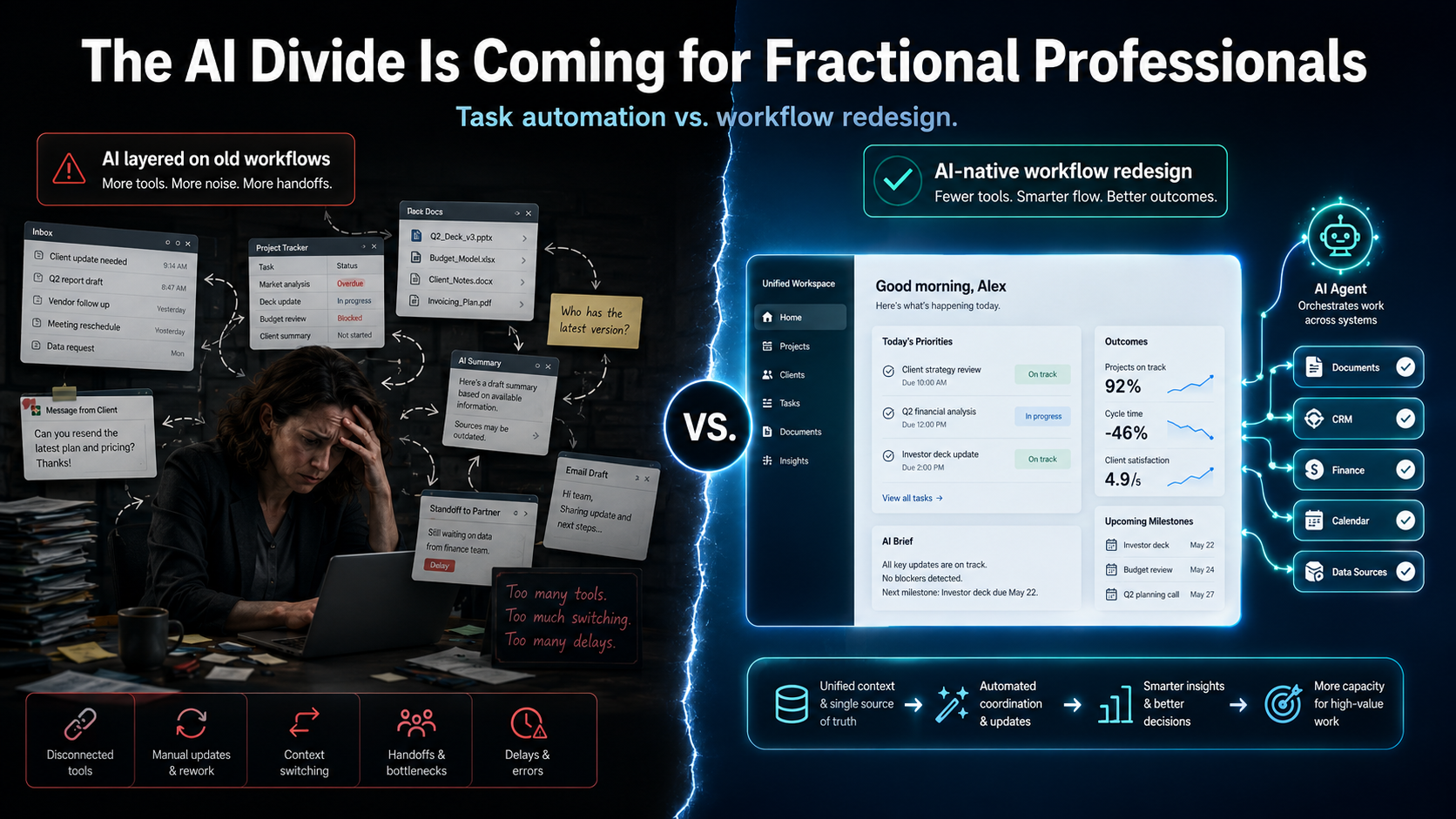
Some will use AI to complete some work faster. Others will redesign how their entire practice operates. Who will be the winner?
Artificial intelligence is creating two very different operating models for fractional professionals.
In an AI-assisted practice, AI helps complete individual tasks such as writing emails, summarizing meetings, conducting research, and preparing presentations.
In an AI-native practice, the work itself is redesigned. AI helps preserve client context, coordinate steps, prepare decisions, maintain records, and move activity from information to action.
The competitive advantage will not come from using the most AI tools. It will come from reducing unnecessary work while protecting the human judgment, accountability, and relationships clients genuinely value.
The divide is not between AI users and nonusers
AI adoption is quickly becoming normal.
The 2026 Stanford AI Index Report found that 88% of surveyed organizations used AI in at least one business function in 2025, up from 78% in 2024. Generative AI was being used in at least one function by 70% of organizations.
AI usage alone is therefore unlikely to remain a meaningful competitive differentiator.
The more important question is how that AI is being used.
One professional may use AI to write an email faster. Another may redesign the client follow-up process so the system recognizes when follow-up is required, assembles the necessary context, prepares the communication, updates the relevant records, and tracks the next commitment.
Both professionals are using AI.
Only one has changed how the work operates.
Why faster tasks do not create a better operating model
Most professional AI adoption begins with isolated tasks.
A fractional executive might use one AI tool to summarize a meeting, another to draft content, another to research a client, and another to create a presentation.
Each tool may save time. However, the professional remains responsible for connecting the outputs.
Consider the work surrounding a single client meeting.
The professional may still need to:
- Find the latest email conversation
- Review notes from previous meetings
- Check outstanding commitments
- Locate the current proposal or project plan
- Research recent developments
- Identify unresolved risks
- Prepare the agenda
- Create a meeting brief
- Record decisions afterward
- Assign and track action items
- Update client records
- Draft and send the follow-up
- Remember when to follow up again
AI might accelerate several of these activities without changing the workflow that connects them.
The professional is still acting as the integration layer between applications, information, decisions, and people.
This creates an AI productivity illusion. Individual tasks become faster, but the operating model remains fragmented.
Why fractional professionals face a larger context burden
Fractional executives, consultants, advisors, and independent specialists do not simply manage tasks. They manage context across multiple organizations.
Every client introduces a different collection of:
- Business objectives
- People and relationships
- Meetings and commitments
- Documents and systems
- Communication preferences
- Organizational dynamics
- Deadlines and deliverables
- Risks and opportunities
A full-time executive may spend years building an understanding of one organization.
A fractional executive may need to move between four or five organizations in one day and appear fully informed in every conversation.
Each transition requires the professional to reconstruct what is happening:
- What changed?
- What was promised?
- Who owns the next action?
- Which issue is becoming urgent?
- What does the client expect?
- Where is the relevant information?
- What should happen next?
This repeated reconstruction creates a context tax.
As the client portfolio expands, the context tax grows. Every additional engagement brings more relationships, meetings, files, messages, systems, and opportunities for something to be missed.
Traditional software provides places to store information. It rarely removes the professional’s responsibility for finding, connecting, interpreting, and acting on it.
AI-assisted work and AI-native work are different
Microsoft’s 2025 Work Trend Index describes a progression in which AI first assists people, then operates as a digital colleague, and eventually participates in end-to-end workflows under human direction.
A similar progression is emerging inside fractional and consulting practices.
| AI-assisted practice | AI-native practice |
|---|---|
| AI writes an email when prompted | AI recognizes that follow-up is needed, assembles context, prepares the message, and tracks the next action |
| AI summarizes a meeting | AI turns the meeting into decisions, actions, updates, risks, and follow-up |
| AI researches a client | AI continuously maintains relevant client and market context |
| AI creates a task list | AI connects tasks to owners, deadlines, commitments, and outcomes |
| AI helps update a CRM | Information is maintained as work happens |
| AI improves a report | AI assembles the latest information and prepares a decision-ready report |
| AI saves time on individual activities | AI reduces the number of activities the professional must coordinate |
| The professional moves information between systems | The workflow moves information to the right place |
| AI waits for instructions | AI prepares work and surfaces exceptions requiring judgment |
An AI-assisted practice helps the professional perform the same activities more quickly.
An AI-native practice asks whether all those activities should still exist in their current form.
Workflow redesign matters more than tool adoption
The largest gains from AI are unlikely to come from adding an AI feature to every application.
They will come from redesigning the way information, decisions, and actions move through the practice.
McKinsey’s research on how organizations are rewiring to capture value from AI found that workflow redesign had the largest effect among the organizational attributes associated with achieving EBIT impact from generative AI.
The same principle applies at a smaller scale.
A fractional professional does not need to transform an entire enterprise. But they can redesign a recurring workflow such as:
- New client onboarding
- Weekly client reporting
- Meeting preparation
- Meeting follow-up
- Lead qualification
- Proposal development
- Project status updates
- Renewal preparation
- Client risk monitoring
- Business development follow-up
The starting point should not be the capabilities of a particular tool.
The starting point should be the outcome the workflow must reliably produce.
Start with the outcome, not the application
A tool-first question sounds like this:
What can this AI product do?
That question usually creates a list of disconnected use cases.
- Write this
- Summarize that
- Research this company
- Improve this presentation
- Create these tasks
An outcome-first question is different:
What should happen from the moment this process begins until the desired result is achieved?
For example, the desired outcome might be:
Every important client meeting begins with complete context and ends with clear, documented, and tracked follow-through.
Once the outcome is defined, the professional can work backward.
1. Identify the trigger
What begins the workflow?
It might be a scheduled meeting, a new inquiry, a client response, a missed deadline, a project change, or an approaching renewal.
2. Identify the required context
What information is needed to understand the situation?
Where does that information currently live, and how often must someone manually retrieve it?
3. Separate judgment from coordination
Which decisions require expertise, experience, discretion, or relationship knowledge?
Which steps merely involve finding, formatting, moving, or recording information?
4. Remove unnecessary handoffs
Which steps exist only because applications or departments are disconnected?
Could the information move directly to the next stage without being manually copied or re-entered?
5. Define the actions
What should happen automatically once the situation is understood?
What should be prepared for review rather than completed automatically?
6. Define the exceptions
Which risks, ambiguities, or high-impact decisions must be escalated to the professional?
7. Define the measure of success
How will the professional know that the redesigned workflow is creating value?
Possible measures include response time, client capacity, consistency, project margin, retention, or time spent on high-value work.
The mapping problem
Selecting where AI should be applied is itself a strategic challenge.
Harvard Business School researchers describe this as the “mapping problem”: discovering where and how AI can create value inside a production process.
This is especially relevant to independent professionals.
The most visible AI use case is not always the most valuable one.
Writing a client email may be easy to automate, but the larger opportunity could be recognizing that the email is required, retrieving the relevant context, understanding the commitment behind it, and ensuring that the next action is not forgotten.
The value often exists between the tasks rather than inside one task.
Keep humans where judgment creates value
Workflow redesign does not mean removing people from every activity.
Fractional professionals are hired for:
- Judgment
- Experience
- Pattern recognition
- Influence
- Creativity
- Accountability
- Trust
- The ability to navigate uncertainty
Automating these responsibilities indiscriminately could reduce the value of the service.
The objective is to distinguish between work that requires professional judgment and work that merely consumes professional attention.
AI may be well suited to:
- Assembling information
- Monitoring changes
- Organizing context
- Preparing routine communications
- Maintaining records
- Identifying inconsistencies
- Tracking commitments
- Producing initial analyses
- Surfacing anomalies
- Preparing decision options
Human involvement becomes more important when work involves:
- Strategic trade-offs
- Sensitive client communication
- Ethical decisions
- Organizational politics
- High-impact recommendations
- Ambiguous information
- Relationship development
- Negotiation
- Accountability for consequences
The correct boundary will differ by profession, client, risk level, and situation.
The important point is that the boundary should be designed intentionally.
The professional should remain involved because their judgment adds value, not because an inefficient workflow requires them to manually touch every step.
One professional may begin to perform like a team
Fractional capacity has traditionally been constrained by personal time.
Adding another client usually means adding more meetings, preparation, administration, communication, and follow-up.
AI can change that equation when it reduces the coordination burden surrounding the work.
A Harvard Business School field experiment involving 776 professionals found that individuals using AI matched the performance of two-person teams without AI on the product innovation tasks studied.
This does not mean AI can replace every team or every form of collaboration.
It does suggest that an individual equipped with the right AI support can perform work that previously required more human capacity.
For fractional professionals, that could mean:
- Supporting more clients without reducing service quality
- Preparing more thoroughly for meetings
- Responding to issues more quickly
- Maintaining more consistent follow-through
- Reducing administrative support requirements
- Spending more time on judgment and less on coordination
- Turning personal expertise into a repeatable operating system
The advantage will not come from producing a greater volume of generic work.
It will come from increasing the percentage of time spent on work clients truly value.
Hours saved are not an operating strategy
Many AI business cases begin and end with time savings.
An activity previously took two hours. It now takes 30 minutes. AI has therefore saved 90 minutes.
But what happens to that time?
Does it create:
- Additional client capacity?
- Faster project delivery?
- Better analysis?
- More proactive advice?
- Stronger relationships?
- Lower operating costs?
- More business development?
- Better work-life boundaries?
Or does it simply disappear into another crowded day?
Time saved only becomes valuable when it is deliberately converted into a better operating result.
A professional should not measure AI success only by the number of tasks completed or hours saved.
They should measure whether the redesigned workflow improves something that matters.
| Weak AI metric | Stronger operating metric |
|---|---|
| Number of AI prompts | Percentage of workflow completed without manual coordination |
| Emails generated | Reduction in follow-up time |
| Meeting summaries created | Percentage of commitments accurately captured and completed |
| Hours theoretically saved | Additional high-value capacity created |
| Number of tools adopted | Reduction in applications manually opened per workflow |
| AI usage frequency | Improvement in client response, consistency, or margin |
| Tasks automated | Exceptions resolved without service failure |
A practical 30-day workflow redesign exercise
Fractional professionals do not need to redesign their entire practice at once.
One recurring workflow is enough to begin.
Week 1: Observe the current workflow
Select one frequent, time-consuming process.
Document:
- What triggers it
- Every step involved
- Every application opened
- Every handoff
- Every decision
- Every point where context is lost
- Every place information is manually copied
- The final outcome
Do not automate anything yet. First understand what is actually happening.
Week 2: Remove unnecessary work
Examine each step and ask:
- Does this step create client value?
- Does it require professional judgment?
- Does it exist because two systems are disconnected?
- Could it be removed?
- Could it happen automatically?
- Could it be prepared for review?
- What could go wrong if it were automated?
The goal is not to automate a bad process. It is to simplify the process before introducing automation.
Week 3: Design human and AI responsibilities
Assign every remaining step to one of three categories:
- AI can complete it
- AI can prepare it for human approval
- A human should complete it
Define the information AI needs, the actions it may take, the rules it must follow, and the situations it must escalate.
Week 4: Measure the operating result
Run the redesigned workflow and compare it with the original.
Measure:
- Total completion time
- Manual steps
- Applications opened
- Handoffs
- Errors or omissions
- Response speed
- Quality of the final result
- Time requiring professional judgment
- Client experience
The purpose is not to prove that AI was used.
The purpose is to determine whether the workflow became meaningfully better.
What an AI-native fractional practice looks like
An AI-native practice is not defined by the number of AI tools it owns.
It is defined by how consistently work moves from information to action.
In an AI-native practice:
- Client context is maintained instead of repeatedly reconstructed
- Meetings begin with relevant information already assembled
- Commitments become tracked actions
- Routine follow-up is prepared without being forgotten
- Records are updated as part of the workflow
- Risks are surfaced before they become emergencies
- Professionals spend more time on judgment and relationships
- Humans remain accountable for important decisions
- AI coordinates work without obscuring how decisions were made
- Capacity increases without allowing service quality to decline
This does not require complete autonomy.
It requires a deliberate operating model in which humans and AI each perform the work they are best suited to perform.
Frequently asked questions
What is AI-assisted work?
AI-assisted work uses artificial intelligence to help a person complete a specific task. Common examples include drafting an email, summarizing a meeting, researching a company, or improving a presentation. The person remains responsible for initiating, connecting, and coordinating the work.
What is an AI-native fractional practice?
An AI-native fractional practice is designed around AI-enabled workflows rather than isolated AI tasks. AI helps assemble context, coordinate steps, prepare actions, maintain records, and surface exceptions while the professional retains judgment and accountability.
How can AI help fractional professionals?
AI can help fractional professionals reduce context switching, prepare for client meetings, track commitments, organize information, monitor changes, produce initial analysis, prepare routine communication, and identify issues requiring attention.
Will AI replace fractional executives and consultants?
AI is more likely to change the composition of their work than eliminate the need for them. Routine coordination and information-processing activities may increasingly be automated, while judgment, trust, influence, accountability, and relationship management remain distinctly human responsibilities.
What workflow should a fractional professional redesign first?
The best starting point is a recurring, high-volume workflow with several manual steps or handoffs. Meeting preparation, meeting follow-up, weekly client reporting, lead qualification, client onboarding, and project status updates are strong candidates.
How should fractional professionals measure AI ROI?
AI ROI should be connected to operating results such as increased client capacity, faster response time, improved consistency, fewer missed commitments, higher project margins, stronger retention, and more time devoted to high-value professional judgment.
The coming divide
Some fractional professionals will continue adding AI features to a growing collection of applications.
They will write faster, summarize faster, research faster, and create more output. But they will remain responsible for connecting every task, system, and decision.
Others will redesign their practices around outcomes.
They will determine where AI should prepare, monitor, coordinate, and act. They will define where human judgment must remain central. Their workflows will preserve context, reduce unnecessary handoffs, and turn routine activity into connected execution.
Both groups may use AI every day.
But they will not have the same capacity.
They will not have the same economics.
They will not deliver the same client experience.
The most important question for a fractional professional is no longer:
How can I use AI to do my current work faster?
It is:
How would I design this work if today’s AI capabilities had existed from the beginning?