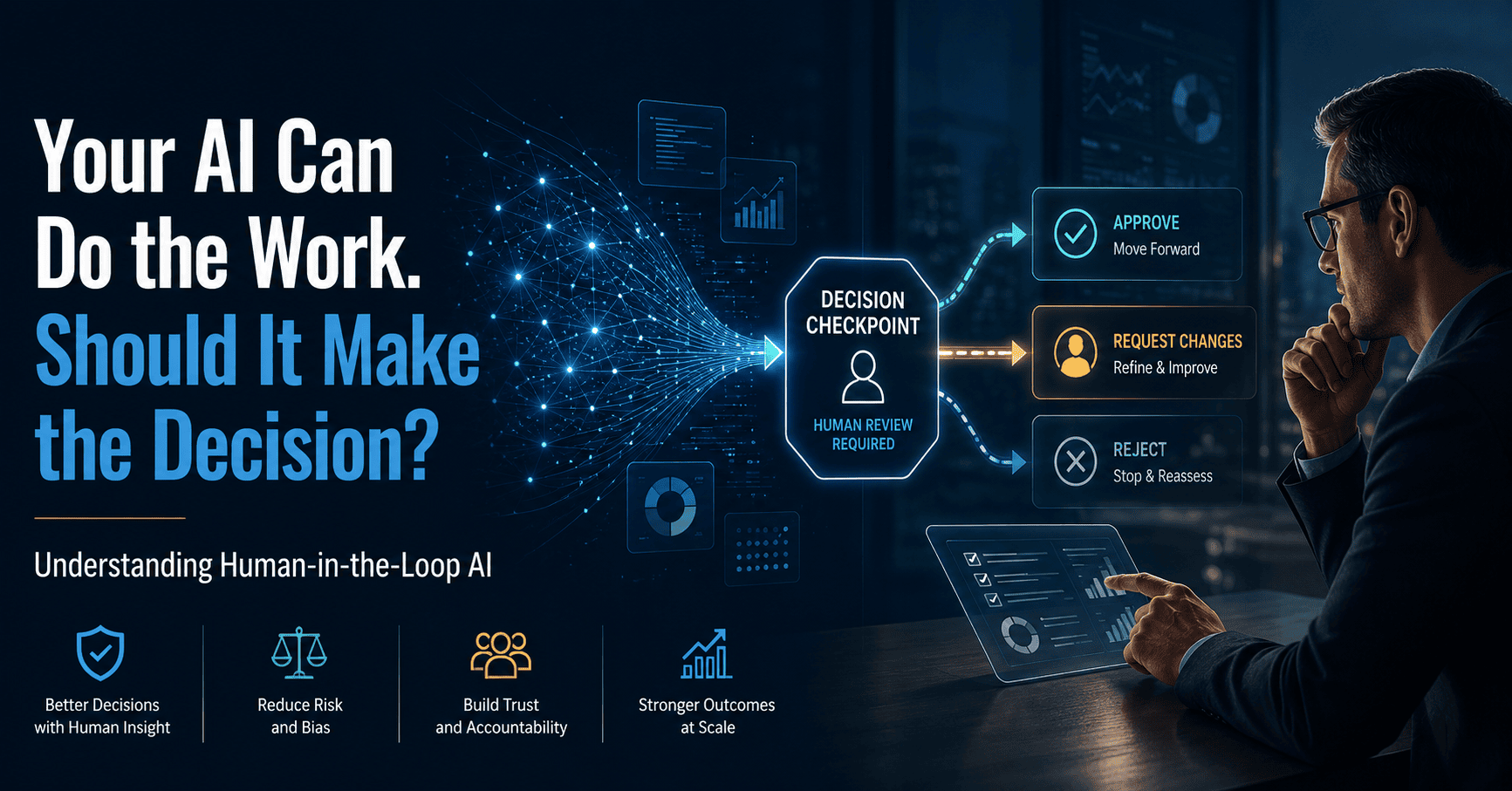
Your AI Can Do the Work. Should AI Also Make the Decisions For You?
By David Brown ·
Human in the Loop AI – Would you let AI run your business—or only the parts of it that do not require human judgment?
That question is becoming increasingly important as AI moves beyond writing content and answering questions. New AI systems can monitor business activity, analyze information, recommend actions, update records, contact customers, schedule meetings, prioritize opportunities, and complete entire workflows.
The technical ability to automate more work is advancing quickly.
But the fact that AI can perform an action does not necessarily mean it should be allowed to make the final decision.
For most businesses, the answer is not to choose between complete automation and complete human control. The better approach is to decide where AI should operate independently, where people should remain involved, and what should happen when the system is uncertain.
This is the idea behind human-in-the-loop AI.
Why Fully Autonomous AI Makes Business Leaders Nervous
The appeal of autonomous AI is easy to understand.
An AI system that can complete work without constant supervision promises faster execution, lower administrative costs, fewer repetitive tasks, and greater productivity. Instead of waiting for someone to review every email, update every record, or analyze every opportunity, the AI can keep work moving continuously.
The concern is that business decisions are rarely based on data alone.
A customer may appear inactive but still be strategically important. A sales opportunity may look weak in the system even though the account executive knows that the buyer is waiting for budget approval. A frustrated email may require empathy rather than an automated response. A recommendation that appears logical may conflict with a contractual commitment, a sensitive relationship, or information that was never recorded.
AI can process enormous amounts of information, but it may not always understand the complete situation.
That creates several risks:
- Acting on incomplete or incorrect information
- Misinterpreting tone, intent, or relationship history
- Making commitments the business cannot support
- Escalating minor issues unnecessarily
- Failing to recognize unusual circumstances
- Taking actions that are difficult to reverse
- Creating uncertainty about who is accountable
These risks do not mean businesses should avoid AI. They mean businesses need clear rules for when AI can act and when human judgment must remain part of the process.
What Human-in-the-Loop Actually Means
Human-in-the-loop, often shortened to HITL, is an approach in which AI performs part of a task or decision-making process while a person remains involved at specific points.
The AI may gather information, analyze a situation, recommend an action, or prepare the work. The human then reviews, approves, changes, rejects, or completes the decision.
For example, an AI system might:
- Prepare a customer follow-up for approval
- Identify an account that may be at risk
- Recommend changing a sales forecast
- Draft a proposal based on previous documents
- Flag an unusual expense
- Suggest the next priority for a team
- Summarize a meeting and propose follow-up actions
In each case, AI reduces the amount of work required from the person. However, the person remains responsible for the final judgment when the action is important, sensitive, uncertain, or difficult to reverse.
Human-in-the-loop does not mean a person must manually supervise every AI action.
The goal is not to turn automation into another approval queue. The goal is to involve people where their experience, authority, context, or accountability adds meaningful value.
A Simple Human-in-the-Loop Workflow
A practical human-in-the-loop process usually follows five stages.
1. The AI observes
The AI reviews the information available to it.
That information may include emails, meeting notes, customer records, tasks, documents, transactions, project updates, calendars, or other business activity.
2. The AI interprets
The system analyzes what is happening and attempts to determine what matters.
It may identify a risk, recognize missing information, detect a pattern, prioritize an opportunity, or predict what should happen next.
3. The AI prepares or performs an action
The AI may draft a response, update a record, recommend a decision, create a task, generate a report, or initiate a workflow.
Routine and low-risk actions may happen automatically. More consequential actions may be prepared but held for review.
4. A human reviews the decision
A person approves, edits, rejects, or replaces the AI’s proposed action.
The reviewer may add information the AI did not have, consider the relationship involved, or apply professional judgment that cannot be reduced to a simple rule.
5. The outcome improves the system
The correction or approval becomes useful feedback.
Over time, the system can learn which recommendations are accepted, which are regularly changed, what conditions require escalation, and where more context is needed.
The result should be a process in which AI becomes more useful without removing human accountability.
Human In, Human On, and Human Out of the Loop
Not every AI-enabled process requires the same degree of supervision.
A useful way to think about AI responsibility is to divide workflows into three categories.
Human in the loop
A person must review or approve the action before it happens.
This is appropriate when a decision has significant financial, legal, reputational, operational, or customer consequences.
Examples might include:
- Approving a contract
- Sending sensitive customer communication
- Changing an important revenue forecast
- Authorizing a large payment
- Making a hiring decision
- Providing regulated advice
- Committing to pricing or delivery terms
The AI supports the decision, but the person retains authority.
Human on the loop
The AI is allowed to operate, but a person monitors the process and can intervene.
This works when automation is generally reliable, actions are reasonably reversible, and exceptions can be detected quickly.
Examples might include:
- Updating routine customer records
- Assigning ordinary tasks
- Categorizing incoming requests
- Scheduling standard follow-ups
- Prioritizing low-risk work
- Monitoring project deadlines
The human does not approve every action but remains responsible for oversight.
Human out of the loop
The AI completes the process without routine human involvement.
This may be suitable for repetitive, low-risk, well-defined actions where the consequences of error are limited.
Examples might include:
- Formatting information
- Removing duplicate records
- Transcribing meetings
- Organizing files
- Creating internal reminders
- Generating routine summaries
- Synchronizing approved information between systems
Even in these cases, businesses should still monitor performance and maintain a way to correct mistakes.
The appropriate level of human involvement should be determined by risk, not by enthusiasm for automation.
Which Business Actions Should Require Human Approval?
A simple rule is that human review becomes more important as the consequence of a decision increases.
An action should usually involve a person when it affects money, commitments, relationships, rights, reputation, or long-term strategy.
Businesses should consider requiring human approval when:
- The AI has low confidence
- Important information is missing
- The situation is unusual
- The action cannot easily be reversed
- A customer or employee could be materially affected
- The decision creates a financial commitment
- Legal or regulatory requirements apply
- The message involves conflict, complaints, or negotiation
- The decision changes a forecast or strategic priority
- Multiple sources of information disagree
- The action falls outside established rules
The level of review may also vary based on the value or importance of the situation.
An AI system might be allowed to send a routine confirmation automatically but require approval before contacting a major customer about a complaint. It might update a small opportunity automatically but ask a sales leader to review a change involving a large strategic account.
Human-in-the-loop works best when oversight is based on context rather than applied equally to every task.
The Hidden Problem With Poorly Designed Approval Systems
Adding an approval step does not automatically create meaningful human oversight.
In fact, poorly designed human-in-the-loop systems can create a false sense of safety.
When people receive too many requests for approval, they may begin accepting them without careful review. This is sometimes called approval fatigue or automation complacency.
The person technically remains involved, but the review becomes little more than clicking a button.
This can happen when:
- Every action requires approval
- The system does not explain its recommendation
- Reviewers do not have enough context
- Alerts are repetitive or poorly prioritized
- Low-risk and high-risk actions are treated equally
- The reviewer cannot easily change the proposed action
- The system repeatedly raises false alarms
- Approval becomes another administrative burden
Meaningful oversight requires more than presenting a person with a yes-or-no choice.
The reviewer should be able to understand:
- What the AI is recommending
- Why it made the recommendation
- What information it used
- What information may be missing
- How confident the system is
- What could happen if the action is approved
- Whether the decision can be reversed
The best human-in-the-loop systems reduce the number of decisions people must make while improving the quality of the decisions that still require human judgment.
What Buyers Should Ask Before Trusting an AI System
Organizations evaluating AI should look beyond demonstrations of what the technology can do.
They should also ask how control, oversight, and accountability are designed.
Important questions include:
What can the AI do automatically?
The system should clearly distinguish between recommendations, prepared actions, and autonomous actions.
Users should know when the AI is providing advice and when it is actually changing something.
Which actions require approval?
Approval rules should be based on risk, value, role, customer importance, or other meaningful conditions.
A single approval policy is unlikely to work across every business process.
What causes an escalation?
Businesses should understand what happens when the AI lacks information, encounters conflicting data, or operates outside its normal confidence range.
Uncertainty should trigger additional review rather than being hidden behind a confident answer.
Can users understand the recommendation?
The system should provide enough context for a person to evaluate its reasoning.
A recommendation without an understandable explanation is difficult to trust and even more difficult to challenge.
Can an action be reversed?
Reversibility matters.
Automatically creating an internal task carries less risk than sending a binding message, changing a contract, deleting information, or making a financial commitment.
Is there an audit trail?
Organizations should be able to see what the AI recommended, what action was taken, who approved it, what information was used, and what was changed.
This becomes especially important when decisions affect customers, employees, finances, or regulated processes.
Who is accountable?
AI can perform work, but it cannot carry organizational responsibility.
Businesses must still determine who owns the process, who reviews exceptions, and who is accountable for outcomes.
Does the system learn from corrections?
When people repeatedly change the same type of recommendation, the system should adapt.
Human review should improve future performance rather than becoming a permanent manual workaround.
Why Human-in-the-Loop Matters to Fractional Professionals
Human-in-the-loop is especially relevant for consultants, advisors, independent operators, and fractional executives.
These professionals often manage multiple clients, large amounts of information, and a wide range of responsibilities with limited administrative support.
AI can help them prepare meetings, monitor activity, draft communications, organize follow-ups, research accounts, identify risks, and maintain visibility across several engagements.
But their judgment is also the product clients are paying for.
A fractional executive is not hired simply to move information from one system to another. They are hired to interpret situations, make decisions, influence teams, manage relationships, and apply experience.
The right role for AI is therefore not to replace that judgment. It is to remove the operational work surrounding it.
For example:
- AI can prepare the meeting brief; the executive determines the strategy.
- AI can identify a pipeline risk; the fractional CRO decides how to intervene.
- AI can summarize customer feedback; the consultant interprets what it means.
- AI can draft a recommendation; the advisor validates the conclusion.
- AI can create follow-up actions; the relationship owner controls the message.
- AI can monitor several clients; the professional decides where attention is most valuable.
This allows the individual to spend less time gathering information and more time applying expertise.
Human-in-the-loop is therefore not only a safety mechanism. It is also a way to preserve the value of professional judgment while scaling the work around it.
The Future: Fewer Approvals, Better Escalation, Smarter Autonomy
The future of human-in-the-loop AI should not involve people approving hundreds of routine actions every day.
As systems improve, more ordinary work will happen automatically. The human role will shift toward supervising exceptions, reviewing high-impact decisions, and setting the rules under which AI operates.
The most useful systems will know when they have enough information to act and when they need help.
They will escalate because:
- Confidence is low
- Information is incomplete
- The situation is unusual
- A decision exceeds an agreed threshold
- The action affects a sensitive relationship
- Policies conflict
- The potential consequence is significant
They will also provide the human with the context required to make a fast, informed decision.
This is a more valuable form of autonomy than simply automating everything possible.
Good AI does not remove people from every process. It removes them from the repetitive parts of the process and brings them back in when their judgment has the greatest value.
The Real Question Is Not Whether AI Should Act
AI will increasingly perform work that once required people to move between applications, gather information, update records, and manually coordinate tasks.
That change is already underway.
The more important decision for businesses is where to draw the line between execution and authority.
AI may be able to prepare the work, identify the options, predict the outcome, and recommend the next step.
But organizations still need to decide:
- Which decisions can be automated?
- Which decisions should be monitored?
- Which decisions must remain human?
- What level of uncertainty is acceptable?
- Who is accountable when something goes wrong?
Human-in-the-loop provides a practical framework for answering those questions.
The goal is not to keep humans involved in every task. It is to ensure they remain involved in the decisions where context, judgment, responsibility, and relationships still matter.
Your AI may be able to do the work.
But have you decided when it should be allowed to make the decision?