The Fractional CMO Paradox: 5 Problems That Come With Managing Multiple Clients – and How AI Can Help
By David Brown ·
Fractional CMOs are usually hired for the same reasons companies hire any experienced senior marketing executive: judgment, pattern recognition, an understanding of customers and markets, and the ability to turn marketing activity into measurable growth. The difference is that the Fractional CMO has to deliver that value across several companies at the same time.
That creates an interesting paradox.
The fractional model gives companies access to experienced marketing leadership without the cost or commitment of a full-time CMO. For the executive, it creates the opportunity to build a portfolio career across different companies, sectors and leadership teams. But the more successful that portfolio becomes, the more operational complexity the CMO has to absorb.
Most marketing technology was never designed for this way of working. It was built around the assumption that a marketer belongs to one company, works with one brand, manages one CRM, serves one customer base and operates within one relatively consistent technology environment. A Fractional CMO might be managing four companies at the same time, each with its own CEO, positioning, customer profile, competitors, brand voice, pipeline, agencies, reporting cadence and technology stack. Somewhere in the middle of all of that, the CMO also has to find time to grow his or her own business.
That is where the fractional model can become surprisingly inefficient.
The work is fractional. The workload rarely is.
An increasing amount of a Fractional CMO’s day can be spent on activity that has very little to do with why the client hired them in the first place: finding the last conversation, reviewing notes, checking several inboxes, updating CRM records, tracking deliverables, preparing for meetings, researching competitors, chasing actions and moving information from one application into another.
None of those things is necessarily difficult. The problem is accumulation. Across several clients, relatively small administrative tasks turn into a meaningful part of the working week.
I believe this is also where AI becomes more interesting for fractional executives. The real opportunity is not simply using AI to generate more content or write emails faster. It is using AI to reduce the operational work surrounding the CMO’s expertise so that more of their time remains available for the decisions and activities that actually create value.
1. When the Marketing Stack Starts Managing the CMO
Marketing certainly does not suffer from a shortage of technology. A typical CMO may work across CRM, marketing automation, email, social media, analytics, project management, content creation, meeting software, research platforms, spreadsheets and an increasing number of AI applications. Many of those products are very good at what they do.
The problem becomes much more obvious when the CMO is using different versions of those stacks across several clients.
One company may use HubSpot and Slack. Another may run Salesforce and Microsoft Teams. A third has its pipeline in spreadsheets, project management somewhere else and marketing reporting split between an agency dashboard and Google Analytics. Add the Fractional CMO’s own email, calendar, CRM, prospecting activity and content, and the technology intended to make work easier starts demanding a surprising amount of management.
At that point, the executive becomes the integration layer.
Information has to be found in one application, understood in the context of another, acted on somewhere else and then remembered later. Technology integration is already a challenge for marketing leaders generally. The research cited in the original article notes that 29.3% of marketers identified technology integration as something standing between them and their marketing goals, while 40.2% cited measuring ROI and demonstrating business impact. For a Fractional CMO operating across several businesses, those issues do not disappear; they multiply.
This is one reason I think the next generation of AI for executives needs to look different from traditional software.
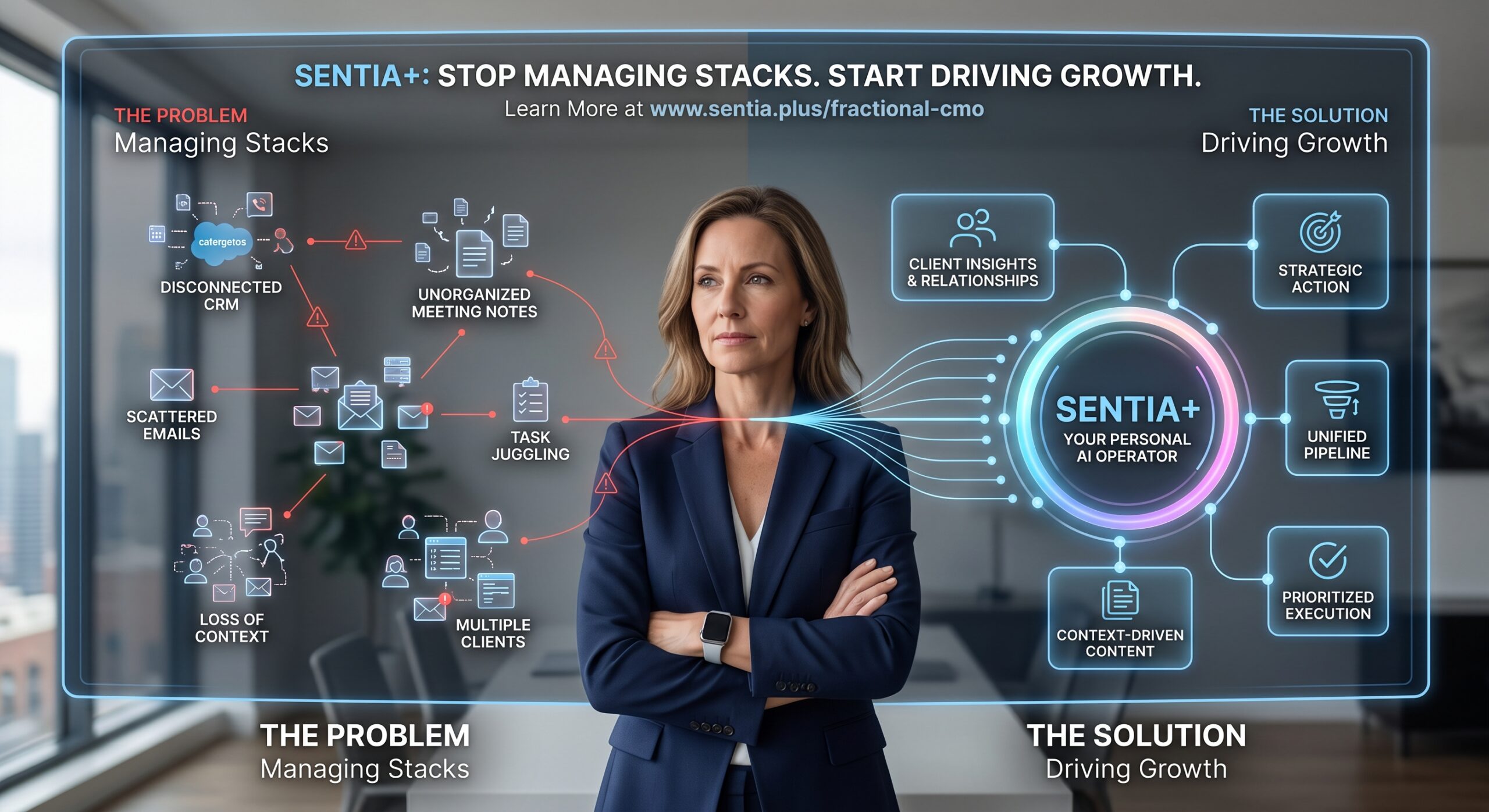
At Sentia, we have been approaching the problem as an operating-layer issue rather than simply another application problem. Sentia+ is intended to bring the activity surrounding contacts, meetings, email, pipeline, research, tasks, follow-ups and other everyday work into a more unified environment. The objective is not to replace every specialist marketing platform. There will always be tools that do a particular job extremely well.
The objective is to reduce how often the CMO has to think about the tools at all.
Instead of starting the day by asking which application needs to be opened, a better operating model starts with the work itself: What matters today? What changed? What requires attention? Which client commitment is slipping? Who needs a response? What should happen next?
That is a subtle change, but an important one.
2. Switching Clients Means Rebuilding Context
I think context switching is one of the most underestimated problems in fractional leadership.
A Fractional CMO can begin the morning discussing pipeline generation with a B2B software company, move into a positioning conversation with a consumer brand, review an agency’s performance for another client and then spend the afternoon preparing for a board conversation somewhere else. These are not simply different meetings on the calendar. They are different markets, customers, competitive environments, personalities, budgets, histories and expectations.
The executive has to switch mental models several times a day.
Before almost every important conversation, there is usually a short period of reconstruction. Where did we leave this? What did the CEO say last time? What did I promise? What is overdue? What changed since we last spoke? What political or organizational issue do I need to remember before raising this subject?
The information often exists, but locating it takes time.
This is where persistent business context becomes much more valuable than a generic chatbot. A Fractional CMO should be able to enter a meeting and quickly understand the relevant history surrounding that client: recent conversations, decisions, actions, contacts, research, pipeline activity and open issues. The original article describes this as the difference between repeatedly rebuilding context manually and having AI bring forward the appropriate context when it is needed.
That is the direction we are taking with Sentia+.
Imagine being able to ask, “Brief me on this client before the meeting,” and receive something useful because the system already understands the surrounding relationship and activity. Or after the meeting, being able to ask for the decisions, next actions and follow-up without first copying the transcript into another AI tool and explaining the background again.
For a fractional executive, the value is not simply speed. It is continuity.
Every time context has to be reconstructed, there is a cognitive cost. Reducing that cost means more attention remains available for the conversation itself.
3. Client Delivery Can Quietly Kill Your Own Pipeline
There is another problem in fractional work that has very little to do with technology on the surface.
When business is quiet, you have time to sell.
When business is busy, you have very little time to sell.
That creates an uncomfortable cycle. The better the Fractional CMO becomes at winning and servicing clients, the easier it becomes to neglect the activity required to win the next one. Then a project ends, a client’s scope changes or a budget gets cut, and suddenly the pipeline that did not seem urgent three months earlier becomes extremely important.
In other words, every Fractional CMO is effectively running two marketing organizations.
One is the marketing organization they lead for clients. The other is their own.
Their own business needs positioning, an ICP, prospecting, relationship development, referrals, follow-ups, pipeline management, content and eventually a revenue forecast. Unfortunately, that second marketing organization often gets whatever time remains after client work is finished, which is frequently not very much. The original article describes this tension simply: client delivery cannibalizes business development.
This is an area where AI can be extremely practical.
The goal should not be to turn a Fractional CMO into a full-time salesperson. It should be to prevent business development from disappearing when the executive gets busy.
Prospects can be researched. Follow-ups can be surfaced. Relationships can be tracked. Opportunities can be prioritized. Potential companies that match an ICP can be identified for review. The executive still makes the important decisions and owns the relationship, but the operating work surrounding business development can continue even when client delivery becomes demanding.
A strong fractional practice should not have to alternate between “delivery mode” and “selling mode.”
Both need to keep moving at the same time.
4. The Meeting Ends, but the Work Doesn’t
Meetings consume a large percentage of any senior executive’s schedule, but fractional executives face an additional problem because their meetings are spread across several completely separate businesses.
The conversation itself is usually not the biggest administrative burden. It is everything that has to happen afterward.
A productive meeting can generate a surprisingly long list of work: decisions need to be captured, owners identified, deadlines agreed, tasks entered, project plans updated, emails sent, CRM records changed and outstanding commitments remembered before the next conversation. When the executive moves directly into another client’s meeting, that post-meeting work can easily get delayed.
Transcription has helped considerably, but a transcript does not solve the whole problem.
Knowing what was said is useful. Knowing what now needs to happen is much more valuable.
This is why we think meeting intelligence needs to connect directly with execution. Sentia+ is intended to capture the conversation, summarize the important points, identify actions, connect those actions with the relevant people or opportunities, prepare follow-up and continue surfacing what remains outstanding. The original article makes an important distinction here: one system remembers what was said; a more useful operating system helps make sure something happens because it was said.
That difference matters a great deal for fractional executives.
If every meeting creates fifteen minutes of administrative work, and the CMO has six meetings in a day, the hidden cost is substantial. More importantly, those are exactly the sorts of tasks that experienced executives should increasingly be supervising rather than performing manually.
5. Generic AI Still Doesn’t Know Your Client
Generative AI has given marketers capabilities that would have seemed extraordinary only a few years ago. Research, analysis, writing, ideation and content production can all happen dramatically faster.
But generic AI has a weakness that becomes particularly obvious for fractional executives.
It usually starts without much context.
Before the output becomes genuinely useful, the CMO often has to explain the company, the market, the ICP, the competitors, the brand voice, the CEO’s priorities, previous campaigns and the strategy. Then, when the Fractional CMO moves to another client, some version of that process begins again.
We adopted AI partly because it saves time, yet we are now spending a meaningful amount of time supplying AI with the context required to make it useful.
The McKinsey research referenced in the original article illustrates the broader gap between adoption and operational value. Nearly 60% of marketers surveyed said they were using AI multiple times each week, yet fewer than 10% had begun capturing value across end-to-end workflows.
I think that distinction is especially important.
Using AI and operating with AI are not the same thing.
The real shift occurs when AI can work from business context that already exists around the executive. Meeting history can inform follow-up. Research can inform content. Previous campaigns can influence the next one. Client information can shape a proposal. Existing relationships can influence outreach. Competitive intelligence can become part of strategic planning without having to be rediscovered every time.
That is a very different experience from opening an empty prompt window and starting again.
For Fractional CMOs in particular, persistent context could ultimately be one of the most important differences between a useful AI assistant and an actual AI operating model.
The Bigger Opportunity for Fractional CMOs
I do not think the most useful question for a Fractional CMO is, “Which AI tool should I add next?”
A better question is: How much of the operational work surrounding my expertise could technology take off my plate?
The distinction matters because the highest-value work of a Fractional CMO has very little to do with maintaining software. Clients are paying for judgment, customer insight, positioning, growth strategy, resource allocation, demand generation, leadership and the ability to connect marketing decisions to commercial outcomes.
Every hour consumed by unnecessary administration, information hunting, system switching and repetitive follow-up is an hour that cannot be spent doing those things.
That does not mean AI should replace the specialist tools CMOs rely on, nor does it mean every decision should be automated. It means there is an opportunity to create a layer around the work that reduces the amount of manual coordination required to operate across multiple clients.
That is the philosophy behind Sentia+.
We are designing it as a personal AI operator for fractional professionals, including Fractional CMOs, with the objective of helping manage the operating work surrounding clients, prospects, meetings, research, pipeline, tasks, content and follow-ups while allowing specialist applications to remain in place where deeper functionality is required.
The fractional model already gives experienced executives an opportunity to create leverage by applying their expertise across several businesses. The next stage is figuring out how technology can create leverage around the executive themselves.
Because ultimately, clients did not hire a Fractional CMO to manage a marketing stack.
They hired them to help the business grow.
So here is the question I would ask every Fractional CMO: if AI could remove 50% of the administrative work surrounding your client portfolio tomorrow, where would you reinvest that time?