What is the Fractional Context Tax? Is it reducing revenue?
By David Brown ·
Your calendar may show available hours. That does not mean your brain has the capacity to use every one of them effectively.
You finish a strategy meeting with one client and immediately join a pipeline review with another.
Twenty minutes later, you are answering a message from a third company about a decision made two weeks ago. Before responding, you search through emails, meeting notes, CRM records and Slack conversations to reconstruct what happened.
By the time you remember the people, priorities, terminology and commitments involved, another notification has arrived.
This is not ordinary multitasking.
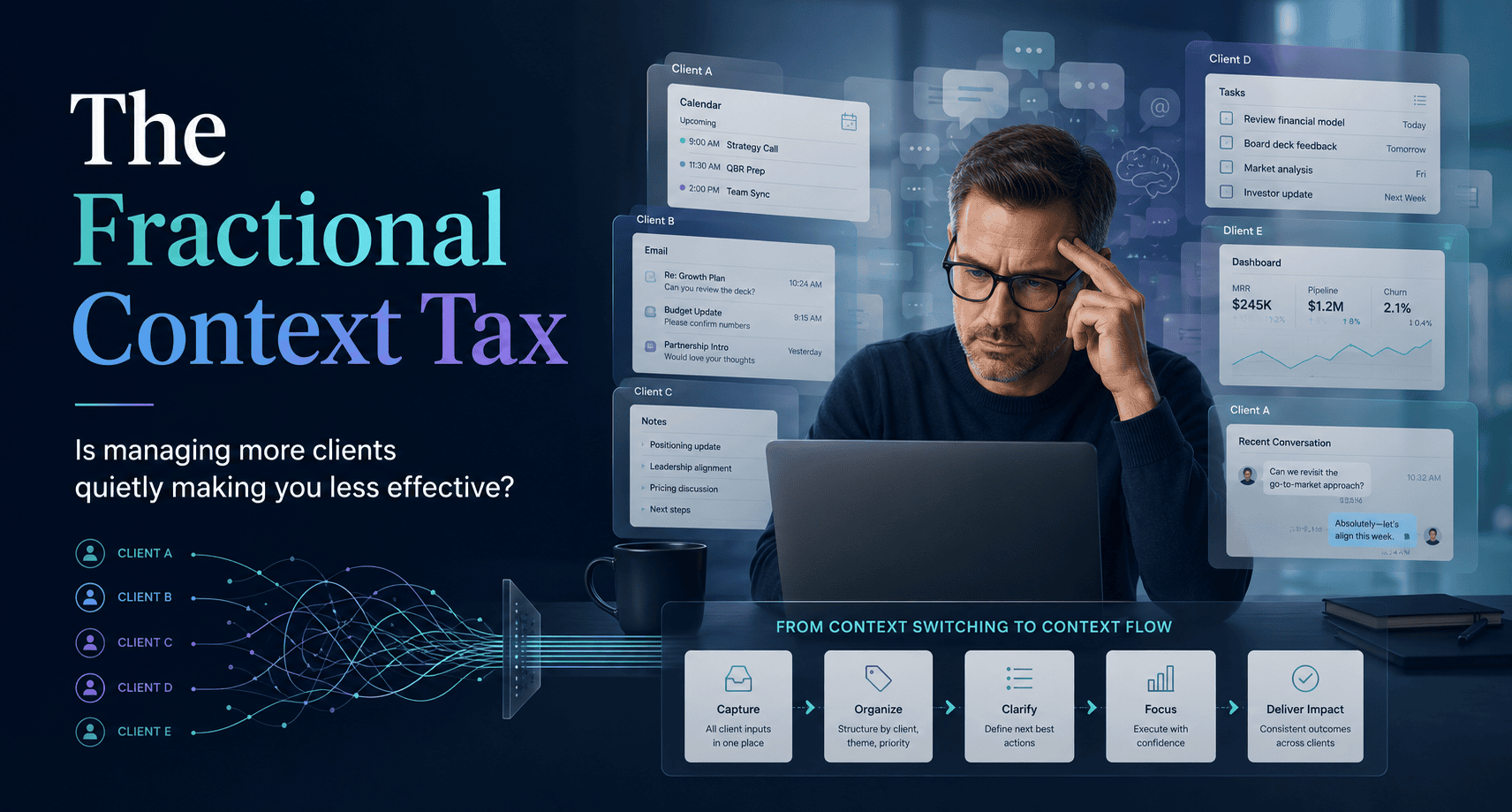
It is the repeated rebuilding of completely different business environments—and it creates what I call the Fractional Context Tax.
For fractional executives, consultants and specialists, the greatest constraint on growth may not be a shortage of hours. It may be the mental and operational cost of carrying several companies in your head at once.
Fractional Work Requires More Than Part-Time Availability
Fractional professionals are not simply part-time employees.
Clients expect experienced leaders who can enter the business, understand its circumstances, make decisions and create measurable progress without requiring months of onboarding.
They may only buy a fraction of your time, but they still expect:
- Relevant strategic judgment
- Fast, informed responses
- Continuity between meetings
- Reliable follow-through
- Awareness of important changes
- Confidence that nothing has been forgotten
In a Harvard Business Review discussion about fractional leadership, Amy Bonsall explained that the client should not feel as though the executive is fractional. The fractional leader must be present during important moments, even though this requires substantially more context switching.
That is the promise of fractional leadership.
It is also the source of its hidden operational burden.
What Is the Fractional Context Tax?
The Fractional Context Tax is the time, energy and attention lost while moving between separate client environments.
Switching from writing an email to reviewing a document within the same company is task switching.
Moving from one client to another is much more demanding.
You must reconstruct an entirely different operating model:
- Who are the decision-makers?
- What is the company trying to accomplish?
- Which initiatives are currently at risk?
- What was decided during the last meeting?
- Which commitments remain outstanding?
- How does this client define success?
- Which systems and processes do they use?
- What political, cultural or organizational sensitivities matter?
- What must happen next?
The brain does not instantly replace one complete business environment with another. Some of the previous context remains active while the new one is being reconstructed.
Research into task switching consistently finds that people become slower and more error-prone immediately after changing tasks. Preparation can reduce the cost, but it does not eliminate it.
For fractional professionals, the transition is rarely between two simple tasks. It is between two companies with different people, priorities, systems, expectations and histories.
The Cost Is Greater Than the Meeting on Your Calendar
A 30-minute client meeting does not consume only 30 minutes.
There is time spent preparing for it, reconstructing the account history, finding the correct information and remembering where the previous conversation ended.
After the meeting, there are notes to organize, systems to update, follow-ups to create and decisions to communicate.
Then comes the transition into the next client environment.
Research associated with University of California, Irvine professor Gloria Mark found that after an interruption, people took an average of approximately 23 minutes and 15 seconds to return to their original task.
That does not mean every notification automatically destroys 23 minutes of work. It does demonstrate that interruptions have a meaningful recovery cost—especially when the person must reconstruct a complicated mental model.
The modern digital environment increases the pressure. Microsoft’s 2025 Work Trend Index reported that meetings, emails and messages interrupt employees approximately every two minutes during core working hours.
For a fractional professional operating across several companies, those interruptions do not all belong to one coherent business environment. Each notification may pull the professional into a different organization.
Your calendar may show eight available hours.
Your effective capacity is the portion of those hours left after preparation, reorientation, administrative work, interruptions and recovery are considered.
More Clients Do Not Automatically Create More Capacity
The fractional business model appears simple:
Add another client, increase revenue.
But each client also adds another collection of:
- Relationships
- Meetings
- Communications
- Commitments
- Documents
- Applications
- Workflows
- Deadlines
- Decisions
- Unwritten organizational knowledge
The workload does not increase only through the hours sold. It also increases through the number of transitions required.
This creates the Fractional Capacity Trap.
You accept another engagement because the scheduled hours appear manageable. The engagement then creates unscheduled questions, preparation, follow-up and switching overhead.
Eventually, strategic time becomes crowded out by operational coordination.
The fractional executive who was hired to provide insight and leadership becomes occupied with finding information, reconstructing conversations and chasing administrative details.
More clients may increase revenue.
They can also reduce the quality of attention available to each client.
When Scattered Context Becomes a Credibility Problem
The Fractional Context Tax is not just a productivity problem.
It can become a client-confidence problem.
A fractional professional does not possess the same ambient awareness as a full-time executive. You may not see every internal message, hear every informal conversation or immediately learn about every decision affecting your work.
That makes the context you do receive even more important.
When information remains scattered across inboxes, notes, meeting transcripts, task managers, spreadsheets and client applications, several problems emerge.
Responses become slower
A question that should take ten minutes to answer becomes a long search through previous messages and documents.
Commitments become harder to track
A follow-up discussed during a meeting may disappear into notes rather than becoming an assigned action.
Decisions lose their reasoning
You may remember what was decided but not why it was decided, which can lead to unnecessary repetition or contradictory recommendations.
Strategic work becomes reactive
Instead of anticipating risks and opportunities, you spend your available time reconstructing what has already happened.
Client trust begins to erode
Clients do not see the invisible work required to rebuild their context. They see a delayed answer, a missed detail or a question they believe was already resolved.
In fractional work, expertise gets you hired.
Continuity and reliability help you remain trusted.
Theme Days Help—but They Do Not Solve the Entire Problem
Many fractional professionals organize their schedules around client days.
Monday belongs to Client A. Tuesday belongs to Client B. Wednesday is divided between two smaller engagements.
This is a sensible practice because it reduces the number of major transitions occurring in a single day.
Where full days are impossible, half-day blocks can protect focus better than an hour-by-hour mixture of unrelated client work.
However, theme days have limits.
Clients do not restrict important decisions, urgent requests and emerging problems to their assigned days.
A message from Tuesday’s client still arrives on Thursday. A Friday meeting may require preparation on Wednesday. An unexpected issue may pull you into an account you have not thought about for several days.
As the portfolio grows, scheduling discipline alone cannot maintain complete awareness across every engagement.
Theme days organize your time.
They do not preserve your context.
Fractional Professionals Need a Personal Operating Layer
The answer is not to remember more.
It is to stop depending on memory as the primary system for running a multi-client business.
Fractional professionals need a personal operating layer that can maintain the working context surrounding every client.
That layer should help capture and organize:
- Client objectives
- Important relationships
- Meeting history
- Decisions and their reasoning
- Commitments
- Open questions
- Risks and opportunities
- Tasks and deadlines
- Communications
- Recommended next actions
Instead of beginning each client interaction by searching through several applications, you should be able to quickly understand:
What has changed?
What matters now?
What have I promised?
What should happen next?
AI can play an important role here, but only when it is connected to the professional’s actual work.
A standalone chatbot can create another context problem. Each new conversation may require the user to explain the client, project, objectives and previous decisions again.
An effective AI operating layer should preserve relevant context across the applications and workflows where work occurs. It should reduce reconstruction—not require more of it.
Importantly, it should assist professional judgment rather than pretend to replace it.
You remain responsible for the strategy, relationship and decision.
The technology should help ensure that the information required to exercise that judgment is available when needed.
Context Must Never Become Cross-Contamination
There is an important requirement that fractional professionals cannot ignore.
Client context must be preserved without allowing information to leak between clients.
A system supporting fractional work should provide clear separation between client environments, including:
- Data
- Documents
- Communications
- Permissions
- Workflows
- AI-generated outputs
- Meeting information
- Contact records
Convenience cannot come at the cost of confidentiality.
The goal is not to combine every client into one uncontrolled pool of information. It is to give the fractional professional one consistent way to work while maintaining appropriate boundaries around each organization.
The best operating layer makes context easier to access while keeping data ownership, permissions and accountability visible.
A Practical Framework for Reducing Your Context Tax
Technology can help, but the first step is understanding where your capacity is currently being lost.
1. Audit Your Real Capacity
For two weeks, track more than billable hours.
Record:
- Preparation time
- Post-meeting administration
- Time spent finding information
- Unplanned client requests
- Application switching
- Follow-up work
- Time required to re-enter an engagement
Compare the results with the hours included in each agreement.
A client contracted for ten hours may be consuming considerably more operational capacity than the calendar suggests.
2. Measure Strategic Work Versus Reactive Work
Separate your activities into two categories.
Strategic work includes decisions, analysis, leadership, planning and high-value recommendations.
Reactive work includes searching, chasing updates, copying information between systems and responding to preventable emergencies.
Some reactive work is unavoidable.
But when it begins consuming the majority of an engagement, the scope, process or supporting infrastructure needs to change.
3. Create a Living Context Record for Every Client
Every engagement should have a current, accessible context record covering:
- Objectives
- Key people
- Active priorities
- Recent decisions
- Outstanding commitments
- Risks
- Deadlines
- Next actions
This should not be a static onboarding document that becomes outdated after two weeks.
It should evolve as conversations, decisions and priorities change.
4. Automate Context Capture and Follow-Through
Meeting summaries are useful, but they are only the beginning.
Look for opportunities to automatically:
- Capture decisions
- Identify commitments
- Draft follow-ups
- Create tasks
- Update relationship history
- Surface approaching deadlines
- Prepare for upcoming meetings
- Highlight unanswered communications
- Recommend the next appropriate action
The objective is not automation for its own sake.
It is to eliminate the repeated reconstruction of information you have already processed.
5. Sell Outcomes and Capacity—not the Fiction of Perfect Availability
Do not price an engagement as though every available hour will become uninterrupted strategic output.
Account for the preparation, communication, coordination and transitions required to deliver the promised result.
Clients are not buying a block of empty calendar space.
They are buying informed judgment, leadership and progress.
Your commercial model should reflect the real operating capacity required to provide those outcomes consistently.
How AI Can Expand Fractional Capacity
AI is often presented as a way to produce more content or complete isolated tasks faster.
For fractional professionals, its greater value may be continuity.
In a randomized field experiment involving approximately 6,000 knowledge workers, Microsoft researchers found that access to generative AI integrated into everyday work applications reduced time spent on email. The broader lesson is important: AI creates more value when it works inside the flow of work rather than forcing users to continually leave their systems and re-establish context.
For a fractional professional, the most valuable AI may not be the tool that writes the fastest.
It may be the one that helps you remember:
- What was discussed
- What was decided
- What remains unresolved
- Who needs a response
- Which opportunity is moving
- Which commitment is approaching
- What deserves your attention today
That is the difference between an AI content tool and an AI operating layer.
One helps generate an output.
The other helps run the work surrounding it.
The Future of Fractional Work Depends on Operational Leverage
Fractional work is becoming an increasingly established way for companies to access experienced leadership and specialized expertise.
But the model cannot scale indefinitely through personal memory, spreadsheets and disconnected applications.
The professionals who thrive will not necessarily be those who work the longest hours or accept the most clients.
They will be those who create the greatest operational leverage.
They will be able to enter each client environment quickly, recover the relevant history, understand what has changed and act without rebuilding everything from the beginning.
Their time may be fractional.
Their understanding, reliability and impact will not feel fractional to the client.
The Bottom Line
You may not be exhausted because you lack discipline or because you accepted too many scheduled hours.
You may be exhausted because you are repeatedly rebuilding several companies inside your head.
That is the Fractional Context Tax.
Calendars and theme days can reduce it. Better documentation can help control it. But as your client portfolio grows, you need an operating model designed to preserve context, protect client boundaries and convert information into action.
Your next growth constraint may not be time.
It may be how much context you can reliably carry.
And that is exactly where intelligent infrastructure can create your greatest leverage.
About Sentia+
Sentia+ is an AI operating layer designed to help fractional professionals manage contacts, pipeline, emails, meetings, follow-ups, tasks, research and business workflows through one intelligent interface.
Rather than requiring users to move repeatedly between CRM, inbox, meeting, transcription, task and project applications, Sentia+ helps preserve working context, identify what matters and support the next action.
Learn more: https://www.sentia.plus/
Sources and Further Reading
Harvard Business Review — “The Growing Trend of Part-Time Executives”
https://hbr.org/podcast/2024/11/the-growing-hr-trend-of-fractional-leadership
The discussion explains why fractional leaders must become present during important organizational moments and why the role creates significant context-switching demands.
Harvard Business Review — “5 Questions Leaders Should Ask Before Turning to Fractional Work”
https://hbr.org/2026/04/5-questions-leaders-should-ask-before-turning-to-fractional-work
A current examination of the market forces driving increased interest in fractional work.
UC Irvine — Gloria Mark’s Research on Interruptions
https://ics.uci.edu/2016/07/25/quartz-neuroscientists-say-multitasking-literally-drains-the-energy-reserves-of-your-brain-mark-quoted/
UC Irvine summarizes Mark’s finding that people took approximately 23 minutes and 15 seconds to return to their original work following an interruption.
Microsoft — 2025 Work Trend Index
https://www.microsoft.com/en-us/worklab/work-trend-index/2025-the-year-the-frontier-firm-is-born
Microsoft 365 telemetry illustrates the frequency of meetings, emails and messages competing for knowledge workers’ attention.
Microsoft Research — “Shifting Work Patterns With Generative AI”
https://www.microsoft.com/en-us/research/publication/shifting-work-patterns-with-generative-ai/
This randomized field experiment examined how integrated generative AI affected the working patterns of approximately 6,000 knowledge workers.
National Library of Medicine — “Task Switching”
https://pubmed.ncbi.nlm.nih.gov/12639695/
This research review explains why responses are generally slower and more error-prone after a task switch, even when people have time to prepare.