
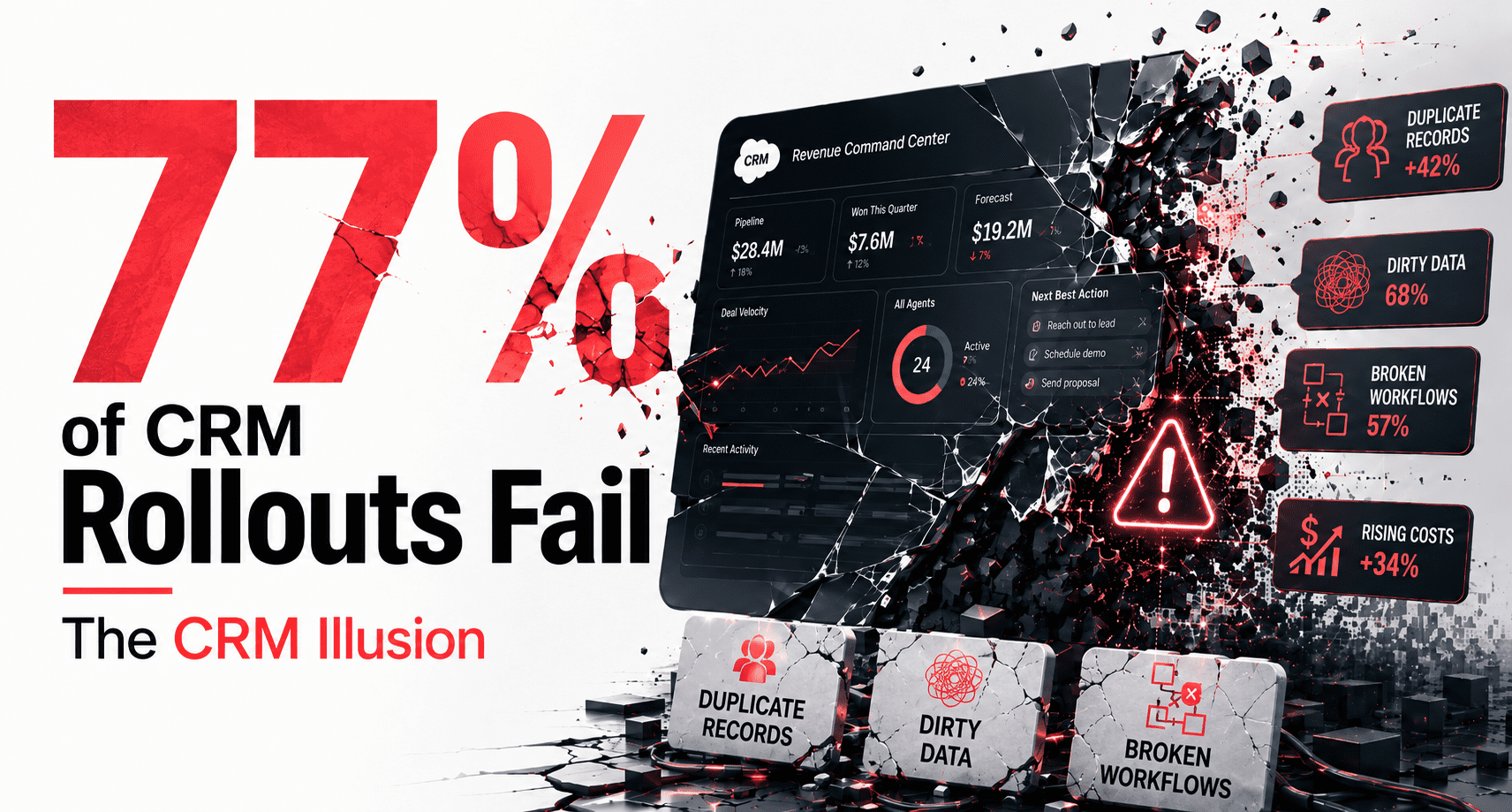
- High Failure Rate: Valoir research indicates that 77% of enterprise B2B Agentforce implementations fail to deliver successful deployment, with only 31% remaining active past the six-month mark.
- Data Hygiene Crisis: High operational failure rates stem directly from corrupted, duplicate legacy database records, which force cognitive engines to automate processing errors at machine speed.
- Complex Cost Structures: Unpredictable total cost of ownership compounds rapidly through mandatory system bundles and metered transaction charges via Flex Credits, driving costs up to $2.00+ per multi-turn transaction.
- Open-Source Migration: Enterprise architectures are transitioning toward database-agnostic “Systems of Action” and open runtimes like Google Agent Executor and Snowflake Natoma.
- Scaled AI Operations: Scaling successfully requires moving away from seat-based software deployment to managing autonomous agents as structured virtual departments with dedicated profit-and-loss metrics.
The Outward Hype vs. The Audited Reality
Enterprise software buyers in Q2 2026 face a severe disconnect between massive marketing promises and audited deployment statistics. While vendors promise seamless digital workforces, independent market reports reveal a much more conservative adoption landscape. According toAd Graphics Research, only 12% of modern software transactions feature an agentic component, and a mere 6% of deals include paid licenses.
This operational gap is further highlighted by audited failure metrics. Data from the 2026 Valoir Salesforce AI Report indicates that 77% of B2B Agentforce deployments fail to achieve successful deployment, and only 31% remain active past the six-month mark. This reality has produced widespread hype fatigue among information technology executives.
A community survey of over 1,200 CRM practitioners by Salesforce Ben found that 50% believe the platform remains stuck in the hype stage. Only 11% of surveyed practitioners reported running these autonomous agents in active production environments. This operational instability has persisted despite iterative product updates.
The late April 2026 release of the Atlas Reasoning Engine v3 claimed a 40% reduction in inconsistent execution paths compared to previous versions. However, independent benchmark evaluations indicate that multi-step workflows still drift or fail in 18% of real-world production setups. This high rate of error highlights the structural limitations of native CRM agent architectures.
2. The B2B Data Graveyard Catch-22
The root cause of these high failure rates is not a limitation in model intelligence or cognitive processing power. Instead, deployments fail due to the legacy database architectures into which these agents are introduced. Traditional CRM platforms were built on a manual, reactive data entry model that inevitably generates duplicate records, stale fields, and broken validation rules.
When an autonomous agent is deployed over this unmaintained infrastructure, it encounters a classic data hygiene bottleneck. Because these platforms utilize Retrieval-Augmented Generation (RAG) to ground their decisions, a chaotic database forces the agent to make incorrect associations or hallucinate entirely. For example, activity capture tools regularly struggle to map inbound customer emails to the correct opportunity record when duplicate account fields exist.
Consequently, the decisional engine processes corrupted inputs, executes incorrect actions, and replicates operational errors at machine speed. This architectural mismatch highlights why throwing advanced software at a broken process simply automates failure. According to the (IBM Thought Leadership business value of Salesforce CRM), only 26% of enterprise leaders believe their customer data is in a state that can support agentic analysis.
The same report indicates that only 33% of AI initiatives are currently meeting their return on investment targets. Furthermore, 72% of these projects fail to scale across business units, and 20% stall or are abandoned completely. These outcomes occur because organizations attempt to run complex models over fragmented data silos.
To resolve this mismatch, enterprise architects must first learn how to (How to Eliminate Data Silos with Agentic AI) before initiating deployments. Aligning backend data structures with the precise requirements of RAG is a prerequisite for any scalable deployment. Without this baseline, the cognitive model remains functionally blind to the broader enterprise context.
3. The True Cost of Agentforce (The Sticker Shock Formula)
Unpredictable financial overhead represents another primary catalyst driving project cancellations. To help RevOps and information technology leaders calculate the true fiscal footprint of a native CRM rollout, the Total Cost of Ownership ($TCO$) of an enterprise deployment is modeled as:
$$TCO = \sum (S_B + D_C + A_L) + V_T$$
Where $S_B$ represents the base Sales or Service Cloud seat licenses, $D_C$ represents the mandatory Salesforce Data Cloud subscription, $A_L$ represents the add-on user licenses, and $V_T$ represents the variable transaction volume.
Base seat licenses ($S_B$) typically cost $175 to $350 per user monthly, while the mandatory Data Cloud subscription ($D_C$) requires a minimum commitment starting at $60,000 annually. The Agentforce add-on user licenses ($A_L$) add an additional $125 to $550 per user monthly depending on the enterprise tier. The variable transaction volume ($V_T$) is driven by the frequency of automated actions ($N_a$) and the metered price rate ($P_a$):
$$V_T = N_a \times P_a$$
Under standard metered structures, each action consumes 20 Flex Credits, establishing a base execution rate ($P_a$) of $0.10.
This credit math quickly compounds because standard real-world interactions require multiple sequential actions. For example, while a basic case-management step costs 60 credits ($0.30), a complex multi-turn knowledge search regularly exceeds 120 credits ($0.60) or even $2.00 per conversation. If an enterprise processes 40,000 automated actions monthly, these transaction charges add an unexpected $18,000 to $48,000 annually.
This lack of budget predictability forces CIOs to implement complex throttling strategies to prevent massive bill overruns. This unpredictable cost modeling has caused a significant shift in procurement preferences. Enterprise buyers are increasingly demanding outcome-based pricing models, similar to Intercom’s Fin charging per successful resolution.
To highlight the disparity, the following table contrasts the baseline licensing layers against actual consumption averages :
| Licensing Tier & Variable Actions | Monthly Cost per User / Unit | Annual Base Commitment | Mandatory Dependencies & Variable Cost Drivers |
| Enterprise Base Seat ($S_B$) | $175 / user | $2,100 / user | Required prerequisite for any Agentforce deployment. |
| Unlimited Base Seat ($S_B$) | $350 / user | $4,200 / user | Includes advanced forecasting and predictive analytics features. |
| Data Cloud Starter ($D_C$) | Flat Annual Rate | $60,000 | Required for real-time data ingestion and mapping. |
| Data Cloud Premium ($D_C$) | Flat Annual Rate | $175,000 | High-profile enterprise package with advanced scaling. |
| Agentforce Sales / Service Add-on ($A_L$) | $125 / user | $1,500 / user | Enables unmetered internal employee agent execution. |
| Agentforce 1 Unified Seat | $550 / user | $6,600 / user | Bundles CRM, Data Cloud credits, and unmetered agents. |
| Flex Credit Metered Action ($P_a$) | $0.10 / action | Variable Usage | Consumes 20 credits per single backend execution step. |
| Complex Multi-Turn Workflow | $0.60 to $2.00 / run | Variable Usage | Triggered by multi-step search, RAG loops, and external updates. |
4. The Pivot to Open Orchestration and Headless Architectures
To bypass the steep pricing structures and database silos of single-vendor suites, modern GTM teams are shifting toward open, database-agnostic “Systems of Action”. This transition has accelerated due to significant infrastructure updates launched in late May and early June 2026. On May 25, 2026, Google introduced the open-source Google Agent Executor to support production-ready distributed agent deployment, durable execution, and secure sandboxing.
This runtime standard automatically ensures backend resilience, allowing long-running agent workflows to resume after disconnections or human-in-the-loop confirmations. By providing secure isolation, it prevents untrusted, generated code from compromising internal networks. To govern these workflows, Snowflake announced the acquisition of Snowflake Natoma in late May 2026.
Natoma operates as a central Model Context Protocol gateway, providing identity verification, access policies, and audit controls at the tool-call level. Furthermore, Snowflake introduced CoWork and Horizon Context to allow agents to query and reason over centralized enterprise data lakes in real time. This co-location of data, governance, and business definitions allows organizations to bypass the monolithic CRM execution layer entirely.
Simultaneously, Microsoft introduced Rayfin to transform Microsoft Fabric into an active application runtime, alongside Frontier Tuning. Frontier Tuning utilizes a managed Reinforcement Learning Environment to train models on real enterprise behavior, approval chains, and terminology. This continuous feedback loop allows agents to acquire organizational muscle memory safely within the tenant’s compliance boundaries.
These technical transformations demonstrate that the CRM is being relegated to a background storage layer, while real value has migrated to open, headless orchestration layers. Technology leaders must look beyond basic pilots and focus on building robust infrastructures. To establish this baseline, teams must actively transition from evaluating prototypes to implementing comprehensive strategy.
They must carefully analyze how to stop celebrating AI pilots and talk about AI operations to avoid scaling failures. By decoupling the application logic from the underlying storage, enterprises ensure long-term flexibility. This open approach mitigates vendor lock-in while providing strict control over computing budgets.
5. The Path to Scaled AI Operations
Restructuring a struggling agentic deployment requires a fundamental shift in both technical and organizational design. According to a study published in the (Harvard Research – Why you shouldn’t treat AI Agents like Employees), organizations must stop treating autonomous agents as basic software extensions or virtual employees. Anthropomorphizing these systems often reduces individual accountability, increases unnecessary escalations, and degrades review quality.
Instead, successful enterprises treat each agent as a structured virtual department. This model requires assigning a clear business owner, setting precise Key Performance Indicators, establishing inputs and outputs, and managing a dedicated P&L. On the technical front, teams must integrate advanced diagnostic frameworks to interpret agent decision-making paths.
Utilizing LIME (Local Interpretable Model-agnostic Explanations) and Neural Networks algorithms allows engineers to audit complex reasoning models and prevent operational drift. Furthermore,(Forrester Research – Test your AI Agents) recommends implementing strict agentic testing suites and red-teaming practices before deploying code to production. These testing suites utilize synthetic prompts to evaluate agent responses against a standardized “golden set” of ideal outcomes.
By combining rigorous testing, open orchestration layers, and a unified data foundation, enterprises can successfully scale past the pilot phase. The era of the monolithic, single-vendor CRM agent is giving way to secure, distributed execution environments. The enterprises that prioritize data readiness and structured operational governance will ultimately capture the true productivity gains of the agentic shift.
What is causing the high failure rate of Agentforce deployments in 2026?
The primary cause of the 77% Agentforce failure rate is poor underlying CRM data quality. Legacy databases are filled with duplicate accounts, stale opportunity pipelines, and unmaintained workflows. When autonomous agents rely on this uncleaned data for decision-making, they execute incorrect actions at machine speed, stalling multi-step workflows.
How much does Salesforce Agentforce actually cost to run?
A standard deployment costs upwards of $125 to $550 per user monthly, plus base CRM licenses of $175 to $350. Additionally, mandatory Data Cloud subscriptions cost up to $175,000 annually. On top of subscription fees, variable action costs are metered via Flex Credits at $0.10 per action.
What is the role of Data Cloud in agentic CRM workflows?
Salesforce Data Cloud serves as the foundational data harmonization layer for AI agents. It ingests and unifies fragmented enterprise customer data from external silos. This allows the execution layer to access structured and unstructured context, which is critical to grounding agent decisions and reducing hallucinations during execution.
What is the Google Agent Executor and why is it open source?
Google Agent Executor is an open-source runtime standard designed for production agent deployment, execution, and resumption. Google open-sourced the platform to provide developers with a highly resilient, sandboxed environment. This strategy builds developer adoption, shifting runtime infrastructure to Google Cloud services and the Gemini Enterprise Platform.
How does Snowflake’s Natoma acquisition impact agent governance?
The acquisition of Natoma integrates a central Model Context Protocol gateway directly into Snowflake. This allows enterprises to govern the exact API tool calls autonomous agents make to external SaaS applications. It shifts the data platform into a secure, centralized control plane for real-time agentic actions.
What is Microsoft’s Frontier Tuning and how does it optimize agents?
Microsoft’s Frontier Tuning is a managed reinforcement learning service that trains AI agents on real-world enterprise behaviors, workflows, and approval chains. Operating within the secure tenant compliance boundary, it teaches models how a business actually operates. This increases task completion rates without the overhead of manual data labeling.
Can organizations bypass native CRM agents using database-agnostic engines?
Yes, enterprises are increasingly bypassing native CRM agent runtimes in favor of database-agnostic Systems of Action. By leveraging platforms like Snowflake CoWork, Google Agent Executor, and open-source MCP networks, GTM teams can orchestrate workflows directly over centralized data lakes, relegating the CRM to a background record database.
What is the Data Graveyard in enterprise CRMs?
The CRM Data Graveyard refers to legacy databases cluttered with duplicate records, obsolete fields, and outdated pipelines. Because manual data entry is highly prone to human error, these systems accumulate massive technical debt. Deployed agents process this corrupted data, leading to severe operational drift.
What is the difference between an AI assistant and an AI agent?
An AI assistant simplifies tasks for users but relies on constant human prompts to proceed. Conversely, an autonomous AI agent plans, triggers, and completes multi-step workflows independently without human intervention. Agents possess the architectural capability to process complex loops and execute actions across disparate external systems.
How should enterprises restructure their teams to support autonomous agents?
Enterprises must treat autonomous agents as virtual departments rather than simple software features. Organizations should assign dedicated business owners, establish performance Key Performance Indicators, define clear input and output parameters, and manage operating budgets. This operational restructuring ensures agentic deployments align with tangible return on investment targets.
Table of Contents
1-the-outward-hype-vs-the-audited-reality
2-the-b2b-data-graveyard-catch-22
3-the-true-cost-of-agentforce-the-sticker-shock-formula
4-the-pivot-to-open-orchestration-and-headless-architectures
5-the-path-to-scaled-ai-operations
WordPress Taxonomy
- Primary Category: AI Operations (AIOps)
- Tags: #Agentforce, #CRMDataQuality, #EnterpriseAIStrategy, #HeadlessOrchestration, #Salesforce #Harvard #Forrester #IBM #Sentia
Author
 David Brown | CCO & Startup AI Investor
David Brown doesn't just discuss AI; he builds the infrastructure that makes it profitable. As CCO and Investor at Sentia AI, David is the strategist enterprise leaders turn to when their AI pilots stall and their data silos remain impenetrable. He fixes stalled AI pilots, CRM / ERP integration and scales enterprise AI with his amazingly talented teamates.
With a career forged on Wall Street and Ernst and Young, David brings a high-focus, results-driven discipline to the tech sector. His trajectory—from navigating global markets to CEO of startups and founding a top-tier international startup incubator for hundreds of ventures—has uniquely positioned him at the bleeding edge of the "Agentic AI" revolution.
The Enterprise AI Architect
David’s mission is the elimination of the "AI Circle of Sorrow"—the gap where expensive AI tools fail to talk to legacy systems and most importantly humans. He specializes in solving the most aggressive enterprise AI scaling hurdles facing large enterprise clients today:
Siloed Data Liquidation: Breaking down the walls between fragmented business units to create a unified data truth. See DIO: www.dio.sentia.online
ERP & CRM Connectivity: Forging seamless, bi-directional integration between core systems of record and modern AI applications. See DSO www.sentia.website
The "Single Pane of Glass": Developing client Unified AI Dashboards—a command center that provides C-Suite leaders with total visibility across every AI-driven workflow in the organization. This is one of Sentia's specialities.
Enterprise AI Scaling: Moving beyond fragmented "app-creep" to build a cohesive, governed, and scalable AI orchestration layer.
A relentless advocate for AI Orchestration, David ensures that Sentia AI remains a premier Salesforce partner by delivering autonomous agentic systems that don't just "help" sales teams—they transform revenue operations into high-velocity engines.
Connect with the Seer of AI Integration success:
LinkedIn: linkedin.com/in/davidbrown07
- Sentia Community
X (Twitter): @intlmktentry
Insights: Sentia AI Community

 David Brown | CCO & Startup AI Investor