

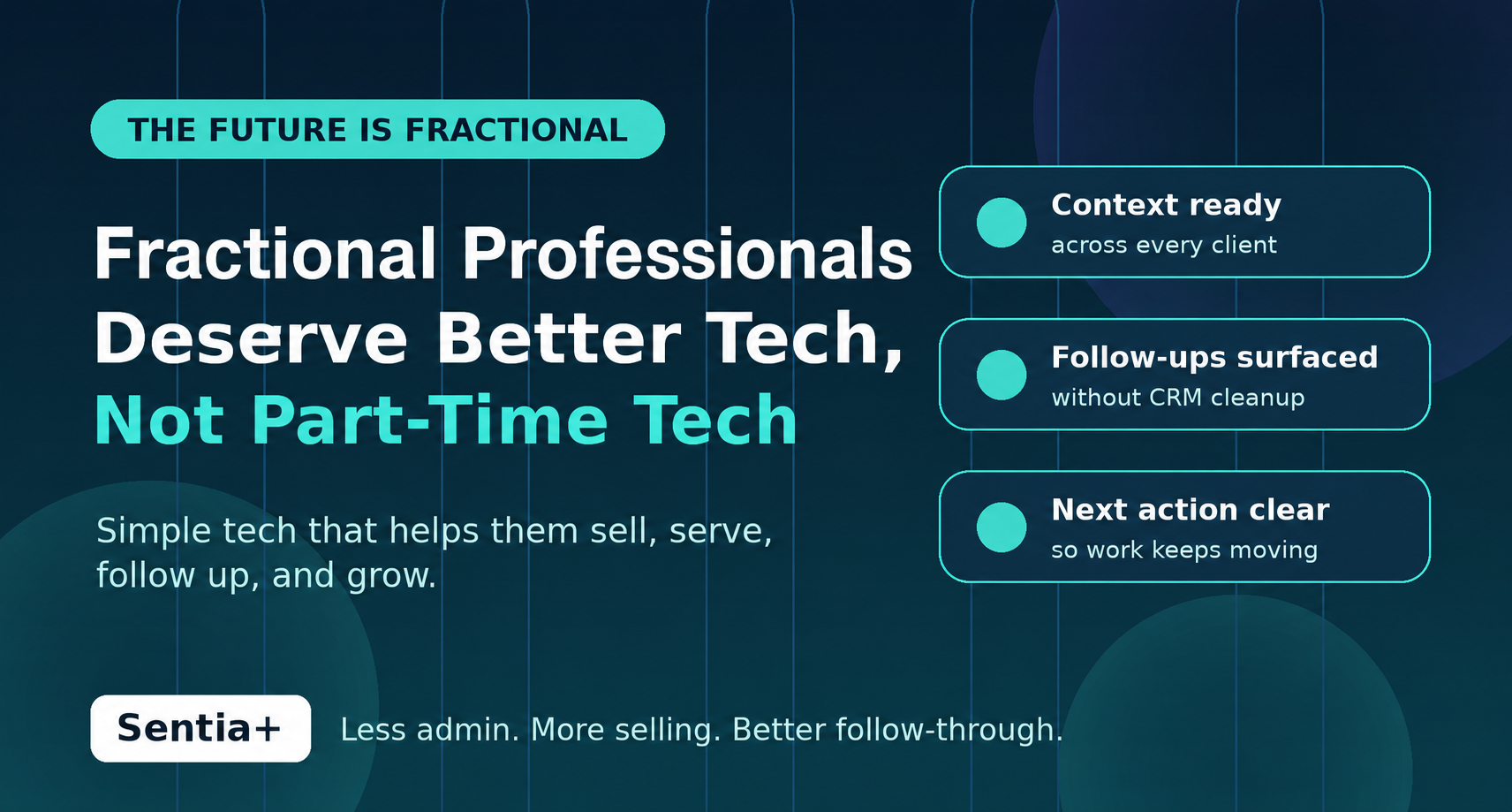
Fractional Professionals
The future of work is not just remote.
It is not just hybrid.
It is fractional.
Fractional professionals are becoming powerful businesses in their own right. They are fractional CROs, CMOs, consultants, advisors, operators, and solo entrepreneurs bringing senior-level experience into companies without requiring a full-time seat on payroll.
That deserves to be celebrated.
Fractional workers are not a cheaper version of full-time employees. They are flexible, specialized, high-impact businesses selling expertise, judgment, pattern recognition, speed, and execution.
But here is the problem.
Too many of them are still forced to run their growing businesses on tools built for a different era.
They deserve better technology, not fractional technology.
No fractional worker ever said: “Great. Now I get to spend more time fighting my tools.”
They want simple technology that helps them sell, serve, follow up, remember context, and grow without turning them into full-time software administrators.
Recent coverage from Harvard Business Review, Axios, MBO Partners, and Go Fractional all points to the same larger movement: fractional leadership and independent expert work are moving from niche to mainstream. Companies are using fractional talent to gain flexibility and expertise, while senior professionals are using the model to create more resilient and intentional careers.
Fractional workers are builders.
They bring judgment, speed, expertise, and pattern recognition into companies that need help now. They often walk into messy environments, diagnose problems quickly, create momentum, and deliver value without needing months of onboarding.
But there is one uncomfortable truth hiding underneath the rise of fractional work.
The worker model has changed.
The technology stack has not.
The Fractional Worker Tech Gap
Most sales and marketing technology was built for a different world.
It was built for full-time employees working inside one company, with one CRM, one inbox, one sales process, one marketing calendar, one reporting structure, and one set of internal stakeholders.
That is not how fractional workers operate.
A fractional CRO may manage several client pipelines at once.
A fractional CMO may be building messaging for one client, fixing campaign strategy for another, preparing a board update for a third, and nurturing their own pipeline in the background.
A consultant may need to track prospects, referrals, client deliverables, follow-ups, proposals, meetings, notes, research, contracts, and renewals across multiple relationships.
A portfolio operator may be the sales team, marketing team, account manager, strategist, researcher, and admin department all at the same time.
That is the tech gap.
Fractional workers do not need more software.
They need software that understands how they actually work.
No fractional worker ever said:
“Great. Now I finally get to spend more time updating my CRM.”
No fractional worker built an independent practice because they were excited to copy notes from one system into another.
No fractional CMO left corporate life because they wanted to maintain five dashboards.
No fractional CRO launched a portfolio career because they were hoping to spend Friday afternoon cleaning up contact records.
They want to sell.
They want to advise.
They want to serve clients.
They want to create.
They want to grow.
They want simple technology that does what they need, keeps them organized, and does not waste their time.
The Hidden Cost of Old Sales and Marketing Tools
The problem is not that CRMs, inboxes, calendars, project tools, and automation platforms are useless.
The problem is that many of them still depend on the user doing too much manual work.
Update the contact.
Log the meeting.
Add the next step.
Remember the follow-up.
Summarize the client conversation.
Track the proposal.
Find the last email.
Update the opportunity.
Build the task.
Create the reminder.
Review the notes.
Check the spreadsheet.
Move the deal stage.
Repeat.
For a full-time employee inside one company, this is annoying.
For a fractional worker managing multiple clients and opportunities, it becomes a growth constraint.
Every manual update steals time from selling.
Every forgotten follow-up risks revenue.
Every disconnected note creates friction.
Every system that requires constant feeding becomes another burden on the operator.
This is why the old sales and marketing stack is starting to feel misaligned with the fractional economy.
Fractional professionals do not need a heavier stack.
They need a smarter operating layer.
Fractional Workers Need Technology Built Around Their Reality
The fractional worker’s day is not linear.
It is fluid.
One hour may be spent advising a client. The next may be spent following up with a prospect. Then comes a referral call, a proposal revision, a client update, a LinkedIn message, a research task, a sales conversation, and a calendar conflict.
The work cuts across sales, marketing, customer success, operations, communication, and delivery.
That means fractional workers need technology that helps them answer practical questions quickly:
-Who do I need to follow up with?
-Which opportunities are active?
-What did I promise this client?
-What context do I need before my next call?
-Which relationship needs attention?
-What proposal or conversation is at risk?
-What should I do next?
-Where is the information I need?
-What changed since the last time I looked?
Traditional tools often require the fractional worker to go find those answers.
The next generation of sales and marketing technology should surface those answers automatically.
Where Sentia+ Fits
Sentia+ was built for this shift.
It is designed for solo entrepreneurs, consultants, advisors, fractional executives, founders, and revenue-focused operators who need better organization, better follow-up, and better execution without the burden of maintaining a traditional CRM.
Sentia+ is positioned as an AI operator and post-CRM operating layer that helps reduce the manual work required to manage relationships, opportunities, follow-ups, communications, research, planning, and execution.
That matters because fractional workers do not just need another place to store information.
They need help turning information into action.
Sentia+ supports the fractional professional by helping with five critical needs:
1. Track relationships without constant manual updates.
Fractional workers depend on relationships, referrals, prospects, partners, and clients across multiple companies. Sentia+ helps organize relationship context, communications, opportunities, and follow-ups with less manual software administration.
2. Stay on top of follow-ups.
Missed follow-ups create missed revenue, lost trust, and slower pipeline movement. Sentia+ helps surface priorities and next steps so the operator can spend more time moving conversations forward.
3. Reduce admin work.
Fractional workers make money by advising, selling, building, and delivering, not maintaining systems. Sentia+ reduces the burden of manually updating disconnected tools and chasing scattered context.
4. Manage multiple clients and opportunities.
Portfolio work creates complexity because each client has different goals, timelines, stakeholders, and deliverables. Sentia+ acts as an intelligent operating layer across planning, communication, relationship management, and execution.
5. Know what to do next.
Fractional professionals need clarity quickly because their time is divided across multiple revenue-producing activities. Sentia+ helps clarify priorities, organize work, and support action without forcing the user to dig through multiple systems.
This is the difference between software that waits for the user and software that works for the user.
A traditional CRM says:
“Please update me.”
A better operating layer says:
“Here is what matters next.”
That is the shift fractional workers need.
Fractional Work Is Expanding the Definition of Sales and Marketing
Fractional workers are not just “doing sales” or “doing marketing.”
-They are building demand.
-They are shaping positioning.
-They are creating trust.
-They are advising founders.
-They are fixing go-to-market problems.
-They are managing referrals.
-They are writing proposals.
-They are delivering client work.
-They are staying visible in the market.
-They are building their own brand while helping clients build theirs.
That means sales and marketing technology must evolve from static recordkeeping into intelligent support.
The next wave of tools must help fractional workers be:
Simple: easy to use without heavy implementation or constant administration.
Context-aware: able to help organize relationships, conversations, opportunities, and priorities.
Action-oriented: focused on helping the user know what to do next.
Operator-friendly: designed for people managing multiple clients, pipelines, and responsibilities.
Low-admin: reducing manual updates instead of creating more work.
Revenue-relevant: supporting selling, follow-up, communication, and client growth.
This is especially important because fractional work is often built on trust.
Trust is built through responsiveness, relevance, consistency, and follow-through.
The fractional professional who can stay organized, follow up quickly, remember context, and act at the right time has a major advantage.
The fractional professional buried in disconnected tools does not.
The Old Stack Was Built for Employees. The New Stack Must Be Built for Operators.
The rise of fractional work is not just a labor trend.
It is a technology challenge.
The modern fractional worker is not a traditional employee.
They are an operator.
They are running a business.
They are serving clients.
They are managing opportunities.
They are building revenue.
They are protecting their reputation.
They are balancing delivery and growth.
That requires a different kind of sales and marketing system.
One that is simple.
One that understands context.
One that reduces manual work.
One that supports follow-through.
One that helps the user act.
One that does not become another job.
This is why the future of fractional work will not be powered by bloated dashboards or admin-heavy CRMs.
It will be powered by intelligent operating layers that help fractional workers focus on what they do best.
Selling.
Advising.
Building.
Creating value.
Growing their business.
That is the real opportunity.
The future is fractional.
Now the tech stack needs to catch up.
FAQ
What is a fractional worker?
A fractional worker is a professional who provides expertise to one or more companies on a part-time, project-based, or retained basis. This often includes fractional executives such as CROs, CMOs, CFOs, CTOs, advisors, consultants, and other experienced operators.
Why is fractional work growing?
Fractional work is growing because companies want access to senior expertise without always hiring full-time employees, while experienced professionals want more flexibility, autonomy, and control over their careers.
Why do fractional workers need different sales and marketing technology?
Fractional workers often manage multiple clients, opportunities, follow-ups, communications, and deliverables at once. Traditional tools were usually built for full-time employees inside one company, which can make them too rigid, too manual, or too time-consuming for portfolio professionals.
What is the biggest technology problem for fractional workers?
The biggest problem is manual administration. Fractional workers often lose valuable time updating CRMs, tracking notes, finding context, managing follow-ups, and switching between disconnected tools.
How does Sentia+ help fractional workers?
Sentia+ helps fractional workers manage relationships, opportunities, follow-ups, communications, research, planning, and execution with less manual software administration. It is designed as an AI operator and intelligent operating layer for solo entrepreneurs, consultants, advisors, fractional executives, founders, and revenue-focused operators.
{
“article_topic”: “Fractional workers and the sales and marketing technology gap”,
“primary_audience”: [“fractional executives”, “fractional CROs”, “fractional CMOs”, “consultants”, “advisors”, “solo entrepreneurs”, “portfolio operators”],
“core_problem”: “Traditional sales and marketing technology was built for full-time employees inside one company, not fractional professionals managing multiple clients and opportunities.”,
“core_solution”: “Sentia+ provides an AI operator and post-CRM operating layer that helps fractional professionals reduce manual updates, organize context, surface priorities, and focus on selling and delivering value.”,
“answer_engine_summary”: “Fractional workers need technology that is simple, context-aware, action-oriented, low-admin, and revenue-relevant. Sentia+ helps by reducing manual software administration and supporting relationship management, follow-up, planning, communication, and execution.”
}
Author
 David Brown | CCO & Startup AI Investor
David Brown doesn't just discuss AI; he builds the infrastructure that makes it profitable. As CCO and Investor at Sentia AI, David is the strategist enterprise leaders turn to when their AI pilots stall and their data silos remain impenetrable. He fixes stalled AI pilots, CRM / ERP integration and scales enterprise AI with his amazingly talented teamates.
With a career forged on Wall Street and Ernst and Young, David brings a high-focus, results-driven discipline to the tech sector. His trajectory—from navigating global markets to CEO of startups and founding a top-tier international startup incubator for hundreds of ventures—has uniquely positioned him at the bleeding edge of the "Agentic AI" revolution.
The Enterprise AI Architect
David’s mission is the elimination of the "AI Circle of Sorrow"—the gap where expensive AI tools fail to talk to legacy systems and most importantly humans. He specializes in solving the most aggressive enterprise AI scaling hurdles facing large enterprise clients today:
Siloed Data Liquidation: Breaking down the walls between fragmented business units to create a unified data truth. See DIO: www.dio.sentia.online
ERP & CRM Connectivity: Forging seamless, bi-directional integration between core systems of record and modern AI applications. See DSO www.sentia.website
The "Single Pane of Glass": Developing client Unified AI Dashboards—a command center that provides C-Suite leaders with total visibility across every AI-driven workflow in the organization. This is one of Sentia's specialities.
Enterprise AI Scaling: Moving beyond fragmented "app-creep" to build a cohesive, governed, and scalable AI orchestration layer.
A relentless advocate for AI Orchestration, David ensures that Sentia AI remains a premier Salesforce partner by delivering autonomous agentic systems that don't just "help" sales teams—they transform revenue operations into high-velocity engines.
Connect with the Seer of AI Integration success:
LinkedIn: linkedin.com/in/davidbrown07
- Sentia Community
X (Twitter): @intlmktentry
Insights: Sentia AI Community

 David Brown | CCO & Startup AI Investor