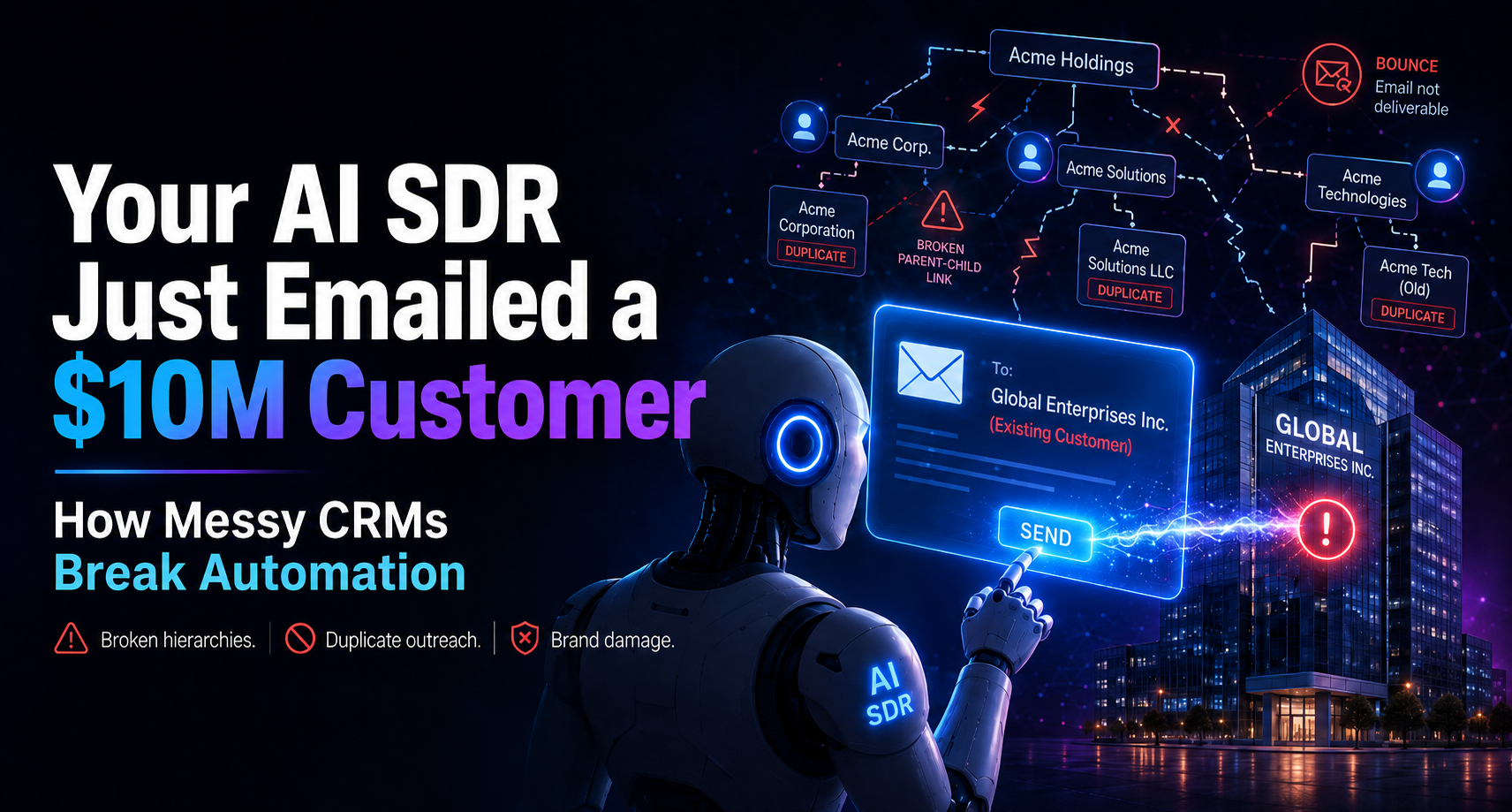
Why Your New AI SDR Just Emailed Your $10M Enterprise Customer
By David Brown ·
Key Takeaways
- The Demo Illusion: Modern AI SDR platforms perform flawlessly in controlled sales demos but trigger massive operational failures when run against fragmented production enterprise databases.
- Data Decay Reality: High-growth contact data decays at 22.5% to 70.3% annually, with email addresses failing at 3.6% monthly, quickly degrading outreach lists.
- Structural CRM Breakdowns: Unmapped CRM parent-child hierarchies cause autonomous agents to launch aggressive cold sequences at active, multi-million dollar customers, causing severe brand damage.
- Downstream Amplification: Deploying automation on a chaotic database amplifies underlying structure errors, leading to incorrect lead routing and territory conflicts.
- AIOps Remediation: To eliminate this programmatic chaos, enterprises must transition from passive record storage to active, zero-trust data validation layers with human-in-the-loop guardrails.
- Execution ROI: This operational pivot reduces administrative burdens, accelerates deal velocity by 23%, and prevents revenue leaks caused by data decay.
The Illusion of the Flawless AI SDR Demo
The software demonstration of an AI SDR is a masterclass in modern sales engineering. In these highly sanitized environments, the Large Language Models (LLMs) execute flawless market research, write hyper-personalized outreach, and automatically secure meetings with target personas. The presentation operates on the premise that sales development can be fully automated with minimal operational oversight.
However, once deployed into real production databases, these autonomous systems quickly encounter a structural barrier. The primary issue does not stem from the underlying cognitive capabilities of the generative models. Instead, the system is forced to navigate a completely fragmented map of the target market.
The Scaling Boundary of Generative Systems
When enterprise organizations deploy Agentic AI on top of unstructured, legacy database systems, they amplify existing operational errors at unprecedented speeds. Standard rules of data management dictate that automated tools can only act on the specific context they are fed. When this contextual foundation is broken, even the most sophisticated model will confidently deliver incorrect and damaging customer-facing actions.
This discrepancy has forced a growing realization among Chief Revenue Officer (CRO) executives that sales automation tools cannot function as standalone solutions. Successful implementation requires a complete shift in focus from front-end message generation to back-end database architecture.
The Junk Drawer CRM: Root Cause of Operational Chaos
Most enterprise CRM environments function less like structured sources of truth and more like corporate junk drawers. They suffer from missing parent-child relationships, thousands of duplicate records, orphan regional branches, and unmapped subsidiaries. This database fragmentation introduces a severe level of noise that modern automation systems cannot resolve on their own.
According to research published by Gartner, poor data quality costs organizations an average of $12.9 million annually in lost productivity and operational friction. Data compiled by the(https://hbr.org) reveals that only 3% of corporate datasets meet basic quality standards. When autonomous sales agents run campaigns against these problematic records, programmatic failures become inevitable.
The Compounding Toll of Unmapped Hierarchies
Without established parent-child structures, the relational context of enterprise customers is completely lost. The CRM database treats every office, subsidiary, or regional branch as an isolated, independent entity. This structural blind spot prevents the automated system from aggregating commercial metrics or verifying ownership rules across the corporate family tree.
This lack of hierarchical alignment directly impacts territory planning and forecast predictability. When subsidiary pipelines are decoupled from the ultimate parent corporate record, revenue leaders cannot accurately calculate net revenue retention or coordinate account-based marketing efforts. The lack of structured relationships turns the customer database into a liability rather than an asset.
Analysis of Enterprise Data Decay Rates
This database challenge is worsened by rapid data decay, which continuously degrades historical records. In high-growth sectors, professional mobility and corporate restructuring ensure that database accuracy declines significantly every month.
| Data Field | Annual Decay Rate | Cumulative Impact on Automated Outreach |
| Corporate Structures | 10.0% – 20.0% | Unmapped mergers, acquisitions, and regional branch additions |
| Direct Phone Numbers | 15.0% – 25.0% | Disconnected lines, failed call-routing, and lost connect rates |
| Technical Stack | 20.0% – 30.0% | Irrelevant technographic pitches and outdated product comparisons |
| Professional Job Titles | 25.0% – 35.0% | Targeting demoted, promoted, or departed personnel with wrong titles |
| Corporate Email Lists | 37.3% (3.6% monthly) | Hard bounces, spam flagging, and severe domain reputation damage |
A database starting the year at peak accuracy will deteriorate by nearly three-quarters within twelve months. This decay ensures that static, quarterly cleanup initiatives are fundamentally inadequate for supporting autonomous outreach systems.
The Failure Modes: Production-Level Brand Damage
When autonomous systems are deployed on top of decaying, unmapped databases, they act as high-speed amplifiers of existing errors. This automation-to-data mismatch triggers three critical production failure modes that directly damage brand equity and disrupt revenue operations.
Programmatic Harassment of Active Enterprise Accounts
Without structured parent-child mappings, an automated agent cannot identify that a regional branch is owned by an active customer spending millions annually. The system processes the branch as a cold, net-new logo and initiates aggressive outbound sequences. This duplicate outreach makes the vendor appear highly disorganized, severely damaging professional trust with the client’s executive team.
Broken Routing Rules and Territory Contamination
Incoming marketing leads are frequently misrouted because the database cannot match the prospect’s email domain to the commercial parent company. Leads matching major accounts are routed to junior reps in incorrect territories, creating severe internal conflict. The lack of hierarchy-aware routing tools prevents the seamless transition of deals to the designated global account manager.
Master Service Agreement Blindness and Pricing Clashes
Large enterprises operate under highly structured Master Service Agreements (MSAs) that govern pricing, compliance, and custom contract terms. Because the automated system is blind to these legal structures, it may pitch standard, out-of-the-box pricing to a subsidiary branch. This error directly undermines the strategic negotiations of the account team and exposes severe internal alignment gaps.
The AI as an Amplifier of Database Failure
To evaluate how these failures happen, data scientists utilize interpretability frameworks like LIME (Local Interpretable Model-agnostic Explanations) alongside advanced Neural Networks to trace model decisions. These analyses show that the AI does not lack logical reasoning; instead, it is simply operating on an incorrect map of the market.
If the database contains duplicate entries or broken relationships, the algorithm will execute wrong decisions at a programmatic scale. This creates a situation where bad data leads to immediate brand damage and revenue leakage.
The RevOps Playbook: Cleaning the Account Hierarchies
Resolving these structural failures requires a shift from standard prospecting tactics to systematic Data Governance. Revenue operations teams must implement a structured playbook to secure and clean the database before enabling any autonomous sales agents.
Standardizing Parent-Child Relationships
Organizations must establish an external, reliable source of truth to supply and maintain corporate hierarchy data. Relying on manual input from field representatives is highly prone to human error. RevOps leaders must define a canonical commercial parent model that separates legal structures from GTM territory assignments.
This structural approach mirrors the risk-management standards outlined in the(https://www.bis.org) BCBS 239 guidelines, which emphasize data aggregation accuracy to prevent operational risk. Defining strict naming conventions and limiting hierarchical depth to three or four levels ensures that the account map remains clean and readable for downstream automation systems.
Zero-Trust Data Validation and Deduplication Architecture
Enterprises must transition to a zero-trust model of data entry where every record is thoroughly verified before writing to the CRM. This architecture uses automated identity resolution and Deduplication systems to catch overlapping records.
According to a study published by the(https://sloanreview.mit.edu), up to 47% of newly created database records contain at least one critical error. Enforcing real-time verification at the point of entry ensures that duplicate records do not pollute the database, keeping downstream automation clear of conflict.
Operationalizing Human-in-the-Loop Guardrails
No data enrichment system is entirely perfect. Therefore, organizations must establish strict policy parameters where the automated system must route low-confidence records to a human supervisor.
Managing these digital workers requires consistent daily oversight and optimization. By instituting a human-in-the-loop review process for any account resolution scoring below a 100% threshold, the enterprise protects its high-value customer relationships from programmatic errors.
The Sentia Community Bridge: Systems of Execution
The B2B enterprise landscape is reaching a major turning point. Traditional CRM software platforms were built as passive systems of record designed for storage and manager reporting, not as active systems of execution. This legacy design is the root cause of the high failure rates seen in modern automated sales pilots.
To overcome these structural limitations, organizations must transition from experimental pilots to disciplined AI operations. This professionalized discipline, known as AI Operations (AIOps), embeds automation directly into core business workflows rather than treating it as a separate, isolated tool.
The Q1 2025 CRM Wave report from Forrester highlights that the market is on the cusp of a major shift, where customer data and automated execution must merge into a unified layer. Success requires a connected data model that keeps information unified across disparate silos in real-time.
Multi-Agent Orchestration via Sentia+
This unified architecture is achieved by reconciling siloed enterprise applications through agentic AI. Instead of maintaining rigid, easily broken API integrations, modern enterprises layer a coordinated team of specialized agents over their database. This orchestration layer ensures that every digital worker shares the exact same customer history and real-time context.
This context-sharing is supported by the open-source Model Context Protocol (MCP), which allows external AI agents to securely connect and correlate data across disparate software suites. Sentia+ operates as this intelligent operational brain. Rather than acting as another system to maintain, Sentia+ completely replaces obsolete software layers, ensuring that the sales motion always runs on structured, context-rich truth.
How are enterprise organizations currently preventing automated account collisions, and what specific guardrails have revenue leaders implemented to protect brand equity from messy database structures?
Frequently Asked Questions
What is an AI SDR?
An AI SDR is an autonomous software application that handles prospecting, lead qualification, multi-channel outreach, and meeting scheduling. It uses generative AI to analyze buyer behavior and customize communication without relying on manual entry, allowing sales teams to scale outreach and focus on closing deals.
Why do AI SDR implementations fail?
AI SDR implementations fail primarily because of low-quality CRM data, unmapped account structures, and poor API integration. When autonomous tools execute outreach based on outdated contact lists or incomplete parent-child mappings, the results include duplicate campaigns, brand damage, and domain blacklisting.
How fast does B2B contact data decay?
B2B contact data decays at a rapid rate of 22.5% to 70.3% annually, with email addresses invalidating at 3.6% monthly. Job changes, organizational acquisitions, and corporate restructuring continuously degrade data accuracy, making static quarterly database cleanups obsolete within weeks.
What are the financial costs of poor CRM data?
Poor CRM data costs the average enterprise approximately $12.9 million per year, according to Gartner. Furthermore, studies show that over 44% of organizations lose more than 10% of their annual revenue due to duplicate records, incomplete files, and broken territory routing.
What is a CRM parent-child account hierarchy?
A CRM parent-child account hierarchy is an organized database structure mapping the relationships between a corporate headquarters and its subsidiaries or regional offices. This multi-level mapping gives revenue teams a comprehensive view of how enterprise accounts are structured for sales and reporting.
How do messy hierarchies break sales automation?
Messy hierarchies break sales automation by blinding AI agents to existing customer relationships within corporate subsidiaries. When parent-child links are absent, the automated system treats corporate subsidiaries as cold leads, initiating redundant campaigns and proposing generic pricing that violates active enterprise agreements.
How do you prevent duplicate outreach in AI SDRs?
Preventing duplicate outreach requires establishing accurate parent-child database structures and enforcing zero-trust data validation policies. By integrating identity resolution tools that automatically match and link incoming contacts to their commercial parents, enterprise software protects active customer relationships from collision.
What are human-in-the-loop sales guardrails?
Human-in-the-loop sales guardrails are operational safety boundaries where an autonomous system escalates low-confidence data resolutions to human supervisors. If an AI agent cannot verify a lead’s relationship to an existing customer with absolute confidence, the record is paused for manual review.
What is the Model Context Protocol (MCP)?
The Model Context Protocol is an open-source standard enabling external AI agents to securely connect and correlate data across disparate enterprise software platforms. This architecture facilitates real-time context-sharing, allowing cross-functional agents to coordinate workflows independent of rigid legacy database connections.
What is AI Operations (AIOps) in B2B sales?
AI Operations in B2B sales is the professional discipline of deploying, monitoring, and continuously optimizing orchestrated AI systems across an enterprise GTM infrastructure. Rather than running isolated, stateless pilots, sales operations teams manage AI agents as a structured, scalable digital workforce.
Table of Contents
the-illusion-of-the-flawless-ai-sdr-demo
the-junk-drawer-crm-root-cause-of-operational-chaos
the-failure-modes-production-level-brand-damage
the-revops-playbook-cleaning-the-account-hierarchies
the-sentia-community-bridge-systems-of-execution
WordPress Taxonomy
- Primary Category: Revenue Operations (RevOps)
- Tags: Sales Automation, CRM Data Hygiene, AI SDR, Account Hierarchy, Agentic AI