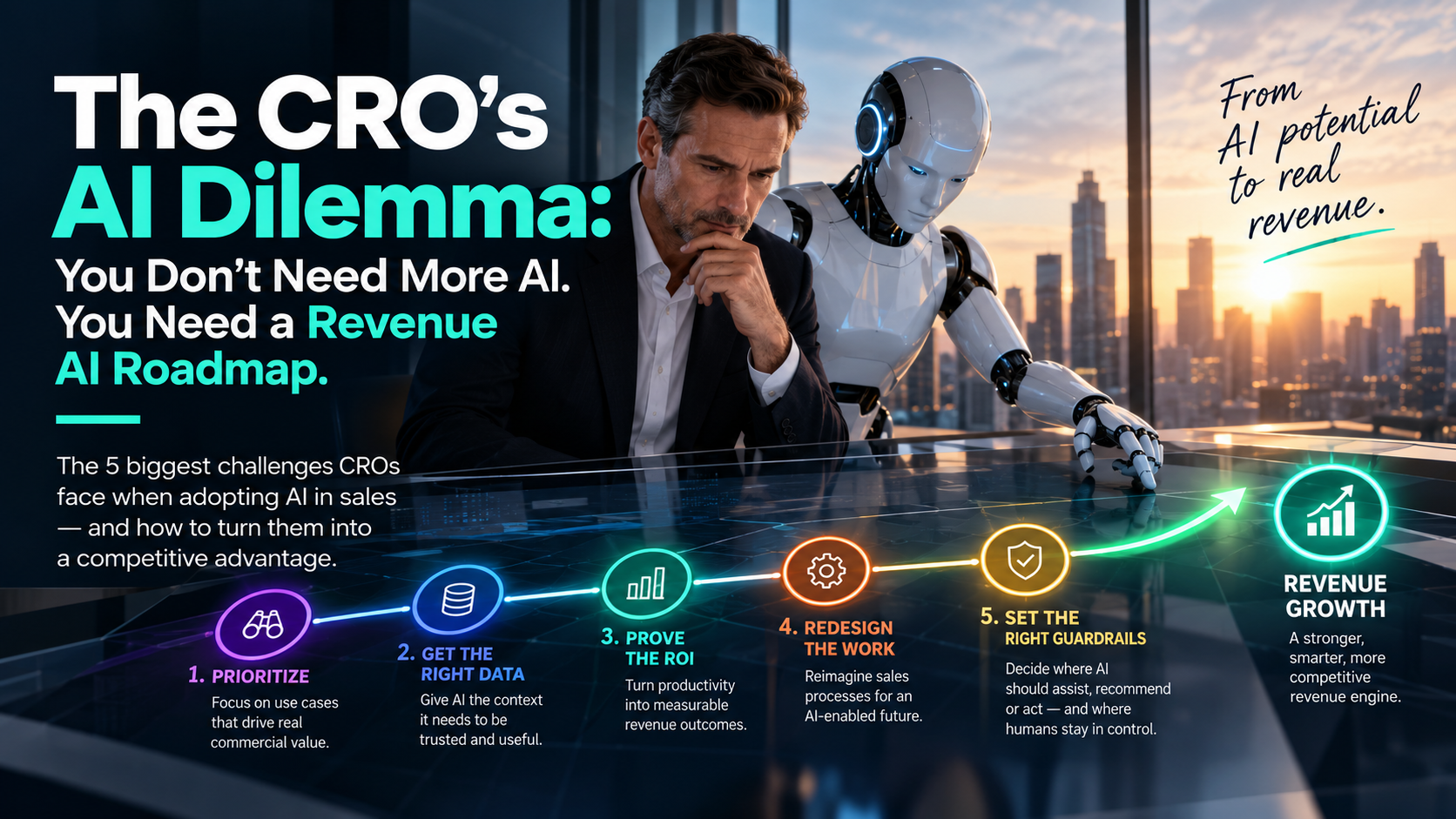
Why do CROs Get Fired Faster Than Any Other Role? Can AI help?
By David Brown ·

The role of Chief Revenue Officer (CRO) remains one of the most volatile and high-pressure positions in the C-suite. Despite its rapid rise as one of the fastest-growing executive titles, the average tenure of a CRO is now just 18–25 months—the shortest among all C-level roles123. In the age of AI and relentless growth expectations, the clock is ticking even faster for today’s CROs.
Why Do CROs Have Such Short Tenure?
Several factors contribute to the high turnover rate:
- Unrealistic Growth Expectations: CROs are often hired to deliver rapid revenue growth or to turn around struggling companies. Boards and investors expect quick, visible results, and patience is in short supply. If growth stalls, the CRO is usually the first to go—replacing them is easier and less disruptive than overhauling company strategy or leadership at the CEO or CFO level123.
- Boardroom Dynamics: Other senior leaders may lobby for the CRO’s job or undermine their efforts, especially in high-pressure environments. The CRO’s performance is highly visible, and their results are scrutinized more than most C-suite peers1.
- Misalignment with the CEO or Board: A lack of ongoing alignment with the CEO or board is a top reason for CRO exits. Any strategic shift or loss of confidence can quickly lead to a change at the top of the revenue organization134.
- Failure to Embrace Technology—Especially AI: In 2025, AI is not just a buzzword; it’s a board-level mandate. CROs who fail to integrate AI into sales, marketing, and customer success processes are seen as laggards. Boards expect CROs to leverage AI for efficiency, forecasting, lead generation, and customer engagement—or risk being replaced by someone who will15.
- Quick Fix Mentality: When a company is struggling, firing the CRO is often the fastest, least controversial way to signal change to investors and employees13.
The High Cost of CRO Turnover
Recent research highlights the organizational cost of frequent CRO changes. In 2024, 62% of companies saw their revenue growth rate decline or remain flat in the fiscal year following a CRO change, with a median growth rate drop of nearly four percentage points3. Despite this, boards continue to pull the trigger quickly: CRO turnover accelerated by more than 50% from 2022 to 2023, and 70% of CRO departures were involuntary3.
The New AI-Driven CRO Mandate
AI is fundamentally reshaping the CRO role. Today’s top CROs are expected to:
- Integrate AI into Every Revenue Function: From sales forecasting and pipeline management to customer segmentation and personalized outreach, AI is now central to the CRO’s toolkit15.
- Accelerate Onboarding and Training: AI-powered tools can drastically reduce ramp times for new sales reps, identify skill gaps, and match talent to roles more efficiently1.
- Drive Cross-Functional Alignment: Success now depends on breaking down silos between sales, marketing, and customer success—often by using shared AI-driven insights and platforms4.
- Deliver Quick Wins: Boards want to see immediate impact from AI investments—CROs must prioritize tools that solve real problems fast, not just add complexity1.
- Reduce Headcount and Turnover: AI can automate routine tasks, allowing smaller, more agile teams to outperform larger, less tech-enabled competitors1.
Five Reasons CROs Get Fired in 2025
- Missing Revenue Targets: The primary, non-negotiable metric for CROs.
- Lack of Alignment with Leadership: Poor relationships with the CEO or board remain fatal.
- Underperforming Teams: CROs are held accountable for sales, marketing, and customer success performance.
- Failure to Lead AI Transformation: Boards expect CROs to be AI champions, not skeptics.
- Company Needs a Quick Turnaround: CROs are often seen as the most “expendable” C in times of crisis134.
How CROs Can Use AI to Extend Their Tenure
- Automate Sales Forecasting and Reporting: Free up time for strategic work.
- Personalize Customer Engagement: Use AI to deliver insights and recommendations tailored to each account.
- Accelerate Lead Qualification: AI can score and prioritize leads faster and more accurately than traditional methods.
- Upskill Teams Continuously: AI-driven training identifies and addresses skill gaps in real time.
- Identify New Revenue Opportunities: Spot trends and cross-sell/upsell opportunities invisible to manual analysis15.
The Bottom Line
The CRO role is more demanding—and less forgiving—than ever. In today’s AI-driven economy, CROs must deliver results fast, align with leadership, and lead digital transformation. Those who fail to adapt are quickly replaced, often at great cost to the organization’s momentum and growth. For CROs, embracing AI is no longer optional—it’s essential for survival and success1354.
Note: The CRO is responsible for all aspects of revenue generation, including sales, marketing, and customer success. The CSO typically focuses more narrowly on sales productivity and execution. The distinction matters more than ever as AI blurs traditional functional boundaries and demands a holistic, data-driven approach to growth.
Frequently Asked Questions: CRO Tenure and the AI Mandate
What is the average tenure of a Chief Revenue Officer (CRO)? The average tenure of a CRO is currently between 18 and 25 months, which is the shortest among all C-suite roles. This volatility is driven by high-pressure growth expectations and the high visibility of revenue performance to boards and investors.
Why do CROs have such high turnover rates? The primary reasons for high turnover include unrealistic growth expectations, misalignment with the CEO or Board of Directors, and a “quick fix” mentality where firing the CRO is seen as an easy signal of change. In 2025, a failure to lead an organization’s AI transformation has also become a leading cause of dismissal.
What is the organizational cost of firing a CRO? Frequent CRO turnover is highly disruptive. Research indicates that 62% of companies see their revenue growth decline or remain flat in the fiscal year following a CRO change. The median growth rate often drops by nearly four percentage points during these transitions.
How is AI reshaping the role of the Chief Revenue Officer? AI has transformed the CRO role into a tech-driven mandate. Modern CROs are expected to use AI to automate sales forecasting, reduce rep ramp times through AI coaching, and break down data silos between sales, marketing, and customer success to drive a unified revenue engine.
Can AI help a CRO extend their job security? Yes. By leveraging AI to deliver “quick wins”—such as more accurate lead qualification, personalized account engagement, and real-time skill gap analysis—CROs can prove immediate ROI to the board. Automating routine reporting also allows the CRO to focus on long-term strategy, improving their alignment with leadership.
What is the difference between a CRO and a CSO? While the terms are often used interchangeably, a Chief Revenue Officer (CRO) is responsible for the entire revenue lifecycle, including sales, marketing, and customer success. A Chief Sales Officer (CSO) typically has a narrower focus on sales productivity and execution.
- https://ppl-ai-file-upload.s3.amazonaws.com/web/direct-files/attachments/32891158/ae67612d-23cd-4625-ad81-7a164f8dd2ee/paste.txt
- https://www.linkedin.com/posts/jameskaikis_the-average-cro-tenure-is-just-18-24-months-activity-7315746581914218498-f_8R
- https://hbr.org/2024/10/the-high-costs-of-chief-revenue-officer-turnover?trk=public_post_main-feed-card-text&deliveryName=NL_DailyAlert_20241011
- https://www.linkedin.com/posts/darenlauda_cro-turnover-is-high-and-tenure-is-short-activity-7271908991880822784-qUYH
- https://huntscanlon.com/preparing-the-c-suite-for-success-in-the-2025-ai-driven-economy/
- https://www.linkedin.com/pulse/ai-automation-redefining-sales-leadership-2025-john-lombardi-for6e
- https://cxl.com/blog/ai-and-conversion-rate-optimization-strategy/
- https://www.revenueoperationsalliance.com/keeping-your-board-happy-as-a-cro/
- https://www.revenuefactors.com/post/high-costs-of-chief-revenue-officer-turnover
- https://complexchaos.ai/the-future-of-chief-revenue-officer-cro
- https://hbr.org/2024/10/the-high-costs-of-chief-revenue-officer-turnover
- https://www.boyden.com/media/preparing-the-c-suite-for-the-ai-economy-in-2025-45024418/
- https://www.linkedin.com/pulse/why-cros-must-embrace-ai-now-thomas-ross-pfa1c
- https://www.aibusinessnetwork.ai/blog/the-evolving-role-of-the-chief-revenue-officer-cro
- https://www.linkedin.com/pulse/90-day-window-when-new-cros-need-fractional-allies-pavel-nov%C3%A1k-mpv5e
- https://www.spencerstuart.com/research-and-insight/chro-2025
- https://behindtheproject.com/what-is-the-average-tenure-of-a-cro/
- https://www.linkedin.com/posts/vinnie-smith-csg-talent_cro-clinicalresearch-jobsearch-activity-7266820493570183168-SjuH
- https://fortune.com/2025/05/30/nearly-20-chros-are-staying-in-role-for-less-than-2-years/
- https://www.mckinsey.com/capabilities/mckinsey-digital/our-insights/superagency-in-the-workplace-empowering-people-to-unlock-ais-full-potential-at-work
- https://lbbonline.com/news/cro-in-2025-how-ai-personalisation-and-micro-conversions-are-changing-the-game