
The CRM was supposed to help sellers sell. Instead, it became another job.
Most sales teams already have a CRM. Salesforce, HubSpot, Pipedrive, Insightly, Zoho, and similar platforms are everywhere. They store contacts, track opportunities, capture activities, and give managers a central place to inspect the pipeline.
That was the promise.
The reality is more painful.
For today’s CRM user, the system often creates almost as much friction as it solves. Sellers are asked to update records, type notes, log calls, copy and paste email details, research accounts, summarize meetings, create follow-up tasks, and keep opportunity data clean.
Managers then rely on that same manually maintained data to forecast revenue, inspect deals, and decide where to focus.
The result is predictable: sellers avoid the CRM, managers do not trust the data, RevOps teams spend too much time cleaning the system, and companies lose visibility into revenue risk.
That is exactly the problem Sentia AI’s DSO is built to solve.
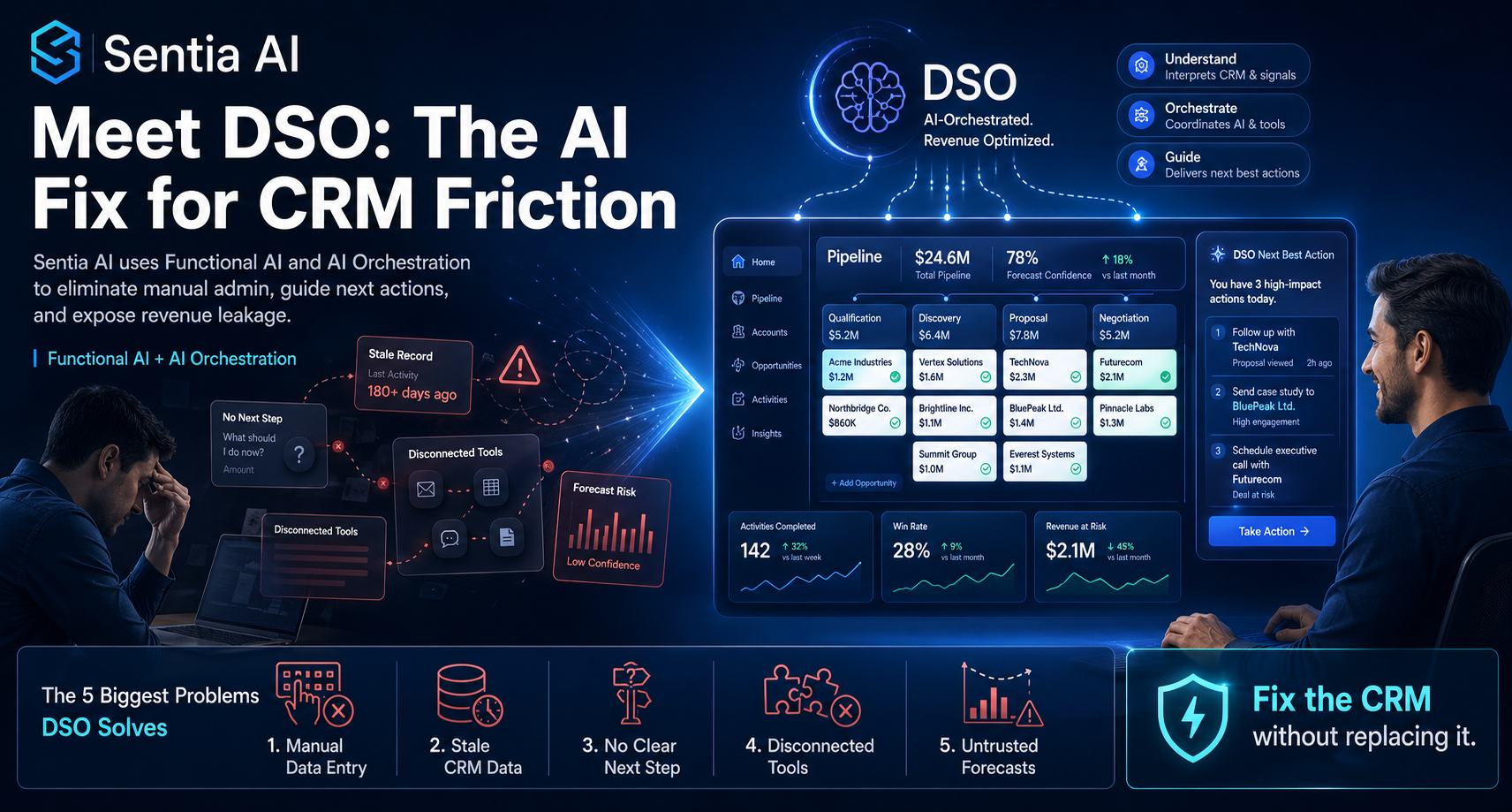
DSO is not another CRM. It is an AI revenue orchestration layer designed to fix the daily pain of using enterprise CRM systems like Salesforce, HubSpot, Pipedrive, and Insightly.
It uses Functional AI and AI orchestration to remove manual data entry, connect disconnected revenue activity, and tell sellers exactly what they need to do next.
“Salespeople should not spend their week maintaining software. DSO is designed to do the work around the CRM so sellers can focus on selling, managers can trust the data, and companies can stop leaking revenue through disconnected systems.”
— David Forder, CEO, Sentia AI
What Is DSO?
DSO is Sentia AI’s enterprise CRM fix for companies that already use Salesforce, HubSpot, Pipedrive, Insightly, or another CRM but still struggle with adoption, data quality, seller productivity, and revenue visibility.
Instead of forcing a company to rip out its CRM, DSO makes the existing CRM dramatically more useful.
It acts as an intelligent operating layer around the CRM, helping automate the work that sellers hate and managers need:
- CRM data capture
- Call and meeting intelligence
- Email and activity context
- Follow-up recommendations
- Opportunity hygiene
- Revenue risk detection
- Sales prioritization
- Next-best-action guidance
- AI-generated outreach and updates
The core idea is simple:
Your CRM should not be a static database that your sales team has to feed manually. It should be an intelligent revenue system that helps the team know what to do next.
That is the promise of DSO.
The Five Biggest Problems DSO Solves for Today’s CRM User
1. CRM Users Are Drowning in Manual Data Entry
The most obvious CRM problem is also the most hated: manual data entry.
Sales reps are expected to keep every contact, company, deal, note, call, task, meeting, and follow-up updated. That sounds reasonable in theory. In practice, it becomes a massive productivity tax.
A seller finishes a call and then has to update the opportunity. They receive an email and then need to log it. They find a new contact and then need to add it. They have a meeting and then need to summarize it. They identify a next step and then need to create the task.
This is where CRM adoption starts to break.
Sellers do not hate revenue systems. They hate systems that make them do repetitive administrative work instead of helping them sell.
How DSO Removes the Problem
DSO uses Functional AI to automate the repetitive CRM work that slows sellers down.
Instead of asking users to manually maintain the CRM, DSO helps capture and organize revenue activity automatically. It can support workflows around contacts, accounts, opportunities, notes, meetings, emails, research, and follow-up actions.
The value is immediate: sellers get time back.
The CRM becomes less of a chore and more of a working revenue assistant.
SEO keywords: CRM automation, AI CRM assistant, eliminate manual data entry, CRM productivity, sales automation software.
2. CRM Data Is Incomplete, Stale, or Wrong
A CRM is only valuable if the data inside it is current and accurate.
But most CRM data is neither.
Contact records go out of date. Deal stages are not updated. Follow-up dates are missed. Meeting notes are incomplete. Important buying signals are buried in emails. Managers inspect pipeline data that may already be stale.
This creates a major business problem: revenue leaders are making decisions based on incomplete information.
That is not just a data issue. It is a revenue risk issue.
Bad CRM data causes bad forecasts, missed follow-ups, weak account strategy, and poor sales execution. It also forces RevOps teams to spend valuable time chasing reps, cleaning records, and trying to reconstruct what actually happened.
How DSO Removes the Problem
DSO helps turn CRM from a passive system of record into an active revenue operating system.
By orchestrating information across seller activity, DSO helps keep the CRM context richer, cleaner, and more useful. Instead of relying only on human memory and manual updates, DSO uses AI to surface what has changed, what matters, and what needs attention.
The result is better CRM hygiene without turning sellers into data-entry clerks.
For revenue leaders, that means more trustworthy pipeline visibility. For sellers, it means less admin. For RevOps, it means fewer cleanup cycles.
SEO keywords: CRM data quality, CRM hygiene, Salesforce data cleanup, HubSpot CRM automation, RevOps automation, pipeline visibility.
3. Sellers Do Not Know What to Do Next
Many CRM systems are good at storing what already happened.
They are much weaker at telling the seller what should happen next.
That creates one of the biggest hidden problems in sales execution: priority confusion.
A seller opens the CRM and sees a list of accounts, opportunities, tasks, contacts, and notes. But which deal is at risk? Which prospect needs attention today? Which account has gone quiet? Which follow-up should happen first? Which email should be sent? Which opportunity is missing a next step?
The CRM may contain the information, but it does not always translate that information into action.
That leaves sellers making judgment calls manually, often while under pressure and switching between email, calendar, meeting notes, LinkedIn, CRM records, and sales tools.
How DSO Removes the Problem
DSO uses AI orchestration to help sellers understand what matters now.
Instead of simply displaying records, DSO helps interpret revenue context and guide the next action. It can help sellers prioritize follow-ups, identify stale opportunities, generate outreach, summarize customer context, and recommend the next step.
This is the difference between ordinary AI and Functional AI.
Generic AI waits for the user to ask a question. Functional AI works inside the revenue workflow and helps the user move forward.
DSO is designed to answer the seller’s most important daily question:
“What should I do next to move revenue forward?”
That is why sellers want to use it. It saves time, reduces uncertainty, and makes the CRM feel useful instead of burdensome.
SEO keywords: next best action sales AI, AI sales assistant, sales prioritization software, CRM next step automation, revenue orchestration.
4. Sales Teams Are Trapped in Disconnected Tools
Modern revenue teams do not use one tool. They use many.
CRM. Email. Calendar. Meeting recorder. Sales engagement platform. LinkedIn. Spreadsheets. Call notes. AI writing tools. Forecasting tools. Business intelligence dashboards.
Each tool may be useful on its own. But together, they create a disconnected sales workflow.
This creates two major problems.
First, sellers constantly switch between applications. That slows them down.
Second, the information in each tool is trapped in a silo. The AI in one system does not understand the context from another system. The CRM may not know what happened in the meeting. The meeting tool may not understand the deal stage. The email system may contain buying signals that never reach the opportunity record.
This is where revenue leakage happens.
Not because teams lack tools, but because the tools do not operate together.
How DSO Removes the Problem
DSO is built around AI orchestration, not isolated AI features.
Many CRM and sales platforms now claim to have AI. But most AI features are limited to the data inside that specific product. The AI inside a CRM sees the CRM. The AI inside email sees the email. The AI inside a meeting tool sees the transcript.
The seller is still responsible for connecting the dots.
DSO is designed to connect the revenue workflow around the CRM.
It helps bring together the signals, context, and actions that matter so the seller and manager can operate from a more complete view of the customer and pipeline.
The outcome is not just tool consolidation. It is revenue orchestration.
SEO keywords: AI orchestration, revenue orchestration platform, CRM integration, sales workflow automation, disconnected sales tools, sales tech stack consolidation.
5. Managers Cannot Trust the Forecast
Every revenue leader knows the pain of the CRM forecast meeting.
The dashboard says one thing. The rep says another. The customer activity suggests something else. The opportunity has not been updated. The next step is vague. The close date may be optimistic. The manager has to interrogate the deal manually.
This is the executive-level cost of poor CRM usage.
When sellers do not update the CRM, managers lose visibility. When managers lose visibility, forecasts become guesses. When forecasts become guesses, companies make poor decisions about hiring, spending, cash flow, and growth.
This is not a CRM reporting problem. It is an operating problem.
How DSO Removes the Problem
DSO helps expose revenue risk earlier by improving the quality and usefulness of CRM context.
It helps identify where deals are stale, where activity does not match forecast confidence, where follow-up is missing, and where the next action is unclear.
That gives managers a better operating view of the pipeline.
Instead of asking, “Did the rep update Salesforce?” the business can ask, “What does the actual revenue activity tell us?”
That is a fundamentally better question.
DSO helps move the organization from CRM compliance to revenue intelligence.
SEO keywords: sales forecast accuracy, revenue leakage, pipeline risk detection, CRM forecast automation, revenue intelligence platform, RevOps AI.
Why Generic AI Is Not Enough
Many companies are experimenting with ChatGPT, Claude, Gemini, Microsoft Copilot, Salesforce AI, HubSpot AI, and other AI tools.
These tools are powerful. But generic AI alone does not solve the CRM problem.
Why?
Because the CRM problem is not just a content-generation problem. It is a workflow problem.
Sellers do not simply need another place to ask questions. They need AI that understands the revenue process, operates around the CRM, captures the right data, recommends the next action, and reduces the daily administrative load.
That is where Functional AI matters.
Functional AI is AI designed to perform specific business functions inside real workflows.
For DSO, that means helping with the actual work of revenue execution:
- Updating context
- Reducing manual entry
- Creating follow-up
- Prioritizing activity
- Surfacing risk
- Improving pipeline hygiene
- Helping sellers move deals forward
Generic AI can help write an email.
DSO helps understand why that email matters, who it should go to, what context should shape it, and what should happen after it is sent.
That is the difference.
Why Sellers Actually Want to Use DSO
Most CRM initiatives fail because they create value for management but extra work for sellers.
DSO flips that equation.
Sellers want to use DSO because it saves them time.
- It reduces manual data entry.
- It gives them clearer priorities.
- It helps them prepare faster.
- It helps them write better follow-ups.
- It reduces app switching.
- It makes customer context easier to access.
- It helps them know what to do next.
When sellers get value first, adoption improves naturally.
That is the key to CRM transformation.
Do not force sellers to maintain the system. Give them a system that helps them win.
Why Sentia AI’s DSO Is the Answer
DSO is the answer because it addresses the real CRM problem.
The problem is not that companies picked the wrong CRM.
The problem is that the CRM became a static system of record in a dynamic revenue environment.
Salesforce, HubSpot, Pipedrive, Insightly, and other CRMs can store important data. But storage is not enough anymore.
Modern revenue teams need orchestration.
They need AI that helps capture the work, understand the context, prioritize the next action, and reduce the friction between seller activity and revenue visibility.
That is what DSO provides.
- It fixes the CRM without forcing a rip-and-replace.
- It saves sellers time without sacrificing data quality.
- It helps managers trust the pipeline without interrogating every update.
- It helps RevOps reduce manual cleanup and focus on revenue acceleration.
- It turns CRM from a compliance burden into a high-velocity revenue system.
The future of CRM is not more fields, more dashboards, or more admin.
The future of CRM is Functional AI and AI orchestration.
And that is why Sentia AI’s DSO is the answer.
FAQ: Sentia AI DSO
What does DSO do?
DSO is Sentia AI’s enterprise CRM fix. It helps companies using Salesforce, HubSpot, Pipedrive, Insightly, and similar platforms reduce manual data entry, improve CRM data quality, guide sellers on next-best actions, and expose revenue leakage.
Is DSO a CRM replacement?
No. DSO is not designed as a rip-and-replace CRM. It is an AI orchestration layer that improves the value of the CRM a company already uses.
How does DSO help sales reps?
DSO saves sellers time by reducing CRM admin, improving follow-up, organizing customer context, and helping them know exactly what to do next.
How does DSO help sales managers?
DSO improves pipeline visibility, reduces reliance on manually updated CRM fields, and helps managers identify deal risk and revenue leakage earlier.
How is DSO different from generic AI tools?
Generic AI responds to prompts. DSO uses Functional AI inside the revenue workflow to help automate CRM-related tasks, orchestrate sales activity, and guide next-best actions.
Who should use DSO?
DSO is built for companies that already use enterprise CRMs like Salesforce, HubSpot, Pipedrive, or Insightly but struggle with adoption, data quality, seller productivity, revenue visibility, or CRM administration.