👋 CROs and GTM leaders, here’s the truth:
Before you pick your first AI pilot, it pays off to analyze exactly how ready your sales and marketing operation really is. The latest B2B wins are coming from teams who measure first, automate second—and that’s why this must-read will help you accelerate the right kind of transformation.
🚦 Why Start with AI Readiness?
In today’s market, it’s not enough to simply buy the next AI tool and hope for ROI.
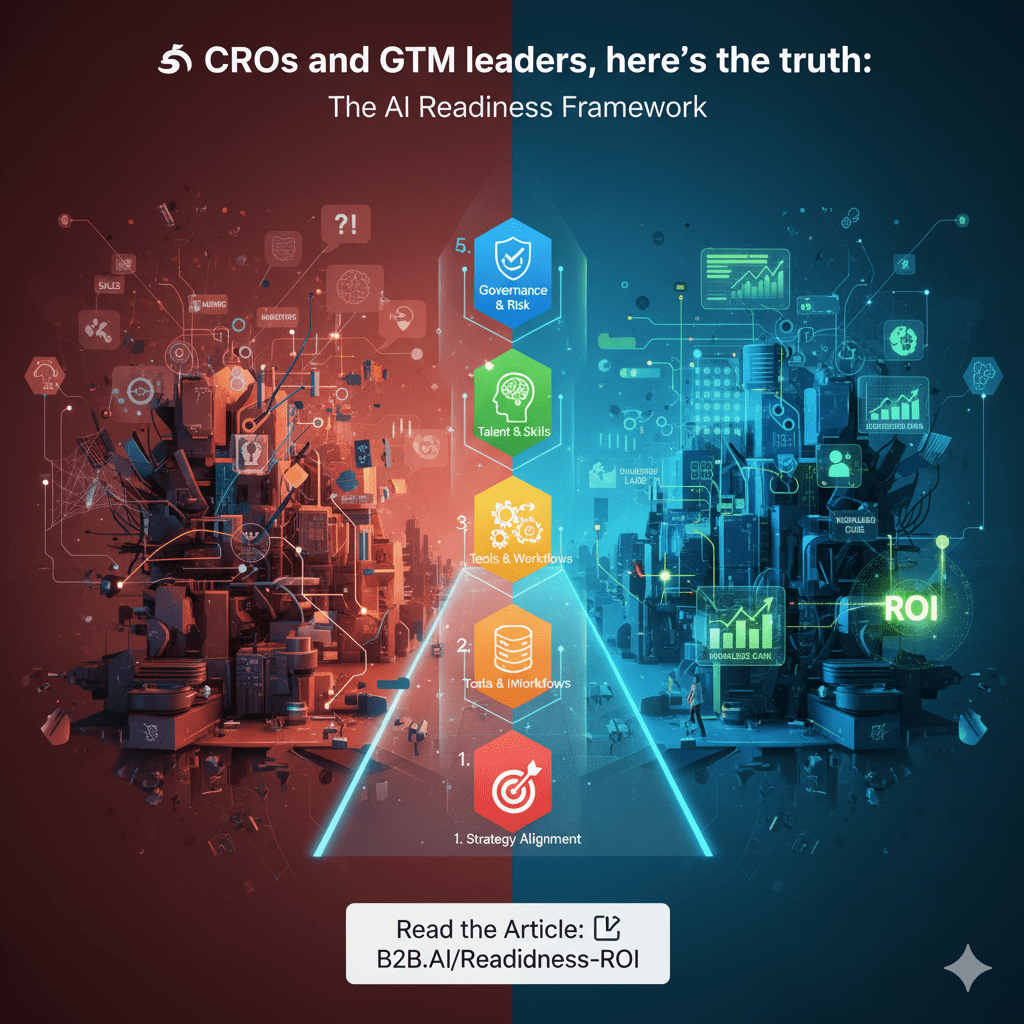
What makes a program successful is clarity: knowing where your data, strategy, workflows, talent, and policies stand before you invest. That’s the whole idea behind The AI Readiness Framework for revenue teams.
5 Pillars: The AI Readiness Framework
- Strategy Alignment — Are pilots mapped to the KPIs that matter most?
- Data & Infrastructure — Is your data centralized and reliable? Is it AI Ready?
- Tools & Workflows — Are your processes connected, or fragmented?
- Talent & Skills — Can your teams actually use new tech? Will Training be Needed?
- Governance & Risk — Is there a plan for responsible experimentation? Outcome analysis?
You don’t need top scores everywhere to start—you need a roadmap to pinpoint where AI could deliver ROI first. Don’t tackle the biggest hairiest problems first. Instead go slow, learn, train, deploy and measure.
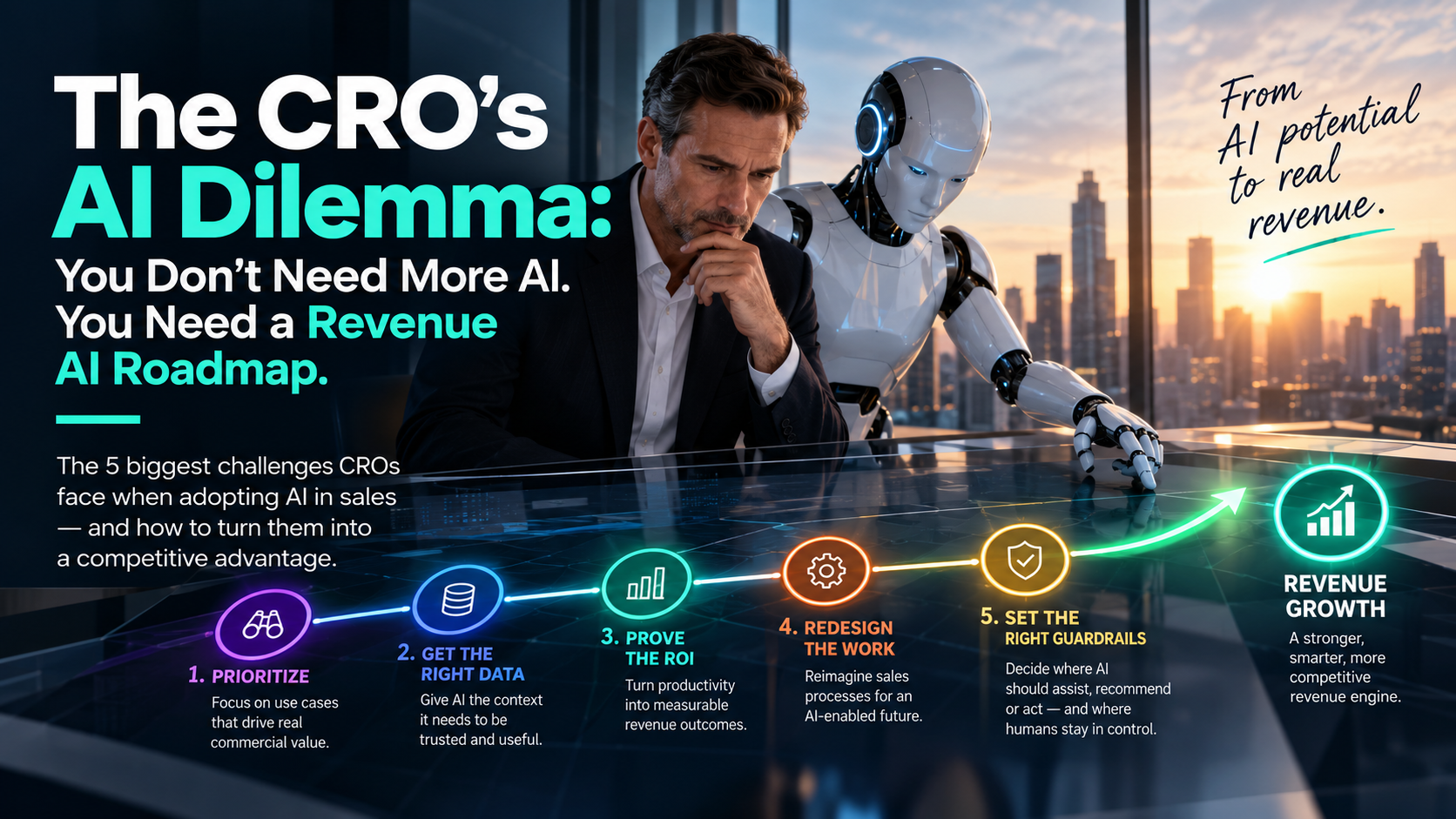
CRO To-Do List: Get ROI from AI
- Clarify Strategy
- Align your execs and pick targets that drive cash flow. Show the $$$$
- Centralize Data
- Break down silos; ensure CRM Sales and Marketing data live together. Ensure you data is clean and setup for AI implementation.
- Automate a First Step
- Choose one repetitive process to automate and scale results. Measure, Analyze, Improve and get employee feedback on useability.
- Upskill Your Team
- Offer AI training tailored to sales and marketing roles. Don’t assume your employees already know how to use AI, when to apply it and when it isn’t being helpful.
- Draft Guardrails
- Create a simple policy for responsible AI rollouts. Treat AI as any other technology. You wouldn’t hire a new employee without guardrails – AI needs the same so you don’t have to worry about Crisis PR when you AI does something unplanned…
📊 Case Study: ACI Corporation’s KPIs Before & After
Let’s look at this method in action with ACI Corporation.
Before AI Readiness & Pilot
KPI | Before |
Sales Conversion Rate | 4.9% |
Lead Qualification Rate | 45.5% |
Average Sales Cycle | 56 days |
Product Knowledge Score | 24% |
After AI Readiness & First Pilot
KPI | After |
Sales Conversion Rate | 6.5% |
Lead Qualification Rate | 64.1% |
Average Sales Cycle | 41 days |
Product Knowledge Score | 34.6% |
Results:
- Conversion rates up 33%.
- 40% more qualified leads.
- Sales cycle shortened by 15 days.
- Product knowledge scores jumped by 45%—direct ROI from targeted AI training and CRM upgrades.
đź’ˇ Bottom Line for CROs
AI will only drive results if your foundations are solid.
Measure readiness, align pilots with achievable goals, and track ROI in real terms—not “proof of concept” experiments. This measure twice, then build, review and improve approach delivers transformation with substance, not just hype.
Let’s make AI work for revenue—starting with clarity of purpose and result measurement.
Frequently Asked Questions: AI Readiness for CROs
Why should a CRO start with an AI Readiness assessment? A Chief Revenue Officer (CRO) should conduct an AI Readiness assessment to ensure that the organization’s foundation—data, strategy, and talent—is solid before investing in expensive tools. This “measure twice, build once” approach prevents wasted budget on “innovation theater” and ensures that AI pilots are mapped directly to revenue-driving KPIs.
What are the five pillars of the AI Readiness Framework? The AI Readiness Framework consists of:
Strategy Alignment: Mapping pilots to critical business KPIs.
Data & Infrastructure: Ensuring CRM data is centralized, clean, and reliable.
Tools & Workflows: Connecting fragmented processes into a unified AI stack.
Talent & Skills: Providing specific AI training for sales and marketing teams.
Governance & Risk: Creating policies for responsible and safe AI implementation.
How does AI readiness impact sales conversion rates? According to real-world data, organizations that prioritize AI readiness before launching pilots saw sales conversion rates jump from 4.9% to 6.5%, representing a 33% improvement. This is achieved by ensuring AI tools have access to high-quality data to properly prioritize and qualify leads.
Can AI actually shorten the sales cycle? Yes. By automating repetitive administrative tasks and improving lead qualification accuracy, the case study showed the average sales cycle was reduced from 56 days to 41 days—a 15-day improvement. This allows sales teams to close more deals in the same amount of time.
What are the most important KPIs for measuring AI success in sales? CROs should focus on four primary metrics to prove AI ROI:
Sales Conversion Rate: The percentage of leads that turn into closed-won deals.
Lead Qualification Rate: The accuracy and volume of leads passed to sales.
Average Sales Cycle Length: The total time from lead creation to close.
Product Knowledge Score: The competency level of the sales team when using AI-enhanced materials.
What is the “CRO To-Do List” for implementing AI?
Clarify Strategy: Pick targets that directly drive cash flow.
Centralize Data: Break down silos between sales and marketing data.
Automate a First Step: Start with one repetitive process, measure, and scale.
Upskill the Team: Don’t assume reps know how to prompt or use AI tools effectively.
Draft Guardrails: Treat AI like a new hire that needs specific rules and boundaries.
Author

David Brown | CCO & Startup AI Investor
David Brown doesn't just discuss AI; he builds the infrastructure that makes it profitable. As CCO and Investor at Sentia AI, David is the strategist enterprise leaders turn to when their AI pilots stall and their data silos remain impenetrable. He fixes stalled AI pilots, CRM / ERP integration and scales enterprise AI with his amazingly talented teamates.
With a career forged on Wall Street and Ernst and Young, David brings a high-focus, results-driven discipline to the tech sector. His trajectory—from navigating global markets to CEO of startups and founding a top-tier international startup incubator for hundreds of ventures—has uniquely positioned him at the bleeding edge of the "Agentic AI" revolution.
The Enterprise AI Architect
David’s mission is the elimination of the "AI Circle of Sorrow"—the gap where expensive AI tools fail to talk to legacy systems and most importantly humans. He specializes in solving the most aggressive enterprise AI scaling hurdles facing large enterprise clients today:
Siloed Data Liquidation: Breaking down the walls between fragmented business units to create a unified data truth. See DIO: www.dio.sentia.online
ERP & CRM Connectivity: Forging seamless, bi-directional integration between core systems of record and modern AI applications. See DSO www.sentia.website
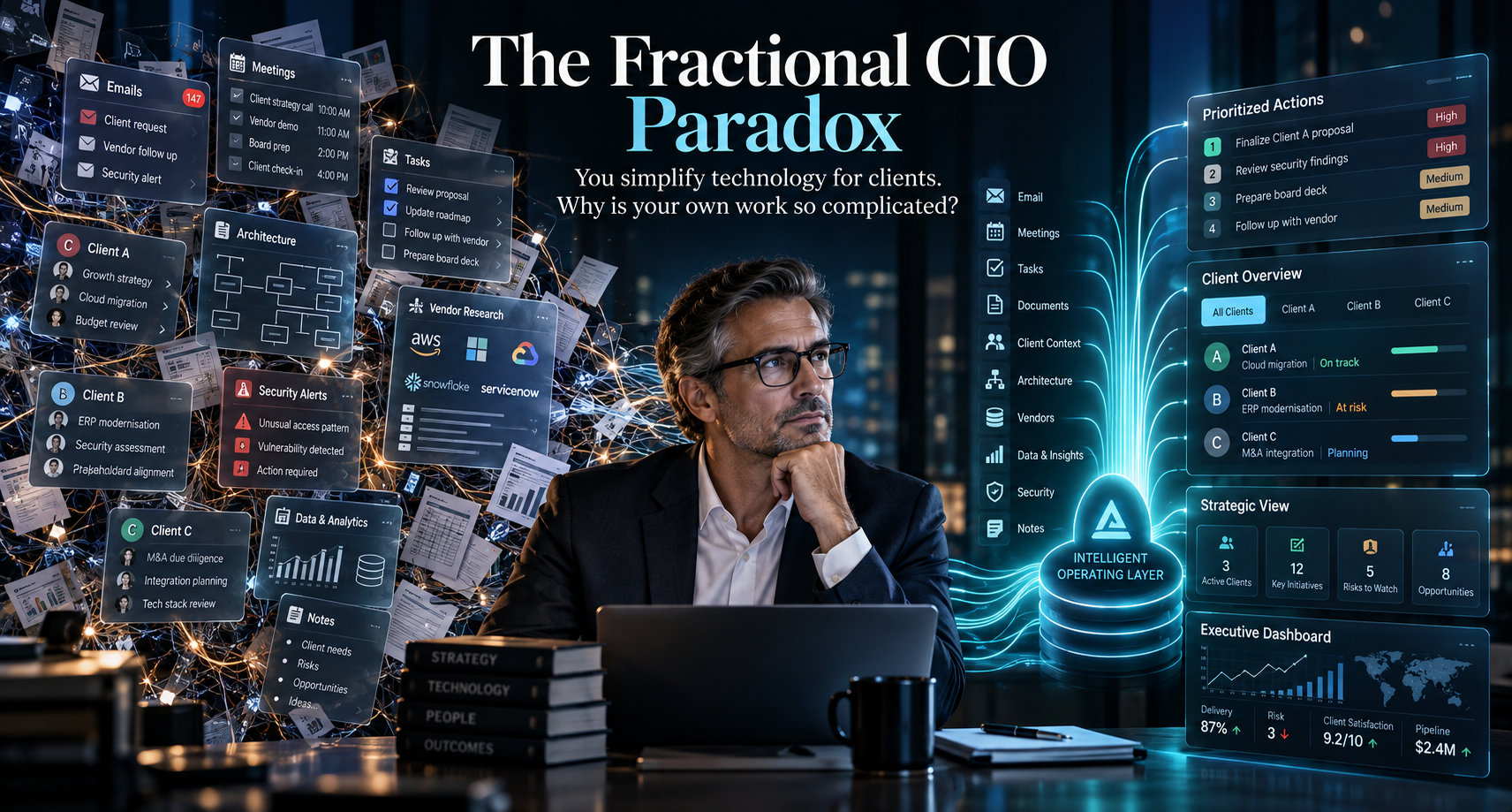
The "Single Pane of Glass": Developing client Unified AI Dashboards—a command center that provides C-Suite leaders with total visibility across every AI-driven workflow in the organization. This is one of Sentia's specialities.
Enterprise AI Scaling: Moving beyond fragmented "app-creep" to build a cohesive, governed, and scalable AI orchestration layer.
A relentless advocate for AI Orchestration, David ensures that Sentia AI remains a premier Salesforce partner by delivering autonomous agentic systems that don't just "help" sales teams—they transform revenue operations into high-velocity engines.
Connect with the Seer of AI Integration success:
LinkedIn: linkedin.com/in/davidbrown07
X (Twitter): @intlmktentry
Insights: Sentia AI Community